


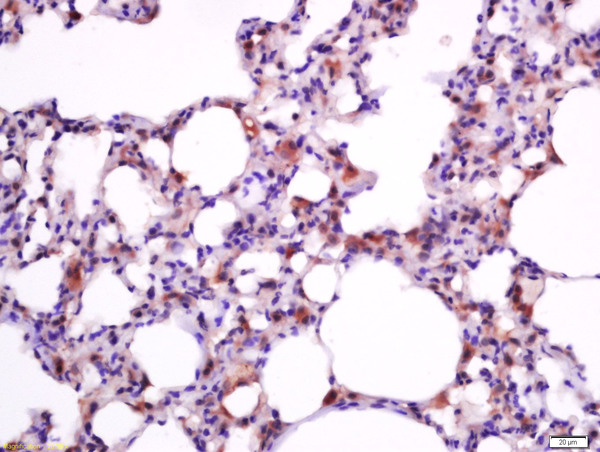
Immunohistochemical analysis of paraffin-embedded Human lung adenocarcinoma, using the Antibody at 1:200 dilution.


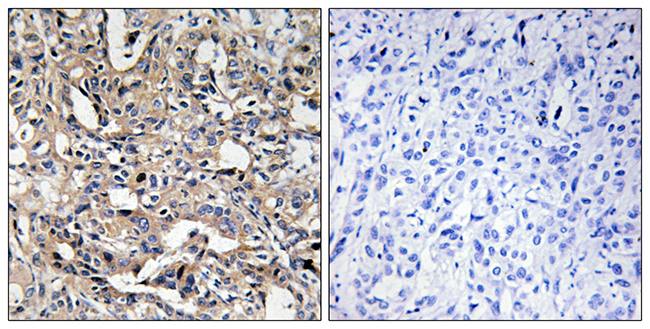
Immunohistochemical analysis of paraffin-embedded Human lung adenocarcinoma, using the Antibody at 1:200 dilution.
Anti-Bax Rabbit Monoclonal Antibody
M00183-1

ApplicationsFlow Cytometry, ImmunoPrecipitation, Western Blot, ImmunoHistoChemistry
Product group Antibodies
ReactivityHuman, Mouse, Rat
TargetBAX
Overview
- SupplierBoster Bio
- Product NameAnti-Bax Rabbit Monoclonal Antibody
- Delivery Days Customer9
- ApplicationsFlow Cytometry, ImmunoPrecipitation, Western Blot, ImmunoHistoChemistry
- CertificationResearch Use Only
- ClonalityMonoclonal
- Clone IDAAB-2
- Gene ID581
- Target nameBAX
- Target descriptionBCL2 associated X, apoptosis regulator
- Target synonymsBCL2L4, apoptosis regulator BAX, BCL2 associated X protein, BCL2-associated X protein omega, Baxdelta2(G8)-RFS protein, Baxdelta2G9, Baxdelta2G9omega, Baxdelta2omega, bcl-2-like protein 4, bcl2-L-4
- HostRabbit
- IsotypeIgG
- Protein IDQ07812
- Protein NameApoptosis regulator BAX
- Scientific DescriptionBoster Bio Anti-Bax Rabbit Monoclonal Antibody catalog # M00183-1. Tested in WB, IHC, IP, Flow Cytometry applications. This antibody reacts with Human, Mouse, Rat.
- ReactivityHuman, Mouse, Rat
- Storage Instruction-20°C
- UNSPSC12352203
References
- Zhang J, Tian L, Cao G, et al. AnGong NiuHuang (AGNH) pill attenuated traumatic brain injury through regulating NF-κB/Nlrp3 axis and glycerophospholipid metabolism. Phytomedicine. 2024,132:155798. doi: 10.1016/j.phymed.2024.155798Read this paper
- Zhu Y, Zhang S, Shao Y, et al. Regulatory role of oxidative stress in retrorsine - Induced apoptosis and autophagy in primary rat hepatocytes. Ecotoxicol Environ Saf. 2024,279:116515. doi: 10.1016/j.ecoenv.2024.116515Read this paper
- Chen F, Yu X. Circ_0002331 Interacts with ELAVL1 to Improve ox-LDL-Induced Vascular Endothelial Cell Dysfunction via Regulating CCND2 mRNA Stability. Cardiovasc Toxicol. 2024,24(7):625-636. doi: 10.1007/s12012-024-09865-2Read this paper
- Zheng H, Liang G, Guan C, et al. Mitochondrial Fission in Nickel Nanoparticle-Induced Reproductive Toxicity: An In Vitro GC-1 Cell Study. Nanomaterials (Basel). 2024,14(8). doi: 10.3390/nano14080689Read this paper
- Wu J, Cui Y, Ding W, et al. The protective effect of Macrostemonoside T from Allium macrostemon Bunge against Isoproterenol-Induced myocardial injury via the PI3K/Akt/mTOR signaling pathway. Int Immunopharmacol. 2024,133:112086. doi: 10.1016/j.intimp.2024.112086Read this paper
- Li Y, Fan F, Liu Q. Cytisine-N-methylene-(5,7,4(')-trihydroxy)- isoflavone ameliorates ischemic stroke-induced brain injury in mouse by regulating the oxidative stress and BDNF-Trkb/Akt pathway. Eur J Pharmacol. 2024,974:176512. doi: 10.1016/j.ejphar.2024.176512Read this paper
- Xiao M, Pu X, Tong W, et al. Declined circular RNA mitofusin 2 constrains the deterioration of Wilms tumor via modulating microRNA-372-3p/transforming growth factor-β receptor type 2 axis. Cell Mol Biol (Noisy-le-grand). 2024,70(2):143-149. doi: 10.14715/cmb/2024.70.2.20Read this paper
- Wang H, Li C, Zhu L, et al. Adiponectin attenuates H2O2-induced apoptosis in chicken skeletal myoblasts through the lysosomal-mitochondrial axis. In Vitro Cell Dev Biol Anim. 2024,60(7):805-814. doi: 10.1007/s11626-024-00857-8Read this paper
- Zhang Y, Gao X, Cao M, et al. Hepatitis E virus causes apoptosis of ovarian cells in hens and resulting in a decrease in egg production. Poult Sci. 2024,103(4):103501. doi: 10.1016/j.psj.2024.103501Read this paper
- Li FR, Yu Y, Du YM, et al. Borneol-Modified Schisandrin B Micelles Cross the Blood-Brain Barrier To Treat Alzheimer's Disease in Aged Mice. ACS Chem Neurosci. 2024,15(3):593-607. doi: 10.1021/acschemneuro.3c00625Read this paper
Datasheet
MSDS
Related products

Product group Antibodies

ApplicationsImmunoPrecipitation, Western Blot, ImmunoCytoChemistry, ImmunoHistoChemistry
ReactivityMouse, Porcine, Rat
TargetBAX
- SizePrice
Product group Antibodies
References

Bax Polyclonal AntibodyBS-0127R
ApplicationsFlow Cytometry, ImmunoFluorescence, ImmunoPrecipitation, Western Blot, ELISA, ImmunoCytoChemistry, ImmunoHistoChemistry, ImmunoHistoChemistry Frozen, ImmunoHistoChemistry Paraffin
ReactivityBovine, Canine, Human, Mouse, Porcine, Rabbit, Rat, Sheep
TargetBAX
- SizePrice
Product group Antibodies

Mouse anti Human baxA100M
ApplicationsWestern Blot
ReactivityHuman
TargetBAX
- SizePrice
Product group Antibodies

Anti-BAX AntibodyA101574
ApplicationsELISA, ImmunoHistoChemistry
ReactivityHuman
- SizePrice


Product group Antibodies

Anti-BAX AntibodyAMAB91490
ApplicationsWestern Blot, ImmunoHistoChemistry
ReactivityHuman
TargetBAX
- SizePrice
Product group Antibodies

Anti-Bax (active monomer) [6A7]Ab00120-1.1
ApplicationsImmunoPrecipitation, Western Blot, ImmunoHistoChemistry
ReactivityHuman, Mouse, Rat
TargetBAX
- SizePrice
Product group Antibodies
References

Bax antibody [N1N2], N-termGTX109683
ApplicationsImmunoFluorescence, ImmunoPrecipitation, Western Blot, ImmunoCytoChemistry, ImmunoHistoChemistry, ImmunoHistoChemistry Frozen, ImmunoHistoChemistry Paraffin
ReactivityHuman, Mouse, Rat
TargetBAX
- SizePrice
Product group Antibodies

Anti-BAX AntibodyRB-02-0025
ApplicationsWestern Blot, ELISA
ReactivityHuman
- SizePrice