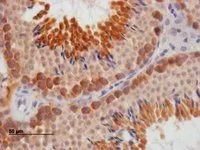
IHC-P analysis of mouse testis using GTX89448 DAZL antibody, Internal.
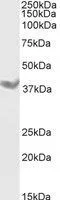
IHC-P analysis of mouse testis using GTX89448 DAZL antibody, Internal.
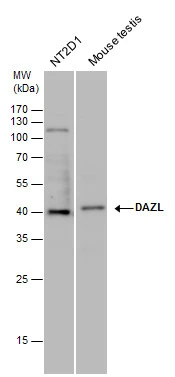
DAZL antibody, Internal
GTX89448

ApplicationsWestern Blot, ImmunoHistoChemistry, ImmunoHistoChemistry Paraffin
Product group Antibodies
ReactivityHuman, Mouse, Rat
TargetDAZL
Overview
- SupplierGeneTex
- Product NameDAZL antibody, Internal
- Delivery Days Customer7
- Application Supplier NoteWB: 0.5-1microg/ml. *Optimal dilutions/concentrations should be determined by the researcher.Not tested in other applications.
- ApplicationsWestern Blot, ImmunoHistoChemistry, ImmunoHistoChemistry Paraffin
- CertificationResearch Use Only
- ClonalityPolyclonal
- Concentration0.50 mg/ml
- ConjugateUnconjugated
- Gene ID1618
- Target nameDAZL
- Target descriptiondeleted in azoospermia like
- Target synonymsDAZH, DAZL1, DAZLA, SPGYLA, deleted in azoospermia-like, DAZ homolog, DAZ-like autosomal, SPGY-like-autosomal, deleted in azoospermia-like 1, germline specific RNA binding protein, spermatogenesis gene on the Y-like autosomal, testis secretory sperm-binding protein Li 204a
- HostGoat
- IsotypeIgG
- Protein IDQ92904
- Protein NameDeleted in azoospermia-like
- Scientific DescriptionThe DAZ (Deleted in AZoospermia) gene family encodes potential RNA binding proteins that are expressed in prenatal and postnatal germ cells of males and females. The protein encoded by this gene is localized to the nucleus and cytoplasm of fetal germ cells and to the cytoplasm of developing oocytes. In the testis, this protein is localized to the nucleus of spermatogonia but relocates to the cytoplasm during meiosis where it persists in spermatids and spermatozoa. Transposition and amplification of this autosomal gene during primate evolution gave rise to the DAZ gene cluster on the Y chromosome. Mutations in this gene have been linked to severe spermatogenic failure and infertility in males. Two transcript variants encoding different isoforms have been found for this gene. [provided by RefSeq, Jun 2010]
- ReactivityHuman, Mouse, Rat
- Storage Instruction-20°C or -80°C,2°C to 8°C
- UNSPSC41116161
References
- Arrest of WNT/beta-catenin signaling enables the transition from pluripotent to differentiated germ cells in mouse ovaries. Le Rolle M et al., 2021 Jul 27, Proc Natl Acad Sci U S ARead this paper
- Retinoic acid synthesis by ALDH1A proteins is dispensable for meiosis initiation in the mouse fetal ovary. Chassot AA et al., 2020 May, Sci AdvRead this paper
Datasheet
Related products

Product group Antibodies

DAZL AntibodyCSB-PA006514LA01HU
ApplicationsImmunoFluorescence, ELISA, ImmunoHistoChemistry
ReactivityHuman
TargetDAZL
- SizePrice

Product group Antibodies

Anti-DAZL Picoband(r) AntibodyA02069-2-CARRIER-FREE
ApplicationsFlow Cytometry, Western Blot, ELISA, ImmunoHistoChemistry
ReactivityHuman, Mouse, Rat
TargetDAZL
- SizePrice
Product group Antibodies

Anti-DAZL AntibodyA8858
ApplicationsWestern Blot
ReactivityHuman, Mouse
- SizePrice
Product group Antibodies

DAZL AntibodyLS-C748985
ApplicationsImmunoFluorescence, Western Blot, ImmunoHistoChemistry
ReactivityHuman, Mouse, Rat
TargetDAZL
- SizePrice
Product group Antibodies

Goat anti-DAZLEB06857
ApplicationsWestern Blot, ELISA
ReactivityBovine, Canine, Human, Mouse, Rat
TargetDAZL
- SizePrice

Product group Antibodies

Anti-DAZL AntibodyHPA019777
ApplicationsWestern Blot, ImmunoHistoChemistry
ReactivityHuman
TargetDAZL
- SizePrice
Product group Antibodies
DAZL antibodyGTX100230
ApplicationsWestern Blot
ReactivityHuman, Mouse
TargetDAZL
- SizePrice
Product group Antibodies

DAZL Recombinant Antibody, Biotin ConjugatedBSM-61548R-BIOTIN
ApplicationsWestern Blot
ReactivityHuman
TargetDAZL
- SizePrice