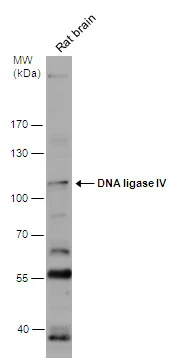
Rat tissue extract (50 μg) was separated by 7.5% SDS-PAGE, and the membrane was blotted with DNA ligase IV antibody (GTX108820) diluted at 1:500.
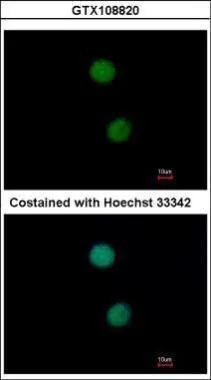
![DNA ligase IV antibody detects DNA ligase IV protein at nucleus and nucleolus by immunofluorescent analysis. Sample: MCF-7 cells were fixed in 4% paraformaldehyde at RT for 15 min. Green: DNA ligase IV stained by DNA ligase IV antibody (GTX108820) diluted at 1:500. Red: alpha Tubulin, a cytoskeleton marker, stained by alpha Tubulin antibody [GT114] (GTX628802) diluted at 1:1000. Blue: Fluoroshield with DAPI (GTX30920).](https://www.genetex.com/upload/website/prouct_img/normal/GTX108820/GTX108820_40506_20220325_ICC_IF_w_23060120_521.webp "DNA ligase IV antibody detects DNA ligase IV protein at nucleus and nucleolus by immunofluorescent analysis. Sample: MCF-7 cells were fixed in 4% paraformaldehyde at RT for 15 min. Green: DNA ligase IV stained by DNA ligase IV antibody (GTX108820) diluted at 1:500. Red: alpha Tubulin, a cytoskeleton marker, stained by alpha Tubulin antibody [GT114] (GTX628802) diluted at 1:1000. Blue: Fluoroshield with DAPI (GTX30920).")
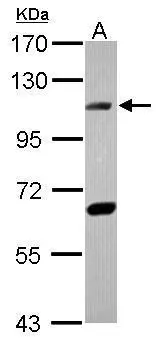
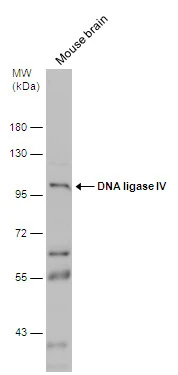
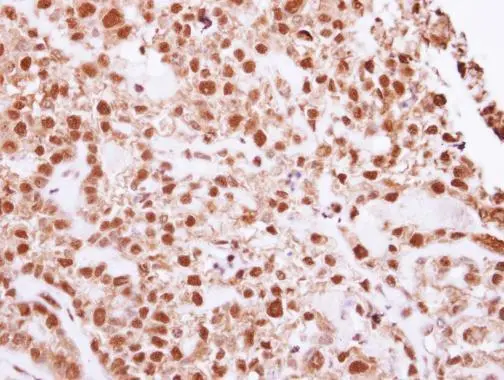
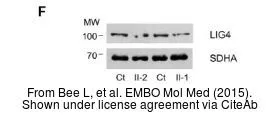
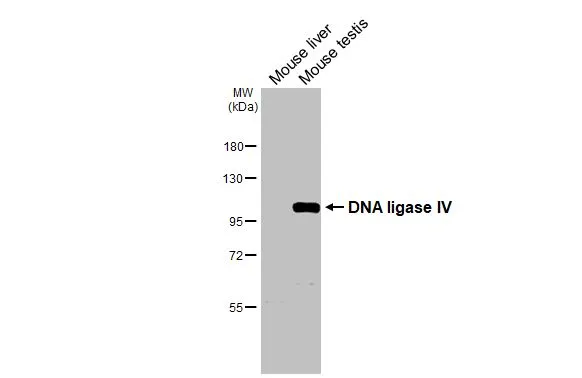
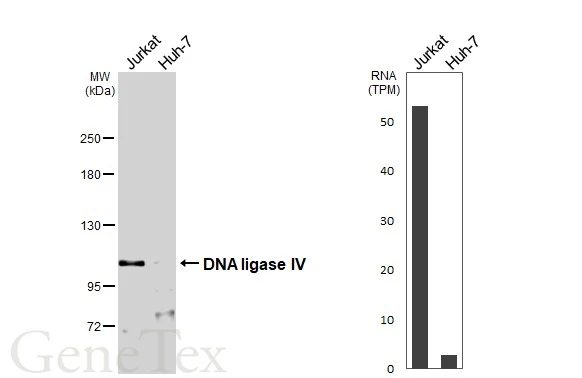
Rat tissue extract (50 μg) was separated by 7.5% SDS-PAGE, and the membrane was blotted with DNA ligase IV antibody (GTX108820) diluted at 1:500.
DNA ligase IV antibody
GTX108820

ApplicationsImmunoFluorescence, Western Blot, ImmunoCytoChemistry, ImmunoHistoChemistry, ImmunoHistoChemistry Paraffin
Product group Antibodies
ReactivityHuman, Mouse, Rat
TargetLIG4
Overview
- SupplierGeneTex
- Product NameDNA ligase IV antibody
- Delivery Days Customer9
- Application Supplier NoteWB: 1:500-1:3000. ICC/IF: 1:100-1:1000. IHC-P: 1:100-1:1000. *Optimal dilutions/concentrations should be determined by the researcher.Not tested in other applications.
- ApplicationsImmunoFluorescence, Western Blot, ImmunoCytoChemistry, ImmunoHistoChemistry, ImmunoHistoChemistry Paraffin
- CertificationResearch Use Only
- ClonalityPolyclonal
- Concentration1 mg/ml
- ConjugateUnconjugated
- Gene ID3981
- Target nameLIG4
- Target descriptionDNA ligase 4
- Target synonymsLIG4S, DNA ligase 4, DNA joinase, DNA ligase IV, DNA repair enzyme, ligase IV, DNA, ATP-dependent, polydeoxyribonucleotide synthase [ATP] 4, polynucleotide ligase, sealase
- HostRabbit
- IsotypeIgG
- Protein IDP49917
- Protein NameDNA ligase 4
- Scientific DescriptionThe protein encoded by this gene is a DNA ligase that joins single-strand breaks in a double-stranded polydeoxynucleotide in an ATP-dependent reaction. This protein is essential for V(D)J recombination and DNA double-strand break (DSB) repair through nonhomologous end joining (NHEJ). This protein forms a complex with the X-ray repair cross complementing protein 4 (XRCC4), and further interacts with the DNA-dependent protein kinase (DNA-PK). Both XRCC4 and DNA-PK are known to be required for NHEJ. The crystal structure of the complex formed by this protein and XRCC4 has been resolved. Defects in this gene are the cause of LIG4 syndrome. Alternatively spliced transcript variants encoding the same protein have been observed. [provided by RefSeq]
- ReactivityHuman, Mouse, Rat
- Storage Instruction-20°C or -80°C,2°C to 8°C
- UNSPSC41116161
Datasheet
Related products
Product group Antibodies

ApplicationsELISA, ImmunoHistoChemistry
ReactivityHuman
- SizePrice
Product group Antibodies

Anti-LIG4 Antibody144-64923
ApplicationsImmunoFluorescence, Western Blot
ReactivityHuman
TargetLIG4
- SizePrice
Product group Antibodies

LIG4 / DNA Ligase IV AntibodyLS-C830636
ApplicationsELISA, ImmunoHistoChemistry
ReactivityHuman, Mouse
TargetLIG4
- SizePrice

Product group Antibodies

Anti-DNA Ligase IV/LIG4 Antibody Picoband(r)A01685-3-CARRIER-FREE
ApplicationsFlow Cytometry, ImmunoFluorescence, Western Blot, ELISA, ImmunoCytoChemistry
ReactivityHuman, Mouse, Rat
TargetLIG4
- SizePrice

Product group Antibodies

DNA Ligase IV Recombinant AntibodyBSM-54131R
ApplicationsImmunoFluorescence, Western Blot, ImmunoCytoChemistry, ImmunoHistoChemistry, ImmunoHistoChemistry Frozen, ImmunoHistoChemistry Paraffin
ReactivityHuman
TargetLIG4
- SizePrice
Product group Antibodies

LIG4 AntibodyCSB-PA002168
ApplicationsImmunoFluorescence, Western Blot, ELISA, ImmunoHistoChemistry
ReactivityHuman
TargetLIG4
- SizePrice
Product group Antibodies
ApplicationsWestern Blot, ImmunoHistoChemistry, ImmunoHistoChemistry Paraffin
ReactivityHuman, Mouse
TargetLIG4
- SizePrice

Product group Antibodies

Anti-LIG4 AntibodyHPA001334
ApplicationsImmunoHistoChemistry
ReactivityHuman
TargetLIG4
- SizePrice