

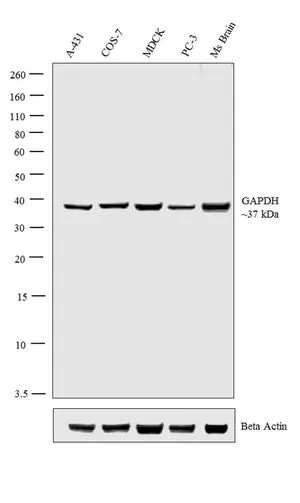
WB analysis of whole cell extracts (30 μg lysate) of A-431 (Lane 1), COS-7 (Lane 2), MDCK (Lane 3), PC-3 (Lane 4) and tissue extract (30 μg lysate) of Ms Brain (Lane 5) using GTX82899 GAPDH antibody. Dilution : 1:1000
WB analysis of whole cell extracts (30 μg lysate) of A-431 (Lane 1), COS-7 (Lane 2), MDCK (Lane 3), PC-3 (Lane 4) and tissue extract (30 μg lysate) of Ms Brain (Lane 5) using GTX82899 GAPDH antibody. Dilution : 1:1000
GAPDH antibody
GTX82899

ApplicationsWestern Blot
Product group Antibodies
ReactivityCanine, Human, Mouse, Primate, Rat, Zebra Fish
TargetGapdh
Overview
- SupplierGeneTex
- Product NameGAPDH antibody
- Delivery Days Customer9
- Application Supplier NoteWB: 1:1000-1:5000. *Optimal dilutions/concentrations should be determined by the researcher.Not tested in other applications.
- ApplicationsWestern Blot
- CertificationResearch Use Only
- ClonalityPolyclonal
- Concentration1 mg/ml
- ConjugateUnconjugated
- Gene ID24383
- Target nameGapdh
- Target descriptionglyceraldehyde-3-phosphate dehydrogenase
- Target synonymsBARS-38, Gapd, glyceraldehyde-3-phosphate dehydrogenase, 38 kDa BFA-dependent ADP-ribosylation substrate, peptidyl-cysteine S-nitrosylase GAPDH
- HostRabbit
- IsotypeIgG
- Protein IDP04797
- Protein NameGlyceraldehyde-3-phosphate dehydrogenase
- Scientific DescriptionThis gene encodes a member of the glyceraldehyde-3-phosphate dehydrogenase protein family. A similar protein in human and mouse has been identified as a moonlighting protein based on its ability to perform mechanistically distinct functions. The encoded protein was originally identified as a key glycolytic enzyme that converts D-glyceraldehyde 3-phosphate (G3P) into 3-phospho-D-glyceroyl phosphate. Subsequent studies in human and mouse have assigned a variety of additional functions to the protein including nitrosylation of nuclear proteins. Many pseudogenes similar to this locus are found throughout the rat genome. [provided by RefSeq, Jan 2014]
- ReactivityCanine, Human, Mouse, Primate, Rat, Zebra Fish
- Storage Instruction-20°C or -80°C,2°C to 8°C
- UNSPSC41116161
References
- Regulation of epidermal growth factor receptor expression and morphology of lung epithelial cells by interleukin-1beta. Nakayama I et al., 2020 Aug 1, J BiochemRead this paper
- Effect of MK-801-induced impairment of inhibitory avoidance learning in zebrafish via inactivation of extracellular signal-regulated kinase (ERK) in telencephalon. Ng MC et al., 2012 Aug, Fish Physiol BiochemRead this paper