

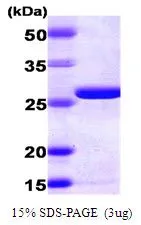
3 μg of GTX66907-pro Human Adenylate kinase 2 protein (active) by SDS-PAGE under reducing condition and visualized by coomassie blue stain
3 μg of GTX66907-pro Human Adenylate kinase 2 protein (active) by SDS-PAGE under reducing condition and visualized by coomassie blue stain
Human Adenylate kinase 2 protein, His tag (active)
GTX66907-PRO

ApplicationsFunctional Assay
Product group Proteins / Signaling Molecules
Protein IDP54819
Overview
- SupplierGeneTex
- Product NameHuman Adenylate kinase 2 protein, His tag (active)
- Delivery Days Customer9
- Application Supplier NoteSpecific activity is > 25 units/mg. One unit will convert 2.0 micromoles of ADP to ATP + AMP per minute at pH 7.5 at 37C.
- ApplicationsFunctional Assay
- CertificationResearch Use Only
- Concentration1 mg/ml
- ConjugateUnconjugated
- Gene ID204
- Target nameAK2
- Target descriptionadenylate kinase 2
- Target synonymsADK2, adenylate kinase 2, mitochondrial, ATP-AMP transphosphorylase 2, ATP:AMP phosphotransferase, adenylate kinase isoenzyme 2, mitochondrial, adenylate monophosphate kinase, testis secretory sperm-binding protein Li 220n
- Protein IDP54819
- Protein NameAdenylate kinase 2, mitochondrial
- Scientific DescriptionAdenylate kinases are involved in regulating the adenine nucleotide composition within a cell by catalyzing the reversible transfer of phosphate groups among adenine nucleotides. Three isozymes of adenylate kinase, namely 1, 2, and 3, have been identified in vertebrates; this gene encodes isozyme 2. Expression of these isozymes is tissue-specific and developmentally regulated. Isozyme 2 is localized in the mitochondrial intermembrane space and may play a role in apoptosis. Mutations in this gene are the cause of reticular dysgenesis. Alternate splicing results in multiple transcript variants. Pseudogenes of this gene are found on chromosomes 1 and 2.[provided by RefSeq, Nov 2010]
- Storage Instruction-20°C or -80°C,2°C to 8°C
- UNSPSC41115809
- SpeciesHuman