

MAFG antibody
GTX114541

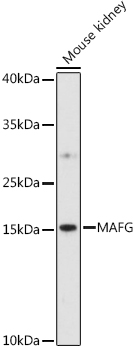
ApplicationsImmunoFluorescence, ImmunoPrecipitation, Western Blot, ChIP Chromatin ImmunoPrecipitation, ImmunoCytoChemistry, ImmunoHistoChemistry, ImmunoHistoChemistry Paraffin
Product group Antibodies
ReactivityHuman, Mouse, Rat
TargetMAFG
Overview
- SupplierGeneTex
- Product NameMAFG antibody
- Delivery Days Customer9
- Application Supplier NoteWB: 1:500-1:3000. ICC/IF: 1:100-1:1000. IHC-P: 1:100-1:1000. IP: 1:100-1:500. *Optimal dilutions/concentrations should be determined by the researcher.Not tested in other applications.
- ApplicationsImmunoFluorescence, ImmunoPrecipitation, Western Blot, ChIP Chromatin ImmunoPrecipitation, ImmunoCytoChemistry, ImmunoHistoChemistry, ImmunoHistoChemistry Paraffin
- CertificationResearch Use Only
- ClonalityPolyclonal
- Concentration1.3 mg/ml
- ConjugateUnconjugated
- Gene ID4097
- Target nameMAFG
- Target descriptionMAF bZIP transcription factor G
- Target synonymshMAF, transcription factor MafG, basic leucine zipper transcription factor MafG, v-maf avian musculoaponeurotic fibrosarcoma oncogene homolog G
- HostRabbit
- IsotypeIgG
- Protein IDO15525
- Protein NameTranscription factor MafG
- Scientific DescriptionGlobin gene expression is regulated through nuclear factor erythroid-2 (NFE2) elements located in enhancer-like locus control regions positioned many kb upstream of alpha- and beta-gene clusters (summarized by Blank et al., 1997 [PubMed 9166829]). NFE2 DNA-binding activity consists of a heterodimer containing a ubiquitous small Maf protein (MafF, MIM 604877; MafG; or MafK, MIM 600197) and the tissue-restricted protein p45 NFE2 (MIM 601490). Both subunits are members of the activator protein-1-like superfamily of basic leucine zipper (bZIP) proteins (see MIM 165160).[supplied by OMIM]
- ReactivityHuman, Mouse, Rat
- Storage Instruction-20°C or -80°C,2°C to 8°C
- UNSPSC12352203
References
- Wang Q, Martínez-Bonet M, Kim T, et al. Identification of a regulatory pathway governing TRAF1 via an arthritis-associated non-coding variant. Cell Genom. 2023,3(11):100420. doi: 10.1016/j.xgen.2023.100420Read this paper
- Lv J, Liu X, Zhou Y, et al. YAP Inactivation by Soft Mechanotransduction Relieves MAFG for Tumor Cell Dedifferentiation. Research (Wash D C). 2023,6:0215. doi: 10.34133/research.0215Read this paper
- Silva Oliveira Junior M, Schira-Heinen J, Reiche L, et al. Myelin repair is fostered by the corticosteroid medrysone specifically acting on astroglial subpopulations. EBioMedicine. 2022,83:104204. doi: 10.1016/j.ebiom.2022.104204Read this paper
- Wheeler MA, Clark IC, Tjon EC, et al. MAFG-driven astrocytes promote CNS inflammation. Nature. 2020,578(7796):593-599. doi: 10.1038/s41586-020-1999-0Read this paper
- Pradas-Juni M, Hansmeier NR, Link JC, et al. A MAFG-lncRNA axis links systemic nutrient abundance to hepatic glucose metabolism. Nat Commun. 2020,11(1):644. doi: 10.1038/s41467-020-14323-yRead this paper
- Caggiano R, Cattaneo F, Moltedo O, et al. miR-128 Is Implicated in Stress Responses by Targeting MAFG in Skeletal Muscle Cells. Oxid Med Cell Longev. 2017,2017:9308310. doi: 10.1155/2017/9308310Read this paper
- de Aguiar Vallim TQ, Tarling EJ, Ahn H, et al. MAFG is a transcriptional repressor of bile acid synthesis and metabolism. Cell Metab. 2015,21(2):298-311. doi: 10.1016/j.cmet.2015.01.007Read this paper
Datasheet
Related products
Product group Antibodies

Anti-MAFG Antibody144-64056
ApplicationsWestern Blot
ReactivityHuman
TargetMAFG
- SizePrice

Product group Antibodies

MAFG AntibodyLS-C833665
ApplicationsWestern Blot
ReactivityHuman
TargetMAFG
- SizePrice

Product group Antibodies

Anti-MAFG Antibody Picoband(r)A04636-2-CARRIER-FREE
ApplicationsFlow Cytometry, Western Blot
ReactivityHuman
TargetMAFG
- SizePrice