

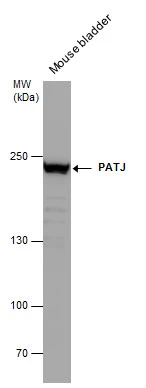
Mouse tissue extract (50 μg) was separated by 5% SDS-PAGE, and the membrane was blotted with PATJ antibody [N1], N-term (GTX104753) diluted at 1:500.
Mouse tissue extract (50 μg) was separated by 5% SDS-PAGE, and the membrane was blotted with PATJ antibody [N1], N-term (GTX104753) diluted at 1:500.
PATJ antibody [N1], N-term
GTX104753

ApplicationsWestern Blot
Product group Antibodies
ReactivityHuman, Mouse
TargetPATJ
Overview
- SupplierGeneTex
- Product NamePATJ antibody [N1], N-term
- Delivery Days Customer9
- Application Supplier NoteWB: 1:500-1:3000. *Optimal dilutions/concentrations should be determined by the researcher.Not tested in other applications.
- ApplicationsWestern Blot
- CertificationResearch Use Only
- ClonalityPolyclonal
- Concentration1 mg/ml
- ConjugateUnconjugated
- Gene ID10207
- Target namePATJ
- Target descriptionPATJ crumbs cell polarity complex component
- Target synonymsCipp, INADL, InaD-like, hINADL, inaD-like protein, PALS1-associated tight junction protein, PDZ domain protein, channel-interacting PDZ domain protein, channel-interacting PDZ domain-containing protein, inactivation no after-potential D-like protein, inactivation-no-afterpotential D-like, protein associated to tight junctions
- HostRabbit
- IsotypeIgG
- Scientific DescriptionThis gene encodes a protein with multiple PDZ domains. PDZ domains mediate protein-protein interactions, and proteins with multiple PDZ domains often organize multimeric complexes at the plasma membrane. This protein localizes to tight junctions and to the apical membrane of epithelial cells. A similar protein in Drosophila is a scaffolding protein which tethers several members of a multimeric signaling complex in photoreceptors. [provided by RefSeq]
- ReactivityHuman, Mouse
- Storage Instruction-20°C or -80°C,2°C to 8°C
- UNSPSC41116161
Datasheet
Related products

Product group Antibodies

Anti-PATJ AntibodyA83990
ApplicationsFlow Cytometry, ImmunoFluorescence, ELISA
ReactivityHuman
- SizePrice
Product group Antibodies

INADL / PATJ AntibodyLS-C830054
ApplicationsELISA, ImmunoHistoChemistry
ReactivityHuman
TargetPATJ
- SizePrice
Product group Antibodies

Goat anti-INADL / PATJEB06197
ApplicationsFlow Cytometry, ImmunoFluorescence, ELISA
ReactivityBovine, Canine, Human, Porcine
TargetPATJ
- SizePrice

Product group Antibodies

Anti-PATJ AntibodyHPA066352
ApplicationsImmunoHistoChemistry
ReactivityHuman
TargetPATJ
- SizePrice
Product group Antibodies
PATJ antibody, N-termGTX28225
ApplicationsImmunoHistoChemistry, ImmunoHistoChemistry Paraffin
ReactivityHuman
TargetPATJ
- SizePrice
![Whole cell extract (30 μg) was separated by 5% SDS-PAGE, and the membrane was blotted with PATJ antibody [N1N2], N-term (GTX117767) diluted at 1:500.](https://www.genetex.com/upload/website/prouct_img/normal/GTX117767/GTX117767_40289_20151105_WB_w_23060519_358.webp)
Product group Antibodies
PATJ antibody [N1N2], N-termGTX117767
ApplicationsWestern Blot, ImmunoHistoChemistry, ImmunoHistoChemistry Paraffin
ReactivityHuman, Rat
TargetPATJ
- SizePrice
Product group Antibodies

Anti-INADL Antibody144-08476
ApplicationsWestern Blot, ImmunoHistoChemistry
ReactivityHuman, Mouse
TargetPATJ
- SizePrice