

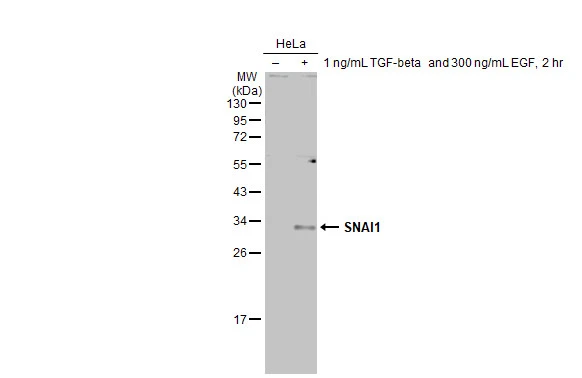
Untreated (–) and treated (+) HeLa whole cell extract (30 μg) were separated by 12% SDS-PAGE, and the membrane was blotted with SNAI1 antibody (GTX125918) diluted at 1:500. The HRP-conjugated anti-rabbit IgG antibody (GTX213110-01) was used to detect the primary antibody.
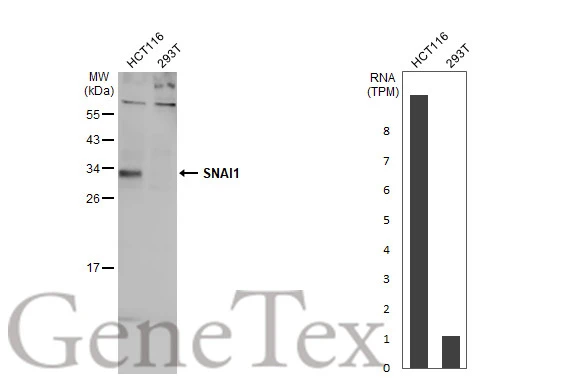
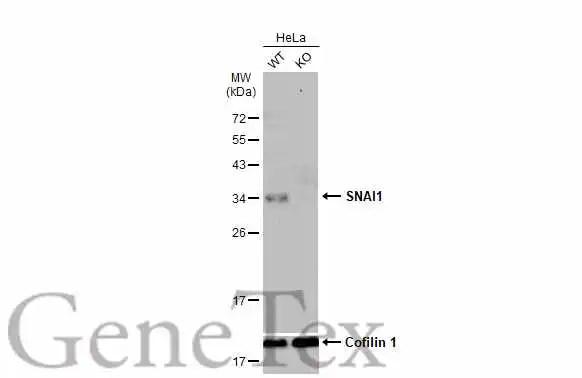
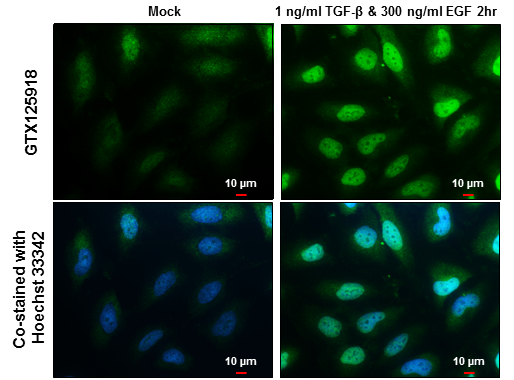
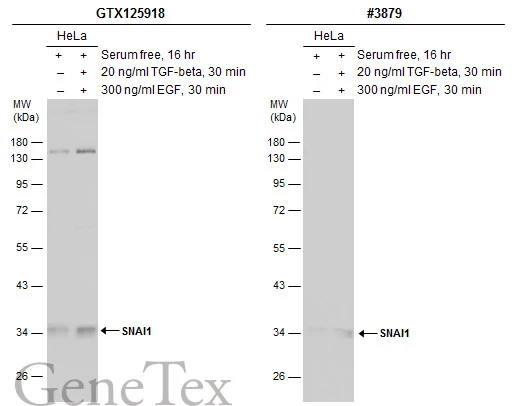
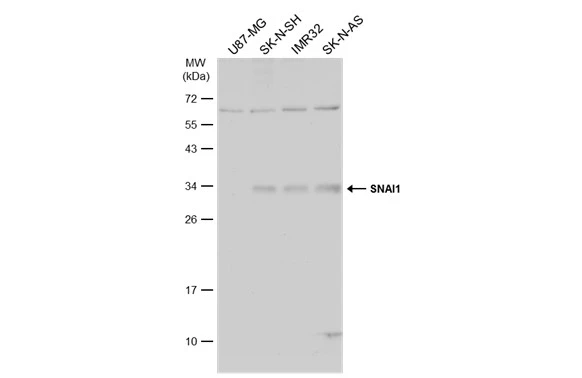
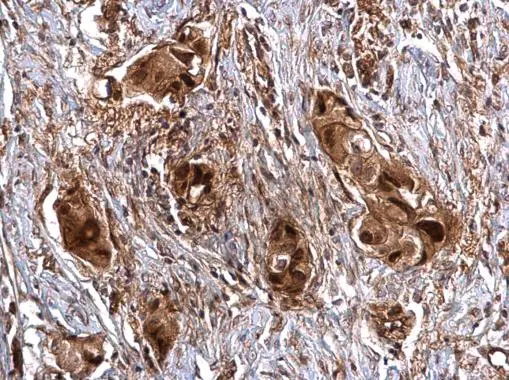
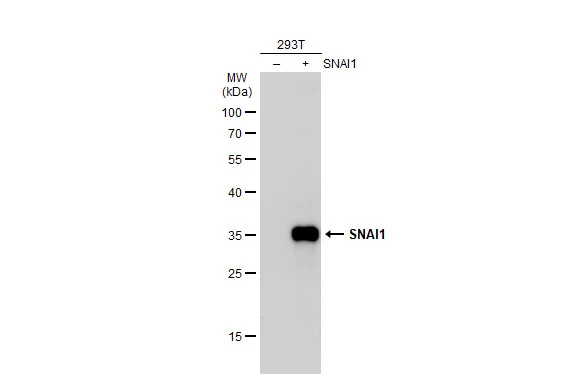
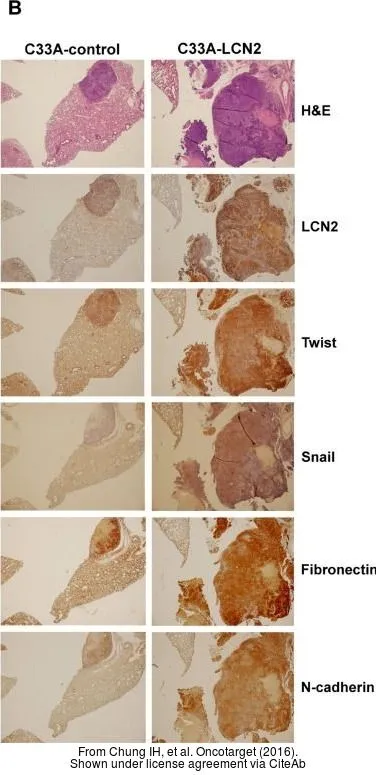
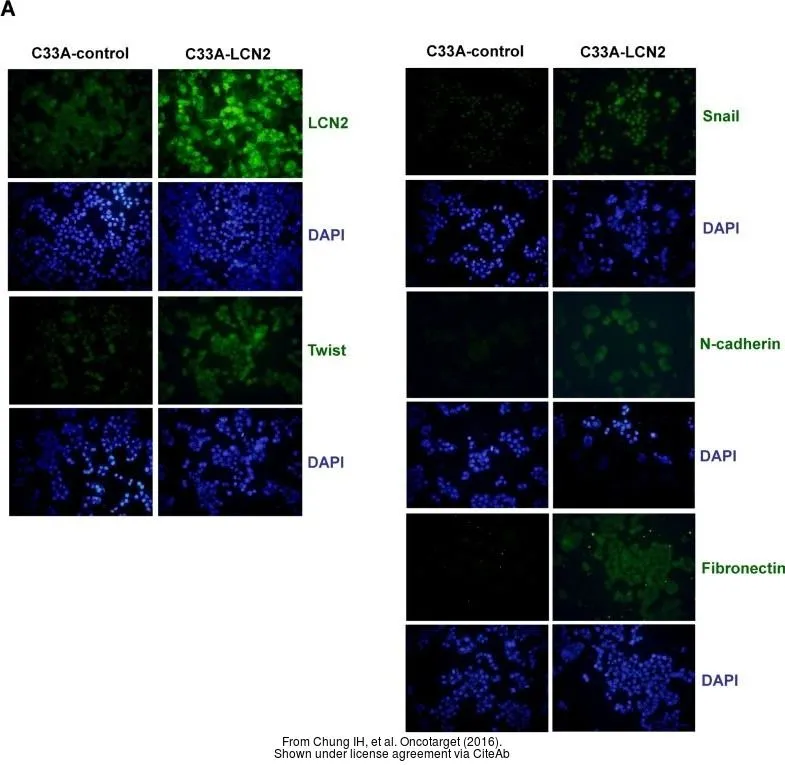
Untreated (–) and treated (+) HeLa whole cell extract (30 μg) were separated by 12% SDS-PAGE, and the membrane was blotted with SNAI1 antibody (GTX125918) diluted at 1:500. The HRP-conjugated anti-rabbit IgG antibody (GTX213110-01) was used to detect the primary antibody.
SNAI1 antibody
GTX125918

ApplicationsImmunoFluorescence, Western Blot, ImmunoCytoChemistry, ImmunoHistoChemistry, ImmunoHistoChemistry Paraffin
Product group Antibodies
ReactivityHuman, Mouse, Rat
TargetSNAI1
Overview
- SupplierGeneTex
- Product NameSNAI1 antibody
- Delivery Days Customer9
- Application Supplier NoteWB: 1:500-1:3000. ICC/IF: 1:100-1:1000. IHC-P: 1:100-1:1000. *Optimal dilutions/concentrations should be determined by the researcher.Not tested in other applications.
- ApplicationsImmunoFluorescence, Western Blot, ImmunoCytoChemistry, ImmunoHistoChemistry, ImmunoHistoChemistry Paraffin
- CertificationResearch Use Only
- ClonalityPolyclonal
- Concentration0.68 mg/ml
- ConjugateUnconjugated
- Gene ID6615
- Target nameSNAI1
- Target descriptionsnail family transcriptional repressor 1
- Target synonymsSLUGH2, SNA, SNAH, SNAIL, SNAIL1, dJ710H13.1, zinc finger protein SNAI1, protein sna, protein snail homolog 1, snail 1 homolog, snail 1 zinc finger protein, snail family zinc finger 1, snail homolog 1
- HostRabbit
- IsotypeIgG
- Protein IDO95863
- Protein NameZinc finger protein SNAI1
- Scientific DescriptionThe Drosophila embryonic protein snail is a zinc finger transcriptional repressor which downregulates the expression of ectodermal genes within the mesoderm. The nuclear protein encoded by this gene is structurally similar to the Drosophila snail protein, and is also thought to be critical for mesoderm formation in the developing embryo. At least two variants of a similar processed pseudogene have been found on chromosome 2. [provided by RefSeq]
- ReactivityHuman, Mouse, Rat
- Storage Instruction-20°C or -80°C,2°C to 8°C
- UNSPSC12352203
References
- Wu WS, Cheng CC, Lee YH, et al. Preclinical trial of targeting the Hic-5-mediated pathway to prevent the progression of hepatocellular carcinoma. Am J Cancer Res. 2023,13(10):4903-4917.Read this paper
- Chen WC, Wu CC, Liu YP, et al. Elafin as a Prognostic Marker in Esophageal Squamous Cell Carcinoma: A Pilot Study Using Three-Dimensional Imaging and Genomic Profiling. Cancers (Basel). 2023,15(15). doi: 10.3390/cancers15153825Read this paper
- Hung TH, Huang Y, Yeh CT, et al. High expression of embryonic stem cell marker SSEA3 confers poor prognosis and promotes epithelial mesenchymal transition in hepatocellular carcinoma. Biomed J. 2024,47(2):100612. doi: 10.1016/j.bj.2023.100612Read this paper
- Wang L, Ye G, Wang Y, et al. Stearoyl-CoA desaturase 1 regulates malignant progression of cervical cancer cells. Bioengineered. 2022,13(5):12941-12954. doi: 10.1080/21655979.2022.2079253Read this paper
- Wang LT, Liu KY, Chiou SS, et al. Phosphorylation of intestine-specific homeobox by ERK1 modulates oncogenic activity and sorafenib resistance. Cancer Lett. 2021,520:160-171. doi: 10.1016/j.canlet.2021.07.011Read this paper
- Lv F, Du Q, Li L, et al. Eriodictyol inhibits glioblastoma migration and invasion by reversing EMT via downregulation of the P38 MAPK/GSK-3β/ZEB1 pathway. Eur J Pharmacol. 2021,900:174069. doi: 10.1016/j.ejphar.2021.174069Read this paper
- Lee KY, Kuo TC, Chou CM, et al. Upregulation of CD109 Promotes the Epithelial-to-Mesenchymal Transition and Stemness Properties of Lung Adenocarcinomas via Activation of the Hippo-YAP Signaling. Cells. 2020,10(1). doi: 10.3390/cells10010028Read this paper
- Jao TM, Fang WH, Ciou SC, et al. PCDH10 exerts tumor-suppressor functions through modulation of EGFR/AKT axis in colorectal cancer. Cancer Lett. 2021,499:290-300. doi: 10.1016/j.canlet.2020.11.017Read this paper
- Kuo CH, Lin MW, Hsu YW, et al. Biomarker discovery in highly invasive lung cancer cell through proteomics approaches. Cell Biochem Funct. 2021,39(3):367-379. doi: 10.1002/cbf.3599Read this paper
- Huang HY, Chou HC, Law CH, et al. Progesterone receptor membrane component 1 is involved in oral cancer cell metastasis. J Cell Mol Med. 2020,24(17):9737-9751. doi: 10.1111/jcmm.15535Read this paper
Datasheet
Related products
Product group Antibodies

SNAI1 (Phospho-Ser246) AntibodyABX012522
ApplicationsImmunoFluorescence, Western Blot, ELISA, ImmunoCytoChemistry
- SizePrice
Product group Antibodies

Anti-SNAI1 Antibody144-05544
ApplicationsWestern Blot, ImmunoHistoChemistry
ReactivityHuman, Mouse, Rat
TargetSNAI1
- SizePrice


Product group Antibodies

Anti-SNAIL/SNAI1 Antibody Picoband(r)A00716-2-CARRIER-FREE
ApplicationsFlow Cytometry, Western Blot, ELISA
ReactivityHuman, Mouse, Rat
TargetSNAI1
- SizePrice
Product group Antibodies
References
SNAI1 antibodyGTX100754
ApplicationsImmunoFluorescence, Western Blot, ImmunoCytoChemistry, ImmunoHistoChemistry, ImmunoHistoChemistry Paraffin
ReactivityHuman, Mouse, Rat
TargetSNAI1
- SizePrice
Product group Antibodies
SNAI1 antibody [AT2D5]GTX57596
ApplicationsWestern Blot
ReactivityHuman
TargetSNAI1
- SizePrice
![WB analysis of human SNAI1 (AA: 2-264) recombinant protein using GTX60382 SNAI1 antibody [6D2].](https://www.genetex.com/upload/website/prouct_img/normal/GTX60382/GTX60382_20170912_WB_w_23061123_545.webp)
Product group Antibodies
SNAI1 antibody [6D2]GTX60382
ApplicationsWestern Blot, ELISA
ReactivityHuman
TargetSNAI1
- SizePrice
![Untreated (–) and treated (+) HeLa whole cell extract (30 μg) were separated by 12% SDS-PAGE, and the membrane was blotted with SNAI1 antibody [HL2303] (GTX638370) diluted at 1:1000. The HRP-conjugated anti-rabbit IgG antibody (GTX213110-01) was used to detect the primary antibody.](https://www.genetex.com/upload/website/prouct_img/normal/GTX638370/GTX638370_T-44991_20230414_WB_treatmemt_TGF-beta_EGF_23041723_265.webp)
Product group Antibodies
SNAI1 antibody [HL2303]GTX638370
ApplicationsImmunoFluorescence, Western Blot, ImmunoCytoChemistry
ReactivityHuman
TargetSNAI1
- SizePrice

Product group Antibodies
References
SNAI1 antibody, N-termGTX82509
ApplicationsWestern Blot
ReactivityHuman, Mouse
TargetSNAI1
- SizePrice
Product group Antibodies

ApplicationsImmunoPrecipitation, Western Blot, ImmunoCytoChemistry, ImmunoHistoChemistry
TargetSNAI1
- SizePrice