

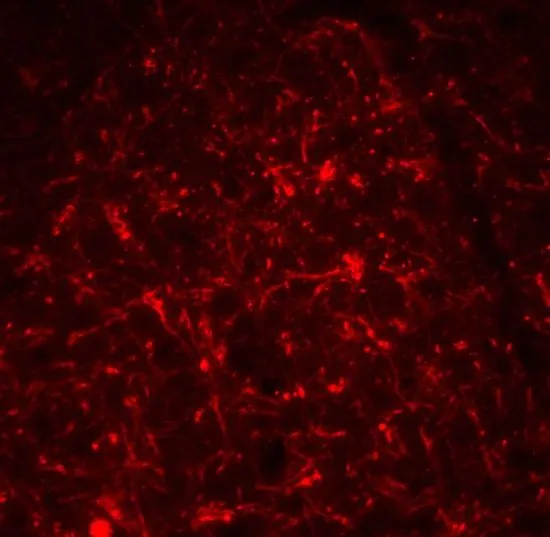
IHC-P analysis of mouse brain tissue using GTX85059 TSLP antibody. Working concentration : 20 μg/ml
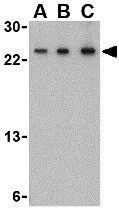
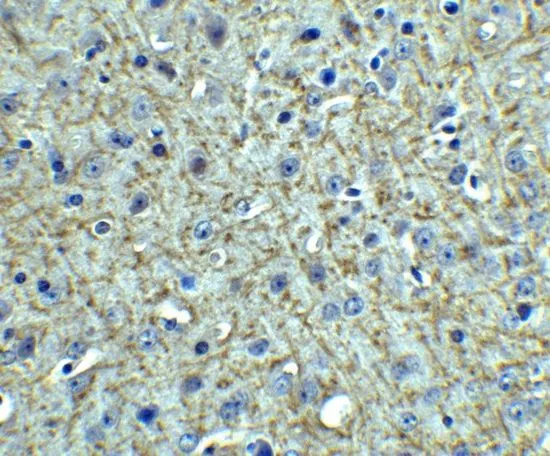
IHC-P analysis of mouse brain tissue using GTX85059 TSLP antibody. Working concentration : 20 μg/ml
TSLP antibody
GTX85059

ApplicationsImmunoFluorescence, Western Blot, ELISA, ImmunoCytoChemistry, ImmunoHistoChemistry, ImmunoHistoChemistry Paraffin
Product group Antibodies
ReactivityHuman, Mouse
TargetTSLP
Overview
- SupplierGeneTex
- Product NameTSLP antibody
- Delivery Days Customer9
- Application Supplier NoteWB: 0.5 - 2 microg/mL. IHC-P: 2.5 microg/mL. *Optimal dilutions/concentrations should be determined by the researcher.Not tested in other applications.
- ApplicationsImmunoFluorescence, Western Blot, ELISA, ImmunoCytoChemistry, ImmunoHistoChemistry, ImmunoHistoChemistry Paraffin
- CertificationResearch Use Only
- ClonalityPolyclonal
- Concentration1 mg/ml
- ConjugateUnconjugated
- Gene ID85480
- Target nameTSLP
- Target descriptionthymic stromal lymphopoietin
- Target synonymsthymic stromal lymphopoietin, thymic stroma-derived lymphopoietin
- HostRabbit
- IsotypeIgG
- Protein IDQ969D9
- Protein NameThymic stromal lymphopoietin
- Scientific DescriptionThymic stromal lymphopoietin (TSLP) has recently been identified as an important factor capable of driving dendritic cell maturation and activation. TSLP is a four-helix-bundle cytokine that is expressed mainly by barrier epithelial cells and is a potent activator of several cell types such as myeloid dendritic cells. TSLP is involved in the positive selection of regulatory T cells, maintenance of peripheral CD4+ T cell homeostasis and the induction of CD4+ T cell-mediated allergic reaction. TSLP is also capable of supporting the growth of fetal liver and adult B cell progenitors and their differentiation to the IgM-positive stage of B cell development. Amino acid sequence analysis has shown poor homology between human and mouse TSLP although they exhibit similar biological functions and are expressed in similar tissues. Despite its predicted molecular weight, TSLP often migrates at a higher molecular weight in SDS-PAGE. At least two differentially spliced isoforms of TSLP are known to exist.
- ReactivityHuman, Mouse
- Storage Instruction-20°C or -80°C,2°C to 8°C
- UNSPSC41116161
References
- Neonatal endotoxin stimulation is associated with a long-term bronchiolar epithelial expression of innate immune and anti-allergic markers that attenuates the allergic response. Garcia LN et al., 2020, PLoS OneRead this paper
- Exposure to diisononyl phthalate promotes atopic march by activating of NF-kappaB and p38 MAPK. Qin W et al., 2020 May 15, Toxicol Appl PharmacolRead this paper
- Subcutaneous injection of recombinant heat shock protein 70 ameliorates atopic dermatitis skin lesions in a mouse model. Kao JK et al., 2020 Mar, Kaohsiung J Med SciRead this paper
- Benzo(a)pyrene facilitates dermatophagoides group 1 (Der f 1)-induced epithelial cytokine release through aryl hydrocarbon receptor in asthma. Wang E et al., 2019 Sep, AllergyRead this paper
- Exposure to a combination of formaldehyde and DINP aggravated asthma-like pathology through oxidative stress and NF-kappaB activation. Kang J et al., 2018 Jul 1, ToxicologyRead this paper
- Oral exposure to diisodecyl phthalate aggravates allergic dermatitis by oxidative stress and enhancement of thymic stromal lymphopoietin. Shen S et al., 2017 Jan, Food Chem ToxicolRead this paper
- The epithelial cell-derived atopic dermatitis cytokine TSLP activates neurons to induce itch. Wilson SR et al., 2013 Oct 10, CellRead this paper
Datasheet
Related products
Product group Antibodies

Anti-TSLP AntibodyA31221
ApplicationsImmunoHistoChemistry
ReactivityHuman
- SizePrice
Product group Antibodies

ApplicationsNeutralisation/Blocking
TargetTSLP
- SizePrice

Product group Antibodies

Anti-TSLP Antibody Picoband(r)A01096-CARRIER-FREE
ApplicationsWestern Blot, ELISA
ReactivityHuman, Mouse
TargetTSLP
- SizePrice
Product group Antibodies

Anti-TSLP Antibody144-60206
ApplicationsWestern Blot
ReactivityHuman, Mouse, Rat
TargetTSLP
- SizePrice
Product group Antibodies

TSLP Polyclonal AntibodyBS-0449R
ApplicationsImmunoFluorescence, Western Blot, ELISA, ImmunoCytoChemistry, ImmunoHistoChemistry, ImmunoHistoChemistry Frozen, ImmunoHistoChemistry Paraffin
ReactivityHuman
TargetTSLP
- SizePrice
Product group Antibodies

TSLP Polyclonal AntibodyCAC13985
ApplicationsWestern Blot, ELISA, ImmunoHistoChemistry
ReactivityMouse
TargetTSLP
- SizePrice
Product group Antibodies

TSLP AntibodyCSB-PA025141LA01HU
ApplicationsWestern Blot, ELISA, ImmunoHistoChemistry
ReactivityHuman, Mouse
TargetTSLP
- SizePrice
Product group Antibodies

TSLP AntibodyLS-C404375
ApplicationsWestern Blot, ELISA
ReactivityHuman
TargetTSLP
- SizePrice
Product group Antibodies
References
TSLP antibodyGTX85060
ApplicationsWestern Blot, ELISA, ImmunoHistoChemistry, ImmunoHistoChemistry Paraffin
ReactivityHuman
TargetTSLP
- SizePrice

Product group Antibodies

Anti-TSLP AntibodyHPA056350
ApplicationsImmunoCytoChemistry
ReactivityHuman
TargetTSLP
- SizePrice