

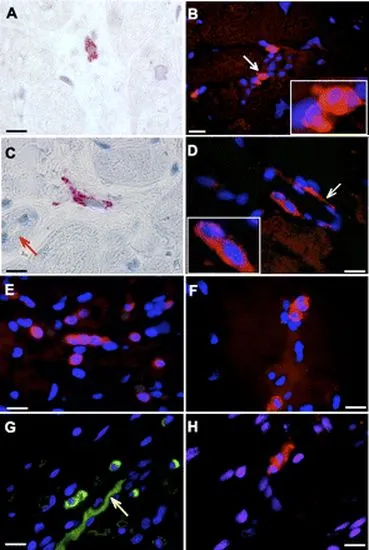
IHC analysis of human heart tissue (labeling of intrinsic cardiac adrenergic (ICA) cells) using GTX10372 Tyrosine Hydroxylase antibody [185].
![IHC analysis of locus coeruleus using GTX10372 Tyrosine Hydroxylase antibody [185].](https://www.genetex.com/upload/website/prouct_img/normal/GTX10372/GTX10372_IHC2_210218_w_23060119_976.webp "IHC analysis of locus coeruleus using GTX10372 Tyrosine Hydroxylase antibody [185].")
![IHC-P analysis of human mid-brain tissue using GTX10372 Tyrosine Hydroxylase antibody [185].](https://www.genetex.com/upload/website/prouct_img/normal/GTX10372/GTX10372_IHC-P_210218_w_23060119_159.webp "IHC-P analysis of human mid-brain tissue using GTX10372 Tyrosine Hydroxylase antibody [185].")
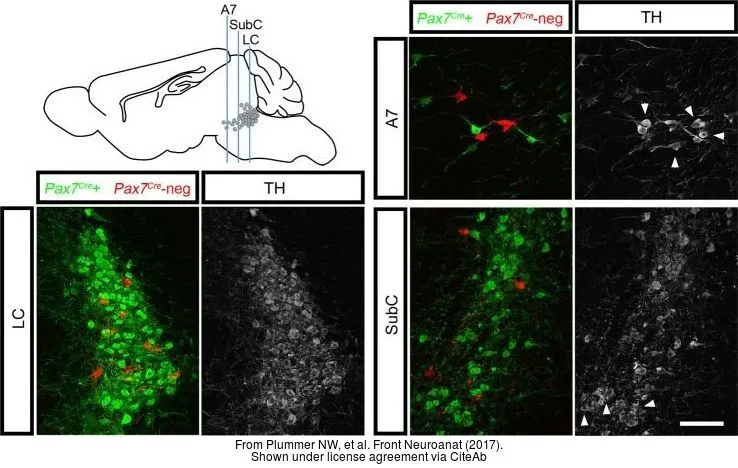
IHC analysis of human heart tissue (labeling of intrinsic cardiac adrenergic (ICA) cells) using GTX10372 Tyrosine Hydroxylase antibody [185].
Tyrosine Hydroxylase antibody [185]
GTX10372

ApplicationsImmunoFluorescence, Western Blot, ImmunoCytoChemistry, ImmunoHistoChemistry, ImmunoHistoChemistry Frozen, ImmunoHistoChemistry Paraffin
Product group Antibodies
ReactivityHuman, Mouse, Rat
TargetTh
Overview
- SupplierGeneTex
- Product NameTyrosine Hydroxylase antibody [185]
- Delivery Days Customer9
- Application Supplier NoteWB: 1:25-1:50. *Optimal dilutions/concentrations should be determined by the researcher.Not tested in other applications.
- ApplicationsImmunoFluorescence, Western Blot, ImmunoCytoChemistry, ImmunoHistoChemistry, ImmunoHistoChemistry Frozen, ImmunoHistoChemistry Paraffin
- CertificationResearch Use Only
- ClonalityMonoclonal
- Clone ID185
- ConjugateUnconjugated
- Gene ID21823
- Target nameTh
- Target descriptiontyrosine hydroxylase
- Target synonymstyrosine 3-monooxygenase, tyrosine 3-hydroxylase
- HostMouse
- IsotypeIgG2a
- Protein IDP24529
- Protein NameTyrosine 3-monooxygenase
- Scientific DescriptionThe protein encoded by this gene is involved in the conversion of tyrosine to dopamine. It is the rate-limiting enzyme in the synthesis of catecholamines, hence plays a key role in the physiology of adrenergic neurons. Mutations in this gene have been associated with autosomal recessive Segawa syndrome. Alternatively spliced transcript variants encoding different isoforms have been noted for this gene. [provided by RefSeq, Jul 2008]
- ReactivityHuman, Mouse, Rat
- Storage Instruction-20°C or -80°C,2°C to 8°C
- UNSPSC41116161
References
- Inhibition of abnormal C/EBPbeta/alpha-Syn signaling pathway through activation of Nrf2 ameliorates Parkinsons disease-like pathology.Read this paper
- Suppression of abnormal alpha-synuclein expression by activation of BDNF transcription ameliorates Parkinsons disease-like pathology.Read this paper
- Critical role of TRPC1 in thyroid hormone-dependent dopaminergic neuron development. Chen C et al., 2017 Oct, Biochim Biophys Acta Mol Cell ResRead this paper
- Two Subpopulations of Noradrenergic Neurons in the Locus Coeruleus Complex Distinguished by Expression of the Dorsal Neural Tube Marker Pax7. Plummer NW et al., 2017, Front NeuroanatRead this paper
- Uncovering diversity in the development of central noradrenergic neurons and their efferents. Robertson SD et al., 2016 Jun 15, Brain ResRead this paper
- Expanding the power of recombinase-based labeling to uncover cellular diversity. Plummer NW et al., 2015 Dec 15, DevelopmentRead this paper
Datasheet
Related products
Product group Antibodies

ApplicationsImmunoFluorescence, ImmunoCytoChemistry, ImmunoHistoChemistry, ImmunoHistoChemistry Frozen, ImmunoHistoChemistry Paraffin
ReactivityMouse, Rat
TargetTh
- SizePrice
Product group Antibodies

ApplicationsImmunoPrecipitation, Western Blot, ImmunoCytoChemistry, ImmunoHistoChemistry
ReactivityMouse
TargetTh
- SizePrice