

VPS33A antibody [C1C3]
GTX119416

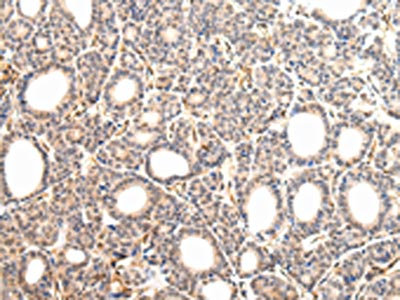
ApplicationsImmunoFluorescence, Western Blot, ImmunoCytoChemistry, ImmunoHistoChemistry, ImmunoHistoChemistry Paraffin
Product group Antibodies
ReactivityHuman, Mouse
TargetVPS33A
Overview
- SupplierGeneTex
- Product NameVPS33A antibody [C1C3]
- Delivery Days Customer9
- Application Supplier NoteWB: 1:500-1:3000. ICC/IF: 1:100-1:1000. IHC-P: 1:100-1:1000. *Optimal dilutions/concentrations should be determined by the researcher.Not tested in other applications.
- ApplicationsImmunoFluorescence, Western Blot, ImmunoCytoChemistry, ImmunoHistoChemistry, ImmunoHistoChemistry Paraffin
- CertificationResearch Use Only
- ClonalityPolyclonal
- Concentration1 mg/ml
- ConjugateUnconjugated
- Gene ID65082
- Target nameVPS33A
- Target descriptionVPS33A core subunit of CORVET and HOPS complexes
- Target synonymsMPSPS, vacuolar protein sorting-associated protein 33A, VPS33A, CORVET/HOPS core subunit, vacuolar protein sorting 33 homolog A, vacuolar protein sorting 33A
- HostRabbit
- IsotypeIgG
- Protein IDQ96AX1
- Protein NameVacuolar protein sorting-associated protein 33A
- Scientific DescriptionVesicle mediated protein sorting plays an important role in segregation of intracellular molecules into distinct organelles. Genetic studies in yeast have identified more than 40 vacuolar protein sorting (VPS) genes involved in vesicle transport to vacuoles. This gene is a member of the Sec-1 domain family, and it encodes a protein similar to the yeast class C Vps33 protein. The mammalian class C VPS proteins are predominantly associated with late endosomes/lysosomes, and like their yeast counterparts, may mediate vesicle trafficking steps in the endosome/lysosome pathway. [provided by RefSeq]
- ReactivityHuman, Mouse
- Storage Instruction-20°C or -80°C,2°C to 8°C
- UNSPSC12352203
References
- Miao G, Zhao H, Li Y, et al. ORF3a of the COVID-19 virus SARS-CoV-2 blocks HOPS complex-mediated assembly of the SNARE complex required for autolysosome formation. Dev Cell. 2021,56(4):427-442.e5. doi: 10.1016/j.devcel.2020.12.010Read this paper
- Uematsu M, Nishimura T, Sakamaki Y, et al. Accumulation of undegraded autophagosomes by expression of dominant-negative STX17 (syntaxin 17) mutants. Autophagy. 2017,13(8):1452-1464. doi: 10.1080/15548627.2017.1327940Read this paper
- Hubert V, Peschel A, Langer B, et al. LAMP-2 is required for incorporating syntaxin-17 into autophagosomes and for their fusion with lysosomes. Biol Open. 2016,5(10):1516-1529. doi: 10.1242/bio.018648Read this paper
- van der Kant R, Jonker CT, Wijdeven RH, et al. Characterization of the Mammalian CORVET and HOPS Complexes and Their Modular Restructuring for Endosome Specificity. J Biol Chem. 2015,290(51):30280-90. doi: 10.1074/jbc.M115.688440Read this paper
- Jiang P, Nishimura T, Sakamaki Y, et al. The HOPS complex mediates autophagosome-lysosome fusion through interaction with syntaxin 17. Mol Biol Cell. 2014,25(8):1327-37. doi: 10.1091/mbc.E13-08-0447Read this paper
- van der Kant R, Fish A, Janssen L, et al. Late endosomal transport and tethering are coupled processes controlled by RILP and the cholesterol sensor ORP1L. J Cell Sci. 2013,126(Pt 15):3462-74. doi: 10.1242/jcs.129270Read this paper
Datasheet
Related products
Product group Antibodies

VPS33A AntibodyCSB-PA128038
ApplicationsELISA, ImmunoHistoChemistry
ReactivityHuman, Mouse, Rat
TargetVPS33A
- SizePrice
Product group Antibodies

VPS33A AntibodyLS-C501518
ApplicationsImmunoFluorescence, ELISA, ImmunoHistoChemistry
ReactivityHuman
TargetVPS33A
- SizePrice