

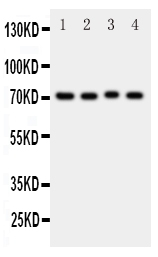
WB analysis of various samples using GTX12131 ABCG2 antibody. Lane 1 : rat liver tissue lysate at 50ug Lane 2 : rat spleen tissue lysate at 50ug Lane 3 : rat kidney tissue lysate at 50ug Lane 4 : mouse spleen tissue lysate at 50ug Dilution : 0.5 μg/mL
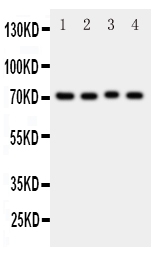
WB analysis of various samples using GTX12131 ABCG2 antibody. Lane 1 : rat liver tissue lysate at 50ug Lane 2 : rat spleen tissue lysate at 50ug Lane 3 : rat kidney tissue lysate at 50ug Lane 4 : mouse spleen tissue lysate at 50ug Dilution : 0.5 μg/mL
ABCG2 antibody
GTX12131

ApplicationsWestern Blot
Product group Antibodies
ReactivityMouse, Rat
TargetAbcg2
Overview
- SupplierGeneTex
- Product NameABCG2 antibody
- Delivery Days Customer9
- Application Supplier NoteWB: 0.1-0.5microg/ml. *Optimal dilutions/concentrations should be determined by the researcher.Not tested in other applications.
- ApplicationsWestern Blot
- CertificationResearch Use Only
- ClonalityPolyclonal
- Concentration500 ug/ml
- ConjugateUnconjugated
- Gene ID26357
- Target nameAbcg2
- Target descriptionATP binding cassette subfamily G member 2 (Junior blood group)
- Target synonymsABC15, ABCP, BCRP, Bcrp1, MXR, MXR1, broad substrate specificity ATP-binding cassette transporter ABCG2, ATP-binding cassette sub-family G member 2, ATP-binding cassette, sub-family G (WHITE), member 2, breast cancer resistance protein 1 homolog, mitoxantrone resistance protein 1, urate exporter
- HostRabbit
- IsotypeIgG
- Protein IDQ7TMS5
- Protein NameBroad substrate specificity ATP-binding cassette transporter ABCG2
- Scientific DescriptionThe membrane-associated protein encoded by this gene is included in the superfamily of ATP-binding cassette (ABC) transporters. ABC proteins transport various molecules across extra- and intra-cellular membranes. ABC genes are divided into seven distinct subfamilies (ABC1, MDR/TAP, MRP, ALD, OABP, GCN20, White). This protein is a member of the White subfamily. Alternatively referred to as a breast cancer resistance protein, the human protein functions as a xenobiotic transporter which may play a major role in multi-drug resistance. This protein likely serves as a cellular defense mechanism in response to mitoxantrone and anthracycline exposure. [provided by RefSeq, Jul 2008]
- ReactivityMouse, Rat
- Storage Instruction-20°C or -80°C,2°C to 8°C
- UNSPSC12352203
References
- Liao WL, Liu YF, Ying TH, et al. Inhibitory Effects of Ursolic Acid on the Stemness and Progression of Human Breast Cancer Cells by Modulating Argonaute-2. Int J Mol Sci. 2022,24(1). doi: 10.3390/ijms24010366Read this paper
- García-Arroyo FE, Gonzaga G, Muñoz-Jiménez I, et al. Probiotic supplements prevented oxonic acid-induced hyperuricemia and renal damage. PLoS One. 2018,13(8):e0202901. doi: 10.1371/journal.pone.0202901Read this paper
- Rosen MB, Jeffay SC, Nichols HP, et al. ATP Binding Cassette Sub-family Member 2 (ABCG2) and Xenobiotic Exposure During Early Mouse Embryonic Stem Cell Differentiation. Birth Defects Res. 2018,110(1):35-47. doi: 10.1002/bdr2.1114Read this paper
Datasheet
Related products
Product group Antibodies

ApplicationsImmunoPrecipitation, Western Blot, ImmunoCytoChemistry, ImmunoHistoChemistry
ReactivityRat
- SizePrice
Product group Antibodies

Anti-BCRP/ABCG2 Antibody Picoband(r)PA1870-CARRIER-FREE
ApplicationsWestern Blot
ReactivityMouse, Rat
TargetAbcg2
- SizePrice