

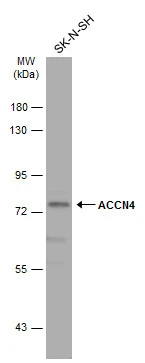
Whole cell extract (30 μg) was separated by 7.5% SDS-PAGE, and the membrane was blotted with ACCN4 antibody [N1N3] (GTX116235) diluted at 1:500. The HRP-conjugated anti-rabbit IgG antibody (GTX213110-01) was used to detect the primary antibody.
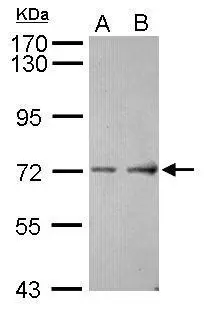
Whole cell extract (30 μg) was separated by 7.5% SDS-PAGE, and the membrane was blotted with ACCN4 antibody [N1N3] (GTX116235) diluted at 1:500. The HRP-conjugated anti-rabbit IgG antibody (GTX213110-01) was used to detect the primary antibody.
ACCN4 antibody [N1N3]
GTX116235

ApplicationsWestern Blot
Product group Antibodies
ReactivityHuman
TargetASIC4
Overview
- SupplierGeneTex
- Product NameACCN4 antibody [N1N3]
- Delivery Days Customer9
- Application Supplier NoteWB: 1:500-1:3000. *Optimal dilutions/concentrations should be determined by the researcher.Not tested in other applications.
- ApplicationsWestern Blot
- CertificationResearch Use Only
- ClonalityPolyclonal
- Concentration0.42 mg/ml
- ConjugateUnconjugated
- Gene ID55515
- Target nameASIC4
- Target descriptionacid sensing ion channel subunit family member 4
- Target synonymsACCN4, BNAC4, acid-sensing ion channel 4, acid sensing ion channel family member 4, acid-sensing (proton-gated) ion channel family member 4, amiloride-sensitive cation channel 4, pituitary, amiloride-sensitive cation channel family member 4, pituitary, brain sodium channel 4
- HostRabbit
- IsotypeIgG
- Protein IDQ96FT7
- Protein NameAcid-sensing ion channel 4
- Scientific DescriptionThis gene belongs to the superfamily of acid-sensing ion channels, which are proton-gated, amiloride-sensitive sodium channels. These channels have been implicated in synaptic transmission, pain perception as well as mechanoperception. This gene is predominantly expressed in the pituitary gland, and was considered a candidate for paroxysmal dystonic choreoathetosis (PDC), a movement disorder, however, no correlation was found between mutations in this gene and PDC. Alternative splicing at this locus results in two transcript variants encoding different isoforms. [provided by RefSeq]
- ReactivityHuman
- Storage Instruction-20°C or -80°C,2°C to 8°C
- UNSPSC12352203
Datasheet
Related products
Product group Antibodies

Anti-ACCN4 (N-term) Antibody102-22336
ApplicationsWestern Blot
TargetASIC4
- SizePrice
Product group Antibodies

ACCN4 Polyclonal AntibodyBS-12129R
ApplicationsImmunoFluorescence, ELISA, ImmunoCytoChemistry, ImmunoHistoChemistry, ImmunoHistoChemistry Frozen, ImmunoHistoChemistry Paraffin
ReactivityBovine, Canine, Equine, Human, Mouse, Porcine, Rat, Sheep
- SizePrice
Product group Antibodies

ASIC4 AntibodyCSB-PA001144GA01HU
ApplicationsWestern Blot, ELISA
ReactivityHuman, Mouse, Rat
TargetASIC4
- SizePrice
Product group Antibodies

ACCN4 / ASIC4 AntibodyLS-C833964
ApplicationsImmunoHistoChemistry
ReactivityHuman, Rat
TargetASIC4
- SizePrice

Product group Antibodies

Anti-ASIC4 AntibodyHPA057078
ApplicationsImmunoCytoChemistry
ReactivityHuman
TargetASIC4
- SizePrice