

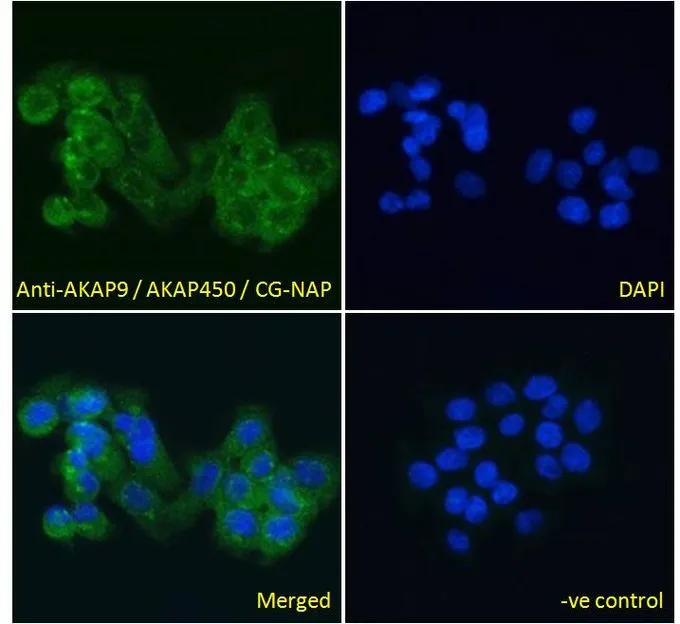
ICC/IF analysis of PFA fixed A431 cells using GTX89583 AKAP9 antibody, C-term. Green : Primary antibody Blue : DAPI Negative control : Unimmunized goat IgG Permeabilization : 0.15% Triton Dilution : 10μg/ml
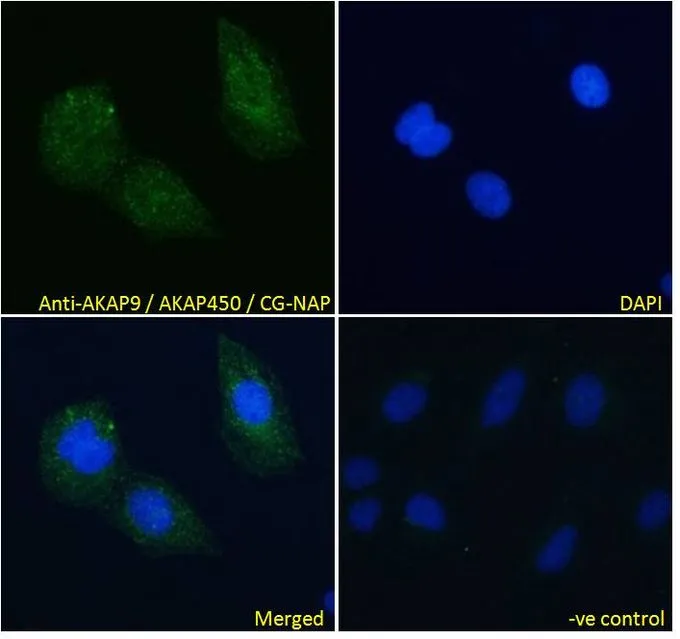
ICC/IF analysis of PFA fixed A431 cells using GTX89583 AKAP9 antibody, C-term. Green : Primary antibody Blue : DAPI Negative control : Unimmunized goat IgG Permeabilization : 0.15% Triton Dilution : 10μg/ml
AKAP9 antibody, C-term
GTX89583

ApplicationsImmunoFluorescence, Western Blot, ImmunoCytoChemistry
Product group Antibodies
ReactivityHuman
TargetAKAP9
Overview
- SupplierGeneTex
- Product NameAKAP9 antibody, C-term
- Delivery Days Customer7
- Application Supplier NoteWB: 1-3microg/ml. ICC/IF: 10microg/ml. *Optimal dilutions/concentrations should be determined by the researcher.Not tested in other applications.
- ApplicationsImmunoFluorescence, Western Blot, ImmunoCytoChemistry
- CertificationResearch Use Only
- ClonalityPolyclonal
- Concentration0.50 mg/ml
- ConjugateUnconjugated
- Gene ID10142
- Target nameAKAP9
- Target descriptionA-kinase anchoring protein 9
- Target synonymsAKAP-9, AKAP350, AKAP450, CG-NAP, HYPERION, LQT11, MU-RMS-40.16A, PPP1R45, PRKA9, YOTIAO, A-kinase anchor protein 9, A kinase (PRKA) anchor protein (yotiao) 9, A kinase (PRKA) anchor protein 9, A-kinase anchor protein 350 kDa, A-kinase anchor protein 450 kDa, AKAP 120-like protein, AKAP9-BRAF fusion protein, centrosome- and Golgi-localized PKN-associated protein, centrosome- and golgi-localized protein kinase N-associated protein, kinase N-associated protein, protein hyperion, protein kinase A anchoring protein 9, protein phosphatase 1, regulatory subunit 45, protein yotiao
- HostGoat
- IsotypeIgG
- Protein IDQ99996
- Protein NameA-kinase anchor protein 9
- Scientific DescriptionThe A-kinase anchor proteins (AKAPs) are a group of structurally diverse proteins which have the common function of binding to the regulatory subunit of protein kinase A (PKA) and confining the holoenzyme to discrete locations within the cell. This gene encodes a member of the AKAP family. Alternate splicing of this gene results in at least two isoforms that localize to the centrosome and the Golgi apparatus, and interact with numerous signaling proteins from multiple signal transduction pathways. These signaling proteins include type II protein kinase A, serine/threonine kinase protein kinase N, protein phosphatase 1, protein phosphatase 2a, protein kinase C-epsilon and phosphodiesterase 4D3. [provided by RefSeq, Aug 2008]
- ReactivityHuman
- Storage Instruction-20°C or -80°C,2°C to 8°C
- UNSPSC41116161
Datasheet
Related products
Product group Antibodies

Anti-AKAP9 AntibodyA45944
ApplicationsImmunoHistoChemistry
ReactivityHuman
- SizePrice
Product group Antibodies

ApplicationsImmunoFluorescence, ImmunoHistoChemistry
ReactivityHuman, Mouse
TargetAKAP9
- SizePrice
Product group Antibodies

Goat anti-AKAP9 / YOTIAOEB09196
ApplicationsELISA
ReactivityCanine, Human
TargetAKAP9
- SizePrice
Product group Antibodies

AKAP9 AntibodyCSB-PA280169
ApplicationsELISA, ImmunoHistoChemistry
ReactivityHuman
TargetAKAP9
- SizePrice
Product group Antibodies

Akap9 Polyclonal AntibodyCAC07934
ApplicationsImmunoFluorescence, Western Blot, ELISA, ImmunoHistoChemistry
TargetAKAP9
- SizePrice
Product group Antibodies

AKAP9 / YOTIAO Antibody (Biotin)LS-C501652
ApplicationsELISA
ReactivityHuman
TargetAKAP9
- SizePrice
![IHC-P analysis of human pancreas tissue using GTX79473 AKAP9 antibody [17G10]. Left : Primary antibody Right : Negative control without primary antibody Antigen retrieval : heat induced antigen retrieval was performed using 10mM sodium citrate (pH6.0) buffer, microwaved for 8-15 minutes Dilution : 1:20](https://www.genetex.com/upload/website/prouct_img/normal/GTX79473/GTX79473_1402_IHC-P_w_23061322_635.webp)
Product group Antibodies
AKAP9 antibody [17G10]GTX79473
ApplicationsImmunoFluorescence, ImmunoPrecipitation, ImmunoCytoChemistry, ImmunoHistoChemistry, ImmunoHistoChemistry Paraffin
ReactivityHuman, Mouse
TargetAKAP9
- SizePrice

Product group Antibodies

Anti-AKAP9 AntibodyHPA008548
ApplicationsImmunoCytoChemistry, ImmunoHistoChemistry
ReactivityHuman
TargetAKAP9
- SizePrice