

Anti-CNGA4 Antibody
ER1901-88

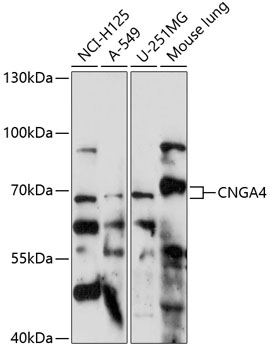
ApplicationsFlow Cytometry, ImmunoFluorescence, Western Blot
Product group Antibodies
ReactivityHuman, Mouse, Rat
TargetCNGA4
Overview
- SupplierHUABIO
- Product NameAnti-CNGA4 Antibody
- Delivery Days Customer7
- ApplicationsFlow Cytometry, ImmunoFluorescence, Western Blot
- Applications SupplierWB,IF-Cell,FC
- CertificationResearch Use Only
- ClonalityPolyclonal
- Concentration1 mg/ml
- ConjugateUnconjugated
- Gene ID1262
- Target nameCNGA4
- Target descriptioncyclic nucleotide gated channel subunit alpha 4
- Target synonymsCNCA2, CNG-4, CNG4, CNG5, CNGB2, OCNC2, OCNCBETA, OCNCb, cyclic nucleotide-gated channel alpha-4, CNG channel alpha-4, cyclic nucleotide gated channel alpha 4, cyclic nucleotide gated channel beta 2, cyclic nucleotide-gated cation channel alpha-4, olfactory cyclic nucleotide-gated channel subunit 2
- HostRabbit
- IsotypeIgG
- Protein IDQ3UW12
- Protein NameCyclic nucleotide-gated channel alpha-4
- Scientific DescriptionSecond messenger, cAMP, causes the opening of cation-selective cyclic nucleotide-gated (CNG) channels and depolarization of the neuron (olfactory sensory neurons, OSNs). CNGA4 is the modulatory subunit of this channel which is known to play a central role in the transduction of odorant signals and subsequent adaptation. By accelerating the calcium-mediated negative feedback in olfactory signaling it allows rapid adaptation to odor stimulation and extends its range of odor detection. When heterologously expressed all subunits with exception of CNGA4, CNGB1 and CNGB3 can form functional homomeric channels. In olfactory sensory neurons, CNG channels which are formed by two CNGA2, one CNGA4 subunits and an isoform of CNGB1, are activated by the binding of cAMP, whose levels increase in response to the binding of odorant molecules to their respective receptors. These channels are highly expressed in retinal photoreceptors and olfactory neurons where their role has been extensively studied. CNG channels have also been detected in brain, testis and kidney although their role in these tissues has yet to be unraveled.
- ReactivityHuman, Mouse, Rat
- Reactivity SupplierHuman,Mouse,Rat
- Storage Instruction-20°C,2°C to 8°C
- UNSPSC41116161
Datasheet
Related products
Product group Antibodies

Anti-CNGA4 AntibodyA90873
ApplicationsWestern Blot
ReactivityHuman, Mouse
- SizePrice
Product group Antibodies

CNGA4 AntibodyLS-C749701
ApplicationsWestern Blot
ReactivityHuman, Rat
TargetCNGA4
- SizePrice

Product group Antibodies

Anti-CNGA4 AntibodyHPA074128
ApplicationsImmunoCytoChemistry
ReactivityHuman
TargetCNGA4
- SizePrice
Product group Antibodies

CNGA4 AntibodyCSB-PA808540LA01HU
ApplicationsELISA, ImmunoHistoChemistry
ReactivityHuman
TargetCNGA4
- SizePrice
Product group Antibodies

Anti-CNGA4 Antibody144-63419
ApplicationsWestern Blot
ReactivityHuman, Mouse
TargetCNGA4
- SizePrice