

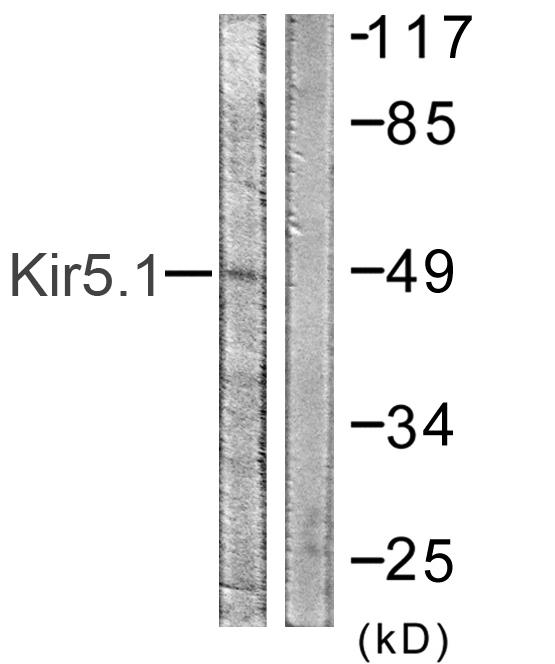
Anti-Kir5.1 Antibody
ER1901-24

ApplicationsFlow Cytometry, Western Blot, ImmunoHistoChemistry, ImmunoHistoChemistry Paraffin
Product group Antibodies
ReactivityHuman, Mouse
TargetKCNJ16
Overview
- SupplierHUABIO
- Product NameAnti-Kir5.1 Antibody
- Delivery Days Customer7
- ApplicationsFlow Cytometry, Western Blot, ImmunoHistoChemistry, ImmunoHistoChemistry Paraffin
- Applications SupplierWB,IHC-P,FC
- CertificationResearch Use Only
- ClonalityPolyclonal
- Concentration1 mg/ml
- ConjugateUnconjugated
- Gene ID3773
- Target nameKCNJ16
- Target descriptionpotassium inwardly rectifying channel subfamily J member 16
- Target synonymsBIR9, HKTD, KIR5.1, inward rectifier potassium channel 16, inward rectifier K(+) channel Kir5.1, inward rectifier K+ channel KIR5.1, potassium channel, inwardly rectifying subfamily J member 16, potassium voltage-gated channel subfamily J member 16
- HostRabbit
- IsotypeIgG
- Protein IDP52191
- Protein NameInward rectifier potassium channel 16
- Scientific DescriptionPotassium inwardly-rectifying channel, subfamily J, member 16 (KCNJ16) is a human gene encoding the Kir5.1 protein. Potassium channels are present in most mammalian cells, where they participate in a wide range of physiologic responses. Kir5.1 is an integral membrane protein and inward-rectifier type potassium channel. Inward rectifier potassium channels are characterized by a greater tendency to allow potassium to flow into the cell rather than out of it. Their voltage dependence is regulated by the concentration of extracellular potassium; as external potassium is raised, the voltage range of the channel opening shifts to more positive voltages. The inward rectification is mainly due to the blockage of outward current by internal magnesium. KCNJ16 may be involved in the regulation of fluid and pH balance. In the kidney, together with KCNJ10, mediates basolateral K+ recycling in distal tubules; this process is critical for Na+ reabsorption at the tubules.
- ReactivityHuman, Mouse
- Reactivity SupplierHuman,Mouse
- Reactivity Supplier NoteRat
- Storage Instruction-20°C,2°C to 8°C
- UNSPSC41116161
Datasheet
Related products
Product group Antibodies

Anti-Kir5.1 AntibodyA96361
ApplicationsImmunoFluorescence, Western Blot, ELISA, ImmunoHistoChemistry
ReactivityMouse, Rat
- SizePrice
Product group Antibodies
References

Kir5.1 antibodyGTX54791
ApplicationsWestern Blot, ImmunoHistoChemistry, ImmunoHistoChemistry Paraffin
ReactivityHuman, Mouse, Rat
TargetKcnj16
- SizePrice