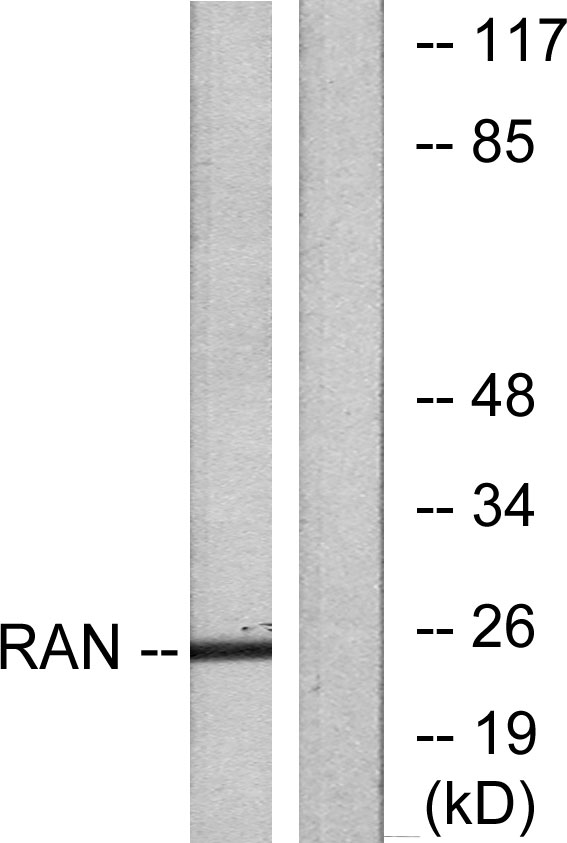
anti-Ran antibody
ARG40977

ApplicationsFlow Cytometry, ImmunoFluorescence, Western Blot, ImmunoCytoChemistry, ImmunoHistoChemistry, ImmunoHistoChemistry Paraffin
Product group Antibodies
ReactivityHuman
TargetRAN
Overview
- SupplierArigo Biolaboratories
- Product Nameanti-Ran antibody
- Delivery Days Customer23
- Application Supplier NoteIHC-P: Antigen Retrieval: Heat mediation was performed in Citrate buffer (pH 6.0, epitope retrieval solution) for 20 min.* The dilutions indicate recommended starting dilutions and the optimal dilutions or concentrations should be determined by the scientist.
- ApplicationsFlow Cytometry, ImmunoFluorescence, Western Blot, ImmunoCytoChemistry, ImmunoHistoChemistry, ImmunoHistoChemistry Paraffin
- CertificationResearch Use Only
- ClonalityPolyclonal
- Concentration0.5 mg/ml
- ConjugateUnconjugated
- Gene ID5901
- Target nameRAN
- Target descriptionRAN, member RAS oncogene family
- Target synonymsARA24, Gsp1, TC4, GTP-binding nuclear protein Ran, GTPase Ran, RanGTPase, androgen receptor-associated protein 24, guanosine triphosphatase Ran, member RAS oncogene family, ras-like protein TC4, ras-related nuclear protein
- HostRabbit
- IsotypeIgG
- Protein IDP62826
- Protein NameGTP-binding nuclear protein Ran
- Scientific DescriptionRAN (ras-related nuclear protein) is a small GTP binding protein belonging to the RAS superfamily that is essential for the translocation of RNA and proteins through the nuclear pore complex. The RAN protein is also involved in control of DNA synthesis and cell cycle progression. Nuclear localization of RAN requires the presence of regulator of chromosome condensation 1 (RCC1). Mutations in RAN disrupt DNA synthesis. Because of its many functions, it is likely that RAN interacts with several other proteins. RAN regulates formation and organization of the microtubule network independently of its role in the nucleus-cytosol exchange of macromolecules. RAN could be a key signaling molecule regulating microtubule polymerization during mitosis. RCC1 generates a high local concentration of RAN-GTP around chromatin which, in turn, induces the local nucleation of microtubules. RAN is an androgen receptor (AR) coactivator that binds differentially with different lengths of polyglutamine within the androgen receptor. Polyglutamine repeat expansion in the AR is linked to Kennedys disease (X-linked spinal and bulbar muscular atrophy). RAN coactivation of the AR diminishes with polyglutamine expansion within the AR, and this weak coactivation may lead to partial androgen insensitivity during the development of Kennedys disease. [provided by RefSeq, Jul 2008]
- ReactivityHuman
- Storage Instruction-20°C
- UNSPSC41116161
Related products
Product group Antibodies

Anti-RAN AntibodyA96437
ApplicationsWestern Blot, ELISA, ImmunoHistoChemistry
ReactivityHuman, Mouse, Rat
- SizePrice

Product group Antibodies

Anti-RAN Antibody144-00976
ApplicationsImmunoFluorescence, Western Blot
ReactivityHuman, Monkey, Mouse
TargetRAN
- SizePrice

Product group Antibodies

Anti-Ran Antibody Picoband(r)A00204-1-CARRIER-FREE
ApplicationsFlow Cytometry, ImmunoFluorescence, ImmunoPrecipitation, Western Blot, ImmunoCytoChemistry, ImmunoHistoChemistry
ReactivityHuman, Mouse, Rat
TargetRAN
- SizePrice
Product group Antibodies

ARA24 Recombinant Antibody, Biotin ConjugatedBSM-61597R-BIOTIN
ApplicationsImmunoPrecipitation, Western Blot
ReactivityHuman, Mouse, Rat
TargetRAN
- SizePrice
Product group Antibodies

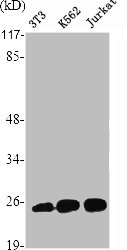
RAN AntibodyCSB-PA003935
ApplicationsWestern Blot, ELISA, ImmunoHistoChemistry
ReactivityHuman, Mouse, Rat
TargetRAN
- SizePrice
Product group Antibodies

Goat anti-RANEB06419
ApplicationsWestern Blot, ELISA, ImmunoHistoChemistry
ReactivityBovine, Canine, Human, Mouse, Rat
TargetRAN
- SizePrice
Product group Antibodies

Ran Polyclonal AntibodyCAC10637
ApplicationsWestern Blot, ELISA, ImmunoHistoChemistry
TargetRAN
- SizePrice
Product group Antibodies

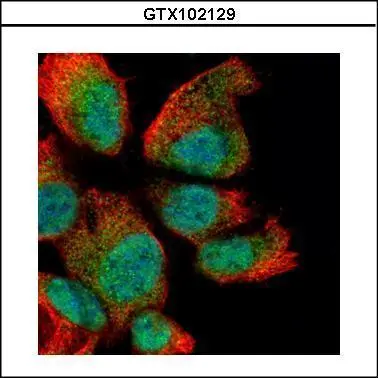
RAN antibodyGTX102129
ApplicationsImmunoFluorescence, ImmunoCytoChemistry
ReactivityHuman
TargetRAN
- SizePrice