

Anti-SIRT6 Antibody
R1511-1

ApplicationsFlow Cytometry, ImmunoFluorescence, Western Blot
Product group Antibodies
ReactivityHuman, Mouse
TargetSIRT6
Overview
- SupplierHUABIO
- Product NameAnti-SIRT6 Antibody
- Delivery Days Customer7
- ApplicationsFlow Cytometry, ImmunoFluorescence, Western Blot
- Applications SupplierWB,IHC-P,FC
- CertificationResearch Use Only
- ClonalityPolyclonal
- Concentration1 mg/ml
- ConjugateUnconjugated
- Gene ID51548
- Target nameSIRT6
- Target descriptionsirtuin 6
- Target synonymsSIR2L6, hSIRT6, NAD-dependent protein deacylase sirtuin-6, NAD-dependent protein deacetylase sirtuin-6, SIR2-like protein 6, protein mono-ADP-ribosyltransferase sirtuin-6, regulatory protein SIR2 homolog 6, sir2-related protein type 6, sirtuin type 6
- HostRabbit
- IsotypeIgG
- Protein IDQ8N6T7
- Protein NameNAD-dependent protein deacylase sirtuin-6
- Scientific DescriptionThe Silent Information Regulator (Sir2) family of genes is a highly conserved group of genes that encode nicotinamide adenine dinucleotide (NAD)-dependent protein deacetylases, also known as class III histone deacetylases. The first discovered and best characterized of this family is Saccharomyces cerevisiae Sir2, which is involved in silencing of mating type loci, telomere maintenance, DNA damage response, and cell aging. SirT6, a mammalian homolog of Sir2, is a nuclear, chromatin-associated protein that promotes the normal maintenance of genome integrity mediated by the base excision repair (BER) pathway. The BER pathway repairs single-stranded DNA lesions that arise spontaneously from endogenous alkylation, oxidation, and deamination events. SirT6 deficient mice show increased sensitivity to DNA-damaging agents, including the alkylating agents MMS and H2O2. In addition, these mice show genome instability with increased frequency of fragmented chromosomes, detached centromeres, and gaps. SirT6 may regulate the BER pathway by deacetylating DNA Polbeta or other core components of the pathway.
- ReactivityHuman, Mouse
- Reactivity SupplierHuman,Mouse
- Storage Instruction-20°C,2°C to 8°C
- UNSPSC41116161
Datasheet
Related products


Product group Antibodies

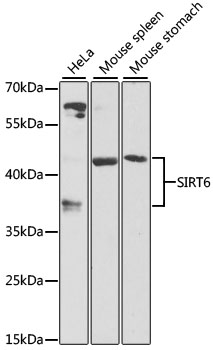
Anti-SIRT6 Antibody Picoband(r)A00611-3-CARRIER-FREE
ApplicationsFlow Cytometry, ImmunoFluorescence, Western Blot, ELISA, ImmunoCytoChemistry
ReactivityHuman
TargetSIRT6
- SizePrice
Product group Antibodies

Anti-SIRT6 AntibodyA12116
ApplicationsWestern Blot
ReactivityHuman, Mouse
- SizePrice


Product group Antibodies

SIRT6 AntibodyCSB-PA113703
ApplicationsWestern Blot, ELISA
ReactivityHuman, Mouse
TargetSIRT6
- SizePrice

Product group Antibodies

Anti-SIRT6 AntibodyHPA049729
ApplicationsImmunoCytoChemistry
ReactivityHuman
TargetSIRT6
- SizePrice
Product group Antibodies

SIRT6 / Sirtuin 6 AntibodyLS-C349129
ApplicationsWestern Blot, ImmunoHistoChemistry
ReactivityHuman, Mouse
TargetSIRT6
- SizePrice
Product group Antibodies

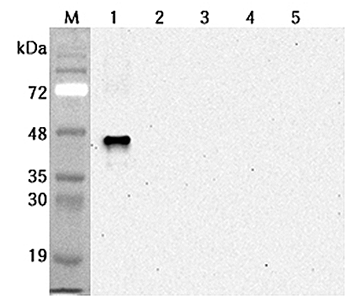
anti-Sirtuin 6 (human), mAb (S6R82-2)AG-20A-0091
ApplicationsWestern Blot, ELISA
ReactivityHuman
TargetSIRT6
- SizePrice
Product group Antibodies

ApplicationsImmunoPrecipitation, Western Blot, ImmunoCytoChemistry, ImmunoHistoChemistry
TargetSIRT6
- SizePrice
Product group Antibodies

SIRT6 Polyclonal AntibodyBS-4174R
ApplicationsImmunoFluorescence, Western Blot, ImmunoCytoChemistry, ImmunoHistoChemistry, ImmunoHistoChemistry Frozen, ImmunoHistoChemistry Paraffin
ReactivityHuman, Mouse, Rat
TargetSIRT6
- SizePrice