

Anti-SSRP1 Antibody
ER1901-13

ApplicationsFlow Cytometry, Western Blot, ImmunoHistoChemistry, ImmunoHistoChemistry Paraffin
Product group Antibodies
ReactivityHuman, Mouse, Rat
TargetSSRP1
Overview
- SupplierHUABIO
- Product NameAnti-SSRP1 Antibody
- Delivery Days Customer7
- ApplicationsFlow Cytometry, Western Blot, ImmunoHistoChemistry, ImmunoHistoChemistry Paraffin
- Applications SupplierWB,IHC-P,FC
- CertificationResearch Use Only
- ClonalityPolyclonal
- Concentration1 mg/ml
- ConjugateUnconjugated
- Gene ID6749
- Target nameSSRP1
- Target descriptionstructure specific recognition protein 1
- Target synonymsFACT, FACT80, T160, FACT complex subunit SSRP1, FACT 80 kDa subunit, FACTp80, chromatin-specific transcription elongation factor 80 kDa subunit, cisplatin-DNA SSRP, facilitates chromatin remodeling 80 kDa subunit, facilitates chromatin transcription complex 80 kDa subunit, facilitates chromatin transcription complex subunit SSRP1, hSSRP1, high mobility group box, recombination signal sequence recognition protein 1
- HostRabbit
- IsotypeIgG
- Protein IDQ04931
- Protein NameFACT complex subunit SSRP1
- Scientific DescriptionComponent of the FACT complex, a general chromatin factor that acts to reorganize nucleosomes. The FACT complex is involved in multiple processes that require DNA as a template such as mRNA elongation, DNA replication and DNA repair. During transcription elongation the FACT complex acts as a histone chaperone that both destabilizes and restores nucleosomal structure. It facilitates the passage of RNA polymerase II and transcription by promoting the dissociation of one histone H2A-H2B dimer from the nucleosome, then subsequently promotes the reestablishment of the nucleosome following the passage of RNA polymerase II. The FACT complex is probably also involved in phosphorylation of Ser-392 of p53/TP53 via its association with CK2 (casein kinase II). Binds specifically to double-stranded DNA and at low levels to DNA modified by the antitumor agent cisplatin. May potentiate cisplatin-induced cell death by blocking replication and repair of modified DNA. Also acts as a transcriptional coactivator for p63/TP63.
- ReactivityHuman, Mouse, Rat
- Reactivity SupplierHuman,Mouse,Rat
- Storage Instruction-20°C,2°C to 8°C
- UNSPSC41116161
Datasheet
Related products
Product group Antibodies

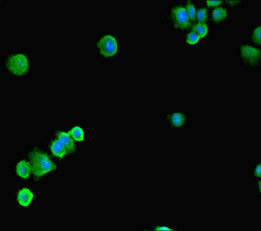
SSRP1 AntibodyCSB-PA022721LA01HU
ApplicationsImmunoFluorescence, Western Blot, ELISA
ReactivityHuman
TargetSSRP1
- SizePrice

Product group Antibodies

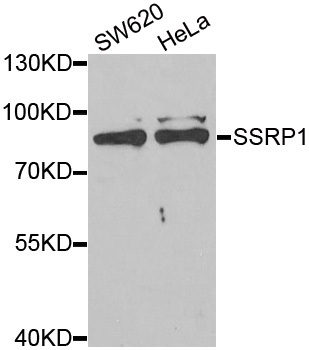
Anti-SSRP1 AntibodyA31364
ApplicationsWestern Blot, ImmunoHistoChemistry
ReactivityHuman, Mouse, Rat
- SizePrice

Product group Antibodies

Anti-SSRP1 Antibody Picoband(r)A02606-1-CARRIER-FREE
ApplicationsFlow Cytometry, ImmunoFluorescence, Western Blot, ELISA, ImmunoCytoChemistry, ImmunoHistoChemistry
ReactivityHuman, Monkey, Mouse, Rat
TargetSSRP1
- SizePrice
Product group Antibodies

FACT / SSRP1 AntibodyLS-C748677
ApplicationsImmunoFluorescence, Western Blot, ImmunoHistoChemistry
ReactivityHuman
TargetSSRP1
- SizePrice

Product group Antibodies

Anti-SSRP1-25ulHPA002697
ApplicationsWestern Blot, ImmunoHistoChemistry
ReactivityHuman
- SizePrice
Product group Antibodies

SSRP1 Polyclonal AntibodyCAC14549
ApplicationsImmunoFluorescence, Western Blot, ELISA
TargetSSRP1
- SizePrice
![Various whole cell extracts (30 μg) were separated by 7.5% SDS-PAGE, and the membrane was blotted with SSRP1 antibody [N1N3] (GTX111816) diluted at 1:1000. The HRP-conjugated anti-rabbit IgG antibody (GTX213110-01) was used to detect the primary antibody.](https://www.genetex.com/upload/website/prouct_img/normal/GTX111816/GTX111816_40079_20160922_WB_w_23060500_146.webp)
Product group Antibodies

SSRP1 antibody [N1N3]GTX111816
ApplicationsImmunoPrecipitation, Western Blot, ImmunoHistoChemistry, ImmunoHistoChemistry Paraffin
ReactivityHuman
TargetSSRP1
- SizePrice
Product group Antibodies

Anti-SSRP1 Antibody144-06413
ApplicationsImmunoFluorescence, Western Blot, ImmunoHistoChemistry
ReactivityHuman, Mouse
TargetSSRP1
- SizePrice