

Anti-STAT1 Antibody
R1408-2

ApplicationsImmunoFluorescence, Western Blot
Product group Antibodies
ReactivityHuman, Mouse, Rat
TargetSTAT1
Overview
- SupplierHUABIO
- Product NameAnti-STAT1 Antibody
- Delivery Days Customer7
- ApplicationsImmunoFluorescence, Western Blot
- Applications SupplierWB,IF-Cell
- CertificationResearch Use Only
- ClonalityPolyclonal
- Concentration1 mg/ml
- ConjugateUnconjugated
- Gene ID6772
- Target nameSTAT1
- Target descriptionsignal transducer and activator of transcription 1
- Target synonymsCANDF7, IMD31A, IMD31B, IMD31C, ISGF-3, STAT91, signal transducer and activator of transcription 1-alpha/beta, signal transducer and activator of transcription 1, 91kD, signal transducer and activator of transcription 1, 91kDa, transcription factor ISGF-3 components p91/p84
- HostRabbit
- IsotypeIgG
- Protein IDP42224
- Protein NameSignal transducer and activator of transcription 1-alpha/beta
- Scientific DescriptionAll STAT molecules are phosphorylated by receptor associated kinases, that causes activation, dimerization by forming homo- or heterodimers and finally translocate to nucleus to work as transcription factors. Specifically STAT1 can be activated by several ligands such as Interferon alpha (IFNalpha), Interferon gamma (IFNgamma), Epidermal Growth Factor (EGF), Platelet Derived Growth Factor (PDGF), Interleukin 6 (IL-6), or IL-27. Type I interferons (IFN-alpha, IFN-beta) bind to receptors, cause signaling via kinases, phosphorylate and activate the Jak kinases TYK2 and JAK1 and also STAT1 and STAT2. STAT molecules form dimers and bind to ISGF3G/IRF-9, which is Interferon stimulated gene factor 3 complex with Interferon regulatory Factor 9. This allows STAT1 to enter the nucleus.[6] STAT1 has a key role in many gene expressions that cause survival of the cell, viability or pathogen response. There are two possible transcripts (due to alternative splicing) that encode 2 isoforms of STAT1. STAT1alpha, the full-length version of the protein, is the main active isoform, responsible for most of the known functions of STAT1. STAT1beta, which lacks a portion of the C-terminus of the protein, is less-studied, but has variously been reported to negatively regulate activation of STAT1 or to mediate IFN-gamma-dependent anti-tumor and anti-infection activities. STAT1 is involved in upregulating genes due to a signal by either type I, type II, or type III interferons. In response to IFN-gamma stimulation, STAT1 forms homodimers or heterodimers with STAT3 that bind to the GAS (Interferon-Gamma-Activated Sequence) promoter element; in response to either IFN-alpha or IFN-beta stimulation, STAT1 forms a heterodimer with STAT2 that can bind the ISRE (Interferon-Stimulated Response Element) promoter element. In either case, binding of the promoter element leads to an increased expression of ISG (Interferon-Stimulated Genes). Expression of STAT1 can be induced with diallyl disulfide, a compound in garlic.
- ReactivityHuman, Mouse, Rat
- Reactivity SupplierHuman,Mouse,Rat
- Storage Instruction-20°C,2°C to 8°C
- UNSPSC41116161
Datasheet
Related products

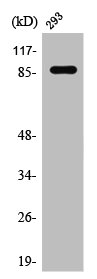
Product group Antibodies

STAT1 AntibodyCSB-PA004167
ApplicationsWestern Blot, ELISA, ImmunoHistoChemistry
ReactivityHuman, Mouse, Rat
TargetSTAT1
- SizePrice

Product group Antibodies

Anti-STAT1 Antibody Picoband(r)A00036-2-CARRIER-FREE
ApplicationsFlow Cytometry, ImmunoFluorescence, Western Blot, ImmunoCytoChemistry, ImmunoHistoChemistry
ReactivityHuman
TargetSTAT1
- SizePrice
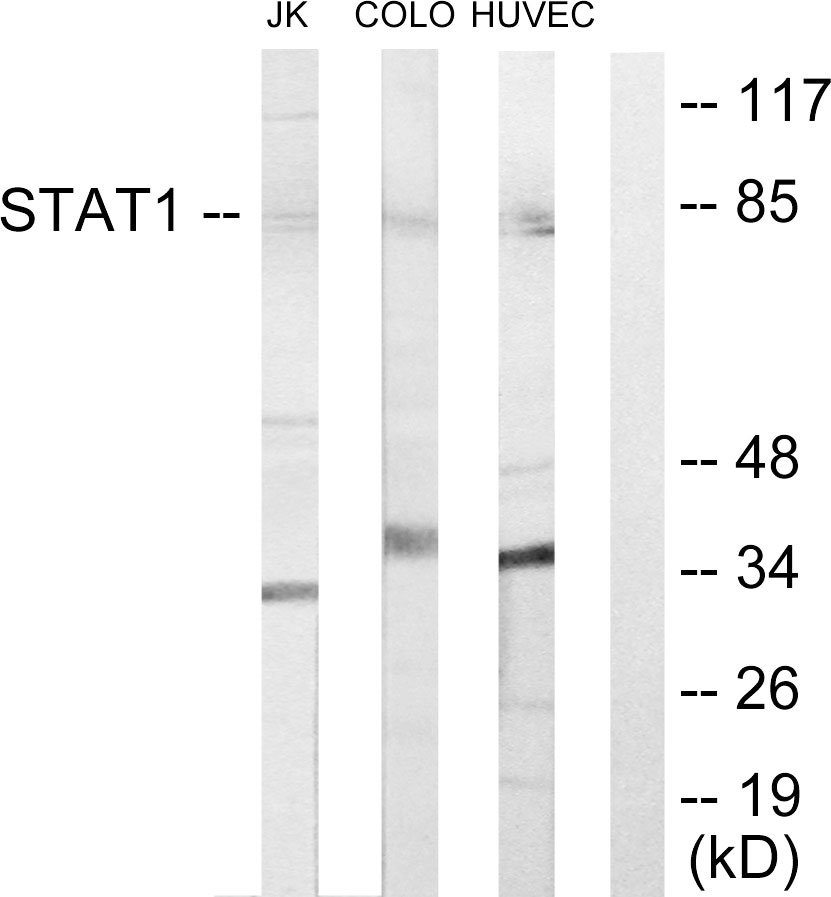
Product group Antibodies

Anti-STAT1 AntibodyA100762
ApplicationsWestern Blot, ELISA
ReactivityHuman
- SizePrice
Product group Antibodies

Anti-STAT1 [AbAb1-STAT1]AB04098-10.0
ApplicationsELISA
ReactivityHuman
TargetSTAT1
- SizePrice
Product group Antibodies

STAT1 Antibody (Tyr701)LS-C769543
ApplicationsImmunoFluorescence, Western Blot, ELISA, ImmunoHistoChemistry, ImmunoHistoChemistry Paraffin
ReactivityHuman, Monkey, Mouse, Rat
TargetSTAT1
- SizePrice

Product group Antibodies

Anti-STAT1 AntibodyHPA000931
ApplicationsWestern Blot, ImmunoCytoChemistry, ImmunoHistoChemistry
ReactivityHuman
TargetSTAT1
- SizePrice
Product group Antibodies

STAT1 Polyclonal AntibodyCAC15929
ApplicationsImmunoPrecipitation, Western Blot, ImmunoHistoChemistry
ReactivityMouse, Primate, Rat
TargetSTAT1
- SizePrice
Product group Antibodies

Anti-STAT1Y158012
ApplicationsWestern Blot, ELISA, ImmunoHistoChemistry
ReactivityHuman, Mouse, Rat
- SizePrice
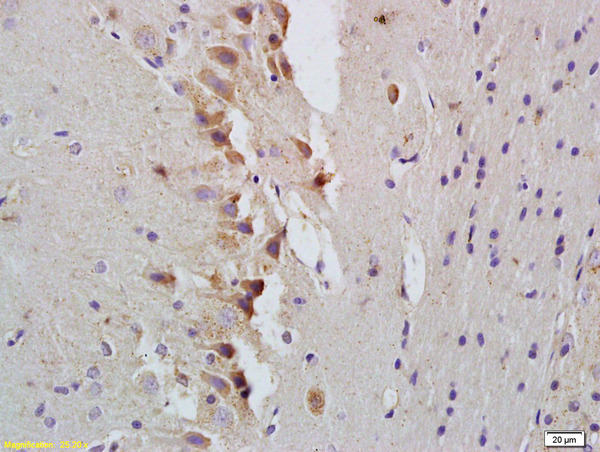
Product group Antibodies
References

STAT1 Polyclonal AntibodyBS-1317R
ApplicationsImmunoFluorescence, Western Blot, ELISA, ImmunoCytoChemistry, ImmunoHistoChemistry, ImmunoHistoChemistry Frozen, ImmunoHistoChemistry Paraffin
ReactivityBovine, Canine, Equine, Human, Mouse, Porcine, Rat, Sheep
TargetSTAT1
- SizePrice