

Anti-TNFAIP3 Antibody
ER1706-32

ApplicationsFlow Cytometry, ImmunoFluorescence, Western Blot, ImmunoHistoChemistry, ImmunoHistoChemistry Paraffin
Product group Antibodies
ReactivityHuman, Mouse, Rat
TargetTNFAIP3
Overview
- SupplierHUABIO
- Product NameAnti-TNFAIP3 Antibody
- Delivery Days Customer7
- ApplicationsFlow Cytometry, ImmunoFluorescence, Western Blot, ImmunoHistoChemistry, ImmunoHistoChemistry Paraffin
- Applications SupplierWB,IF-Cell,IHC-P,FC
- CertificationResearch Use Only
- ClonalityPolyclonal
- Concentration1 mg/ml
- ConjugateUnconjugated
- Gene ID7128
- Target nameTNFAIP3
- Target descriptionTNF alpha induced protein 3
- Target synonymsA20, AIFBL1, AISBL, OTUD7C, TNFA1P2, tumor necrosis factor alpha-induced protein 3, OTU domain-containing protein 7C, putative DNA-binding protein A20, tumor necrosis factor inducible protein A20, tumor necrosis factor, alpha induced protein 3, zinc finger protein A20
- HostRabbit
- IsotypeIgG
- Protein IDM0R7V5
- Protein NameTumor necrosis factor alpha-induced protein 3
- Scientific DescriptionA20 is a Cys2/Cys2 zinc finger protein that is induced by a variety of inflammatory stimuli and regulates gene expression. Specifically, A20 is induced by tumor necrosis factor (TNF) and interleukin 1 (IL-1), and acts as a negative regulator of nuclear factor kappa B (NFkappaB) gene expression. By inhibiting NFkappaB activation, A20 plays a critical role in terminating NFkappaB responses to various stimuli. Although the C-terminal region of A20 contains seven zinc finger domains, only four of these domains are required for in vitro inhibition of TNF-induced NFkappaB activation. A20 also interacts with several other proteins, such as TRAF2, TRAF6 and IkB kinase (IKK) gamma protein, and can thereby inhibit cell death. TXBP151, a novel A20-binding protein, may mediate the anti-apoptotic activity of A20. Involved in the negative feedback regulation of signal transduction, A20 and A20-binding proteins may be useful as novel therapeutic tools in the treatment of a variety of diseases.
- ReactivityHuman, Mouse, Rat
- Reactivity SupplierHuman,Mouse,Rat
- Storage Instruction-20°C,2°C to 8°C
- UNSPSC41116161
Datasheet
Related products

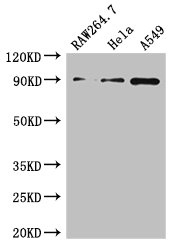
Product group Antibodies

TNFAIP3 AntibodyCSB-PA023958LA01HU
ApplicationsImmunoFluorescence, Western Blot, ELISA
ReactivityHuman, Mouse
TargetTNFAIP3
- SizePrice
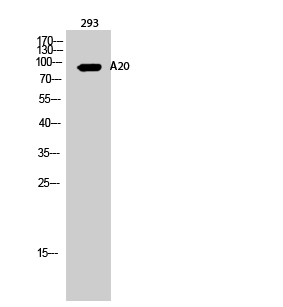
Product group Antibodies

Anti-A20 AntibodyA39263
ApplicationsImmunoFluorescence, Western Blot, ELISA
ReactivityHuman, Mouse
- SizePrice
Product group Antibodies

TNFAIP3 / A20 AntibodyLS-C748675
ApplicationsImmunoFluorescence, Western Blot
ReactivityHuman, Rat
TargetTNFAIP3
- SizePrice

Product group Antibodies

ApplicationsFlow Cytometry, ImmunoFluorescence, Western Blot, ImmunoCytoChemistry, ImmunoHistoChemistry
ReactivityHuman
TargetTNFAIP3
- SizePrice

Product group Antibodies

Anti-TNFAIP3 AntibodyHPA002116
ApplicationsImmunoHistoChemistry
ReactivityHuman
TargetTNFAIP3
- SizePrice
Product group Antibodies

TNFAIP3 Polyclonal AntibodyCAC13227
ApplicationsImmunoFluorescence, Western Blot, ELISA
ReactivityMouse
TargetTNFAIP3
- SizePrice
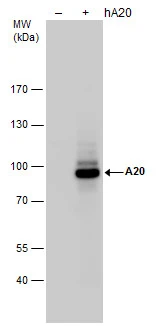
Product group Antibodies

TNFAIP3 antibodyGTX113027
ApplicationsWestern Blot
ReactivityHuman
TargetTNFAIP3
- SizePrice
Product group Antibodies

TNFAIP3 Recombinant Antibody, Biotin ConjugatedBSM-61300R-BIOTIN
ApplicationsWestern Blot, ImmunoHistoChemistry, ImmunoHistoChemistry Frozen, ImmunoHistoChemistry Paraffin
TargetTNFAIP3
- SizePrice
Product group Antibodies

Anti-TNFAIP3 Antibody144-02127
ApplicationsWestern Blot
ReactivityHuman, Mouse
TargetTNFAIP3
- SizePrice