

anti-Ubiquitin (linkage-specific K63) antibody
ARG40604

ApplicationsFlow Cytometry, ImmunoFluorescence, Western Blot, ImmunoCytoChemistry, ImmunoHistoChemistry, ImmunoHistoChemistry Paraffin
Product group Antibodies
ReactivityHuman
TargetUBB
Overview
- SupplierArigo Biolaboratories
- Product Nameanti-Ubiquitin (linkage-specific K63) antibody
- Delivery Days Customer23
- Application Supplier Note* The dilutions indicate recommended starting dilutions and the optimal dilutions or concentrations should be determined by the scientist.
- ApplicationsFlow Cytometry, ImmunoFluorescence, Western Blot, ImmunoCytoChemistry, ImmunoHistoChemistry, ImmunoHistoChemistry Paraffin
- CertificationResearch Use Only
- ClonalityPolyclonal
- ConjugateUnconjugated
- Gene ID7314
- Target nameUBB
- Target descriptionubiquitin B
- Target synonymsHEL-S-50, polyubiquitin-B, epididymis secretory protein Li 50, polyubiquitin B
- HostRabbit
- IsotypeIgG
- Protein IDP0CG47
- Protein NamePolyubiquitin-B
- Scientific DescriptionThis gene encodes ubiquitin, one of the most conserved proteins known. Ubiquitin has a major role in targeting cellular proteins for degradation by the 26S proteosome. It is also involved in the maintenance of chromatin structure, the regulation of gene expression, and the stress response. Ubiquitin is synthesized as a precursor protein consisting of either polyubiquitin chains or a single ubiquitin moiety fused to an unrelated protein. This gene consists of three direct repeats of the ubiquitin coding sequence with no spacer sequence. Consequently, the protein is expressed as a polyubiquitin precursor with a final amino acid after the last repeat. An aberrant form of this protein has been detected in patients with Alzheimers disease and Down syndrome. Pseudogenes of this gene are located on chromosomes 1, 2, 13, and 17. Alternative splicing results in multiple transcript variants. [provided by RefSeq, Aug 2013]
- ReactivityHuman
- Storage Instruction-20°C
- UNSPSC41116161
Related products

Product group Antibodies

ApplicationsImmunoPrecipitation, Western Blot, ImmunoCytoChemistry, ImmunoHistoChemistry
ReactivityBovine, Canine, Equine, Mouse, Porcine, Rabbit, Rat
TargetUBB
- SizePrice
Product group Antibodies

Anti-Ubiquitin Antibody144-61570
ApplicationsImmunoFluorescence, Western Blot
ReactivityHuman, Mouse
TargetUBB
- SizePrice

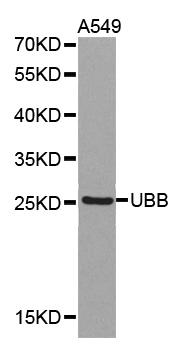
Product group Antibodies

Anti-UBB AntibodyA44357
ApplicationsWestern Blot
ReactivityHuman, Mouse, Rat
- SizePrice

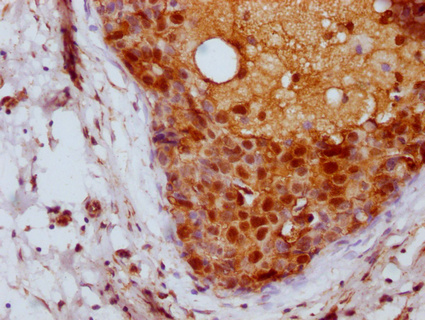
Product group Antibodies

UBB AntibodyCSB-PA04837A0RB
ApplicationsELISA, ImmunoHistoChemistry
ReactivityHuman
TargetUBB
- SizePrice

Product group Antibodies

Anti-UBB AntibodyHPA049132
ApplicationsWestern Blot, ImmunoHistoChemistry
ReactivityHuman
TargetUBB
- SizePrice
Product group Antibodies

UBB / Ubiquitin B AntibodyLS-C400429
ApplicationsWestern Blot, ELISA, ImmunoHistoChemistry
ReactivityHuman, Mouse, Rat
TargetUBB
- SizePrice

Product group Antibodies

Anti-Ubiquitin/UBB Antibody Picoband(r)PB9122-CARRIER-FREE
ApplicationsImmunoFluorescence, Western Blot, ImmunoCytoChemistry, ImmunoHistoChemistry
ReactivityBovine, Canine, Chicken, Drosophila, Equine, Hamster, Human, Monkey, Mouse, Rabbit, Rat
TargetUBB
- SizePrice