

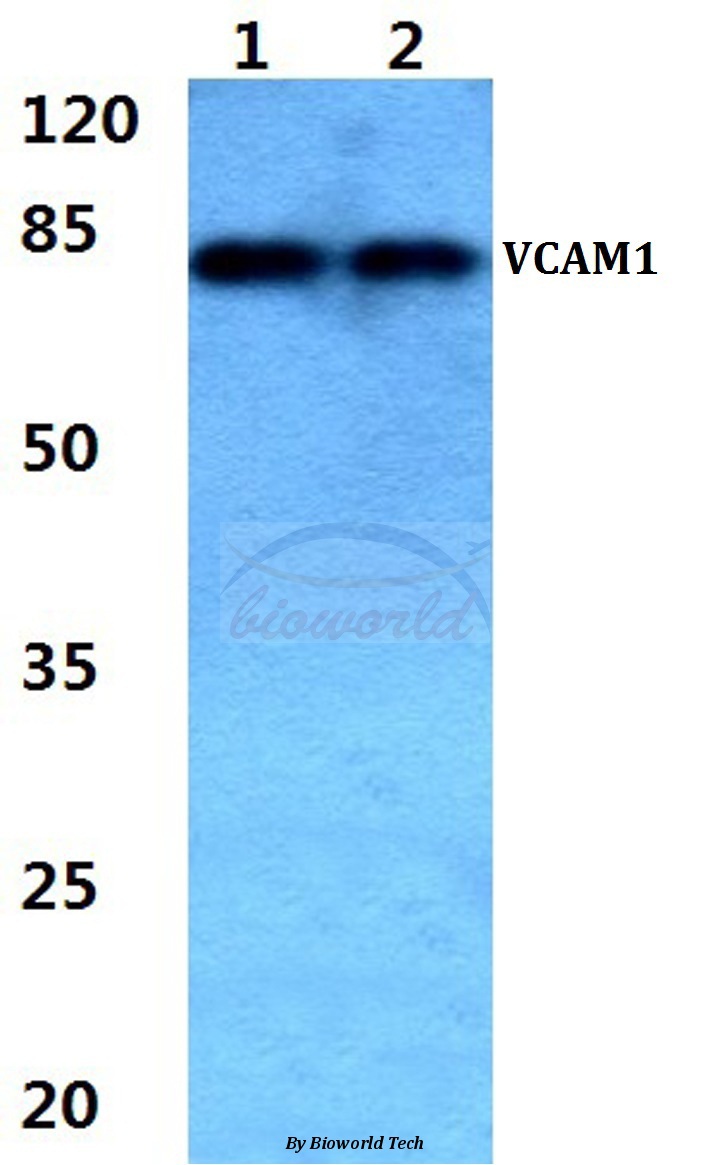
Anti-VCAM1 Antibody
R1512-13

ApplicationsFlow Cytometry, ImmunoFluorescence, Western Blot, ImmunoHistoChemistry, ImmunoHistoChemistry Paraffin
Product group Antibodies
ReactivityHuman
TargetVCAM1
Overview
- SupplierHUABIO
- Product NameAnti-VCAM1 Antibody
- Delivery Days Customer7
- ApplicationsFlow Cytometry, ImmunoFluorescence, Western Blot, ImmunoHistoChemistry, ImmunoHistoChemistry Paraffin
- Applications SupplierWB,IF-Cell,IHC-P,FC
- CertificationResearch Use Only
- ClonalityPolyclonal
- Concentration1 mg/ml
- ConjugateUnconjugated
- Gene ID7412
- Target nameVCAM1
- Target descriptionvascular cell adhesion molecule 1
- Target synonymsCD106, INCAM-100, vascular cell adhesion protein 1, CD106 antigen
- HostRabbit
- IsotypeIgG
- Protein IDP19320
- Protein NameVascular cell adhesion protein 1
- Scientific DescriptionCell adhesion molecules are a family of closely related cell surface glycoproteins involved in cell-cell interactions during growth and are thought to play an important role in embryogenesis and development. Neuronal cell adhesion molecule (NCAM) expression is observed in a variety of human tumors including neuroblastomas, rhabdomyosarcomas, Wilms tumors, Ewings sarcomas and some primitive myeloid malignancies. The intracellular adhesion molecule-1 (ICAM-1), also referred to as CD54, is an integral membrane protein of the immunoglobulin superfamily and recognizes the B2alpha1 and B2alphaM integrins. PECAM-1 (platelet/endothelial cell adhesion molecule-1), also referred to as CD31, is a glycoprotein expressed on the cell surfaces of monocytes, neutrophils, platelets and a subpopulation of T cells. VCAM-1 (vascular cell adhesion molecule-1) was first identified as an adhesion molecule induced on human endothelial cells by inflammatory cytokines such as IL-1, tumor necrosis factor (TNF) and lipopolysaccharide (LPS). The KALIG gene encodes a nerve cell adhesion molecule (NCAM) -like protein and is deleted in 66% of patients with Kallmanns syndrome, anosmia with secondary hypogonadism.
- ReactivityHuman
- Reactivity SupplierHuman
- Reactivity Supplier NoteMouse,Rat
- Storage Instruction-20°C,2°C to 8°C
- UNSPSC41116161
Datasheet
Related products

Product group Antibodies

VCAM1 AntibodyCSB-PA025809LA01HU
ApplicationsELISA
ReactivityHuman
TargetVCAM1
- SizePrice

Product group Antibodies

Anti-VCAM1 Antibody Picoband(r)A01199-1-CARRIER-FREE
ApplicationsWestern Blot, ELISA
ReactivityHuman
TargetVCAM1
- SizePrice
Product group Antibodies

Anti-CD106 [BB17 1], Human IgG1, kappaAB04271-10.0
ApplicationsFlow Cytometry
ReactivityHuman
TargetVCAM1
- SizePrice

Product group Antibodies

VCAM1 / CD106 Antibody (clone M/K-2.7)LS-C770028
ApplicationsImmunoFluorescence, Neutralisation/Blocking
ReactivityMouse
TargetVCAM1
- SizePrice
Product group Antibodies

Goat anti-VCAM1EB12031
ApplicationsWestern Blot, ELISA
ReactivityHuman
TargetVCAM1
- SizePrice

Product group Antibodies

Anti-VCAM1 AntibodyHPA034796
ApplicationsImmunoHistoChemistry
ReactivityHuman
TargetVCAM1
- SizePrice
Product group Antibodies

Mouse anti Human CD106MUB2049P
ApplicationsFlow Cytometry
ReactivityHuman
TargetVCAM1
- SizePrice
Product group Antibodies

ApplicationsImmunoPrecipitation, Western Blot, ImmunoCytoChemistry, ImmunoHistoChemistry
TargetVCAM1
- SizePrice