

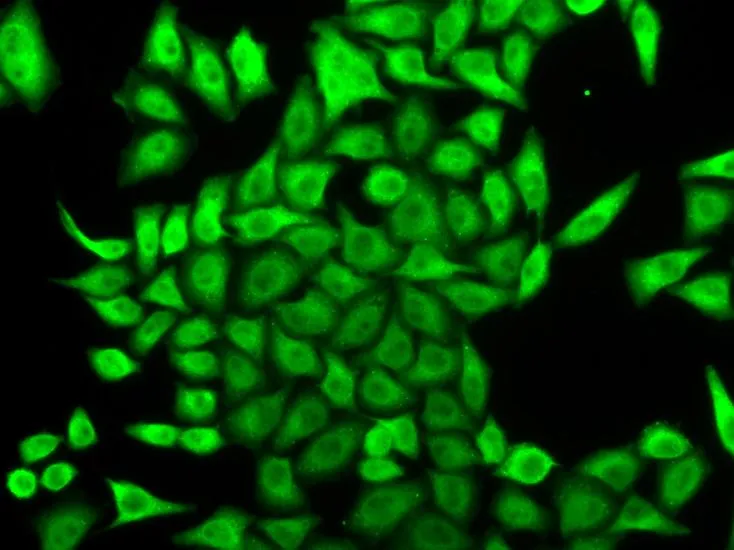
ICC/IF analysis of A549 cells using GTX30061 APRT antibody.
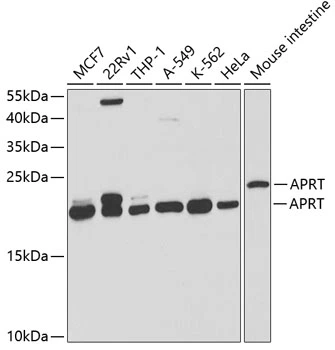
ICC/IF analysis of A549 cells using GTX30061 APRT antibody.
APRT antibody
GTX30061

ApplicationsImmunoFluorescence, Western Blot, ImmunoCytoChemistry
Product group Antibodies
ReactivityHuman, Mouse
TargetAPRT
Overview
- SupplierGeneTex
- Product NameAPRT antibody
- Delivery Days Customer7
- Application Supplier NoteWB: 1:500 - 1:2000. ICC/IF: 1:50 - 1:200. *Optimal dilutions/concentrations should be determined by the researcher.Not tested in other applications.
- ApplicationsImmunoFluorescence, Western Blot, ImmunoCytoChemistry
- CertificationResearch Use Only
- ClonalityPolyclonal
- ConjugateUnconjugated
- Gene ID353
- Target nameAPRT
- Target descriptionadenine phosphoribosyltransferase
- Target synonymsAMP, APRTD, adenine phosphoribosyltransferase, AMP diphosphorylase, AMP pyrophosphorylase, transphosphoribosidase
- HostRabbit
- IsotypeIgG
- Protein IDP07741
- Protein NameAdenine phosphoribosyltransferase
- Scientific DescriptionAdenine phosphoribosyltransferase belongs to the purine/pyrimidine phosphoribosyltransferase family. A conserved feature of this gene is the distribution of CpG dinucleotides. This enzyme catalyzes the formation of AMP and inorganic pyrophosphate from adenine and 5-phosphoribosyl-1-pyrophosphate (PRPP). It also produces adenine as a by-product of the polyamine biosynthesis pathway. A homozygous deficiency in this enzyme causes 2,8-dihydroxyadenine urolithiasis. Two transcript variants encoding different isoforms have been found for this gene. [provided by RefSeq, Jul 2008]
- ReactivityHuman, Mouse
- Storage Instruction-20°C or -80°C,2°C to 8°C
- UNSPSC41116161
Datasheet
Related products
Product group Antibodies

Anti-APRT AntibodyA30787
ApplicationsImmunoFluorescence, Western Blot, ImmunoHistoChemistry
ReactivityHuman, Mouse, Rat
- SizePrice

Product group Antibodies

Anti-APRT Antibody Picoband(r)A02721-CARRIER-FREE
ApplicationsFlow Cytometry, ImmunoFluorescence, Western Blot, ImmunoCytoChemistry
ReactivityHuman
TargetAPRT
- SizePrice
Product group Antibodies

Anti-APRT Antibody144-05456
ApplicationsImmunoFluorescence, Western Blot
ReactivityHuman, Mouse
TargetAPRT
- SizePrice
Product group Antibodies

APRT Antibody (aa1-180)LS-C748961
ApplicationsWestern Blot, ImmunoHistoChemistry
ReactivityHuman, Mouse, Rat
TargetAPRT
- SizePrice
Product group Antibodies

APRT AntibodyCSB-PA001954DSR2HU
ApplicationsELISA, ImmunoHistoChemistry
ReactivityHuman
TargetAPRT
- SizePrice
Product group Antibodies

ApplicationsImmunoPrecipitation, Western Blot, ImmunoCytoChemistry, ImmunoHistoChemistry
ReactivityRat
TargetAPRT
- SizePrice

Product group Antibodies

Anti-APRT-25ulHPA026681
ApplicationsWestern Blot, ImmunoCytoChemistry, ImmunoHistoChemistry
ReactivityHuman
- SizePrice
Product group Antibodies

Anti-APRT AntibodyCAB13946
ApplicationsImmunoFluorescence, Western Blot, ELISA, ImmunoCytoChemistry
ReactivityHuman
TargetAPRT
- SizePrice