

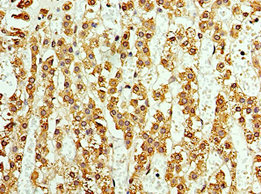
Immunohistochemistry of paraffin-embedded human adrenal gland tissue using CSB-PA002218ESR1HU at dilution of 1:100
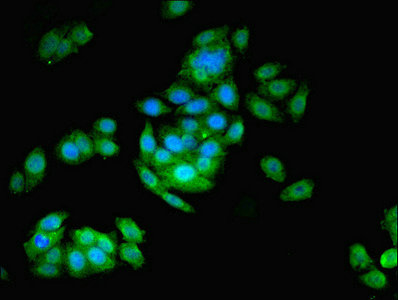
Immunohistochemistry of paraffin-embedded human adrenal gland tissue using CSB-PA002218ESR1HU at dilution of 1:100
ASNA1 Antibody
CSB-PA002218ESR1HU

ApplicationsImmunoFluorescence, ELISA, ImmunoHistoChemistry
Product group Antibodies
ReactivityHuman
TargetGET3
Overview
- SupplierCusabio
- Product NameASNA1 Antibody
- Delivery Days Customer20
- ApplicationsImmunoFluorescence, ELISA, ImmunoHistoChemistry
- CertificationResearch Use Only
- ClonalityPolyclonal
- ConjugateUnconjugated
- Gene ID439
- Target nameGET3
- Target descriptionguided entry of tail-anchored proteins factor 3, ATPase
- Target synonymsARSA-I, ARSA1, ASNA-I, ASNA1, CMD2H, TRC40, ATPase GET3, arsA arsenite transporter, ATP-binding, homolog 1, golgi to ER traffic 3 homolog, transmembrane domain recognition complex 40 kDa ATPase subunit
- HostRabbit
- IsotypeIgG
- Protein IDO43681
- Protein NameATPase GET3
- Scientific DescriptionATPase required for the post-translational delivery of tail-anchored (TA) proteins to the endoplasmic reticulum. Recognizes and selectively binds the transmembrane domain of TA proteins in the cytosol. This complex then targets to the endoplasmic reticulum by membrane-bound receptors, where the tail-anchored protein is released for insertion. This process is regulated by ATP binding and hydrolysis. ATP binding drives the homodimer towards the closed dimer state, facilitating recognition of newly synthesized TA membrane proteins. ATP hydrolysis is required for insertion. Subsequently, the homodimer reverts towards the open dimer state, lowering its affinity for the membrane-bound receptor, and returning it to the cytosol to initiate a new round of targeting (By similarity). May be involved in insulin signaling.
- ReactivityHuman
- Storage Instruction-20°C or -80°C
- UNSPSC41116161
Related products

Product group Antibodies

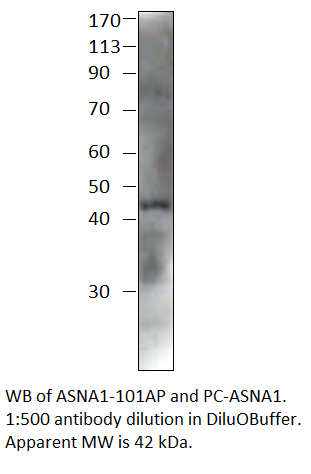
Anti-ASNA1 Antibody144-03746
ApplicationsWestern Blot, ImmunoHistoChemistry
ReactivityHuman, Mouse, Rat
TargetGET3
- SizePrice
Product group Antibodies

Anti-ASNA1 AntibodyA54640
ApplicationsImmunoPrecipitation, Western Blot, ELISA
ReactivityHuman, Mouse, Rat
- SizePrice
Product group Antibodies

ASNA1 AntibodyLS-C832507
ApplicationsELISA, ImmunoHistoChemistry
ReactivityHuman, Mouse
TargetGET3
- SizePrice
Product group Antibodies

ASNA1 Polyclonal AntibodyBS-7972R
ApplicationsImmunoFluorescence, ELISA, ImmunoCytoChemistry, ImmunoHistoChemistry, ImmunoHistoChemistry Frozen, ImmunoHistoChemistry Paraffin
ReactivityChicken, Equine, Human, Mouse, Rat, Sheep
TargetGET3
- SizePrice
Product group Antibodies
References

Goat anti-ASNA1EB08488
ApplicationsWestern Blot, ELISA
ReactivityBovine, Human, Mouse, Rat
TargetGET3
- SizePrice

Product group Antibodies

Anti-ASNA1 AntibodyHPA045951
ApplicationsWestern Blot, ImmunoCytoChemistry, ImmunoHistoChemistry
ReactivityHuman
TargetGET3
- SizePrice
Product group Antibodies

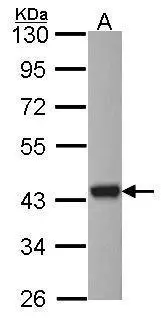
ASNA1 antibodyGTX114268
ApplicationsImmunoFluorescence, Western Blot, ImmunoCytoChemistry, ImmunoHistoChemistry, ImmunoHistoChemistry Paraffin
ReactivityHuman, Mouse
TargetGET3
- SizePrice
Product group Antibodies

Anti-ASNA1 AntibodyCAB3746
ApplicationsImmunoFluorescence, Western Blot, ELISA, ImmunoCytoChemistry
ReactivityHuman
TargetGET3
- SizePrice