

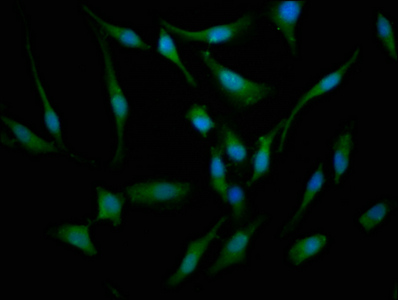
Immunofluorescence staining of Hela cells with CSB-PA814219LA01HU at 1:133, counter-stained with DAPI. The cells were fixed in 4% formaldehyde, permeabilized using 0.2% Triton X-100 and blocked in 10% normal Goat Serum. The cells were then incubated with the antibody overnight at 4°C. The secondary antibody was Alexa Fluor 488-congugated AffiniPure Goat Anti-Rabbit IgG(H+L).
Immunofluorescence staining of Hela cells with CSB-PA814219LA01HU at 1:133, counter-stained with DAPI. The cells were fixed in 4% formaldehyde, permeabilized using 0.2% Triton X-100 and blocked in 10% normal Goat Serum. The cells were then incubated with the antibody overnight at 4°C. The secondary antibody was Alexa Fluor 488-congugated AffiniPure Goat Anti-Rabbit IgG(H+L).
BBS7 Antibody
CSB-PA814219LA01HU

ApplicationsImmunoFluorescence, ELISA
Product group Antibodies
ReactivityHuman
TargetBBS7
Overview
- SupplierCusabio
- Product NameBBS7 Antibody
- Delivery Days Customer20
- ApplicationsImmunoFluorescence, ELISA
- CertificationResearch Use Only
- ClonalityPolyclonal
- ConjugateUnconjugated
- Gene ID55212
- Target nameBBS7
- Target descriptionBardet-Biedl syndrome 7
- Target synonymsBBS2L1, BBSome complex member BBS7, BBS2-like 1, Bardet-Biedl syndrome 7 protein
- HostRabbit
- IsotypeIgG
- Protein IDQ8IWZ6
- Protein NameBBSome complex member BBS7
- Scientific DescriptionThe BBSome complex is thought to function as a coat complex required for sorting of specific membrane proteins to the primary cilia. The BBSome complex is required for ciliogenesis but is dispensable for centriolar satellite function. This ciliogenic function is mediated in part by the Rab8 GDP/GTP exchange factor, which localizes to the basal body and contacts the BBSome. Rab8(GTP) enters the primary cilium and promotes extension of the ciliary membrane. Firstly the BBSome associates with the ciliary membrane and binds to RAB3IP/Rabin8, the guanosyl exchange factor (GEF) for Rab8 and then the Rab8-GTP localizes to the cilium and promotes docking and fusion of carrier vesicles to the base of the ciliary membrane. The BBSome complex, together with the LTZL1, controls SMO ciliary trafficking and contributes to the sonic hedgehog (SHH) pathway regulation. Required for proper BBSome complex assembly and its ciliary localization.
- ReactivityHuman
- Storage Instruction-20°C or -80°C
- UNSPSC41116161
Related products
Product group Antibodies

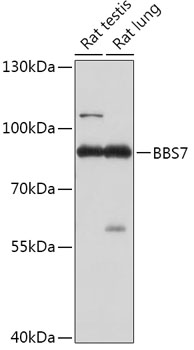
Anti-BBS7 AntibodyA307144
ApplicationsImmunoFluorescence, Western Blot, ImmunoCytoChemistry, ImmunoHistoChemistry
ReactivityHuman, Mouse, Rat
- SizePrice

Product group Antibodies

Anti-BBS7 Antibody144-65107
ApplicationsImmunoFluorescence, Western Blot, ImmunoHistoChemistry
ReactivityHuman, Mouse, Rat
TargetBBS7
- SizePrice
Product group Antibodies

BBS7 AntibodyLS-C673903
ApplicationsImmunoFluorescence, ELISA
ReactivityHuman
TargetBBS7
- SizePrice
Product group Antibodies

Goat anti-BBS7EB09989
ApplicationsWestern Blot, ELISA
ReactivityBovine, Canine, Human, Mouse, Rat
TargetBBS7
- SizePrice

Product group Antibodies

Anti-BBS7 AntibodyHPA044592
ApplicationsWestern Blot, ImmunoHistoChemistry
ReactivityHuman
TargetBBS7
- SizePrice
Product group Antibodies

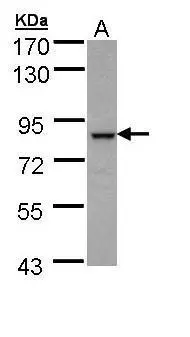
BBS7 antibody [N3C2], InternalGTX109780
ApplicationsWestern Blot
ReactivityHuman, Mouse
TargetBBS7
- SizePrice