

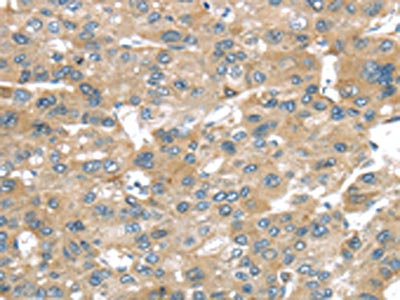
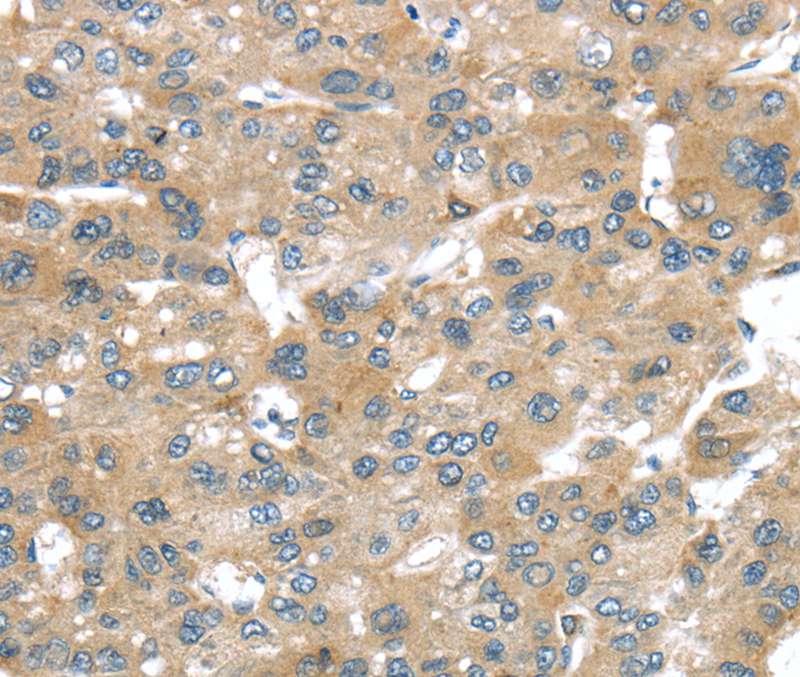
The image on the left is immunohistochemistry of paraffin-embedded Human liver cancer tissue using CSB-PA175261(BRWD1 Antibody) at dilution 1/25, on the right is treated with synthetic peptide. (Original magnification: x200)
The image on the left is immunohistochemistry of paraffin-embedded Human liver cancer tissue using CSB-PA175261(BRWD1 Antibody) at dilution 1/25, on the right is treated with synthetic peptide. (Original magnification: x200)
BRWD1 Antibody
CSB-PA175261

ApplicationsELISA, ImmunoHistoChemistry
Product group Antibodies
ReactivityHuman, Mouse
TargetBRWD1
Overview
- SupplierCusabio
- Product NameBRWD1 Antibody
- Delivery Days Customer20
- ApplicationsELISA, ImmunoHistoChemistry
- CertificationResearch Use Only
- ClonalityPolyclonal
- ConjugateUnconjugated
- Gene ID54014
- Target nameBRWD1
- Target descriptionbromodomain and WD repeat domain containing 1
- Target synonymsC21orf107, CILD51, DCAF19, N143, WDR9, WRD9, bromodomain and WD repeat-containing protein 1, WD repeat protein WDR9-form2, WD repeat-containing protein 9, transcriptional unit N143
- HostRabbit
- IsotypeIgG
- Protein IDQ9NSI6
- Protein NameBromodomain and WD repeat-containing protein 1
- Scientific DescriptionThis gene encodes a member of the WD repeat protein family. WD repeats are minimally conserved regions of approximately 40 amino acids typically bracketed by gly-his and trp-asp (GH-WD) residues which may facilitate formation of heterotrimeric or multiprotein complexes. Members of this family are involved in a variety of cellular processes including cell cycle progression, signal transduction, apoptosis, and gene regulation. This protein contains 2 bromodomains and multiple WD repeats. This gene is located within the Down syndrome region-2 on chromosome 21. Alternative splicing of this gene generates multiple transcript variants encoding distinct isoforms. In mouse, this gene encodes a nuclear protein that has a polyglutamine-containing region that functions as a transcriptional activation domain which may regulate chromatin remodelling and associates with a component of the SWI/SNF chromatin remodelling complex.
- ReactivityHuman, Mouse
- Storage Instruction-20°C or -80°C
- UNSPSC41116161
Related products
Product group Antibodies

Anti-BRWD1 [RAB-C529]Ab01748-1.1
ApplicationsFlow Cytometry, ImmunoFluorescence
ReactivityHuman
TargetBRWD1
- SizePrice
Product group Antibodies

Anti-BRWD1 Antibody144-12656
ApplicationsWestern Blot
ReactivityHuman, Mouse
TargetBRWD1
- SizePrice

Product group Antibodies

Anti-BRWD1 AntibodyA46386
ApplicationsImmunoHistoChemistry
ReactivityHuman
- SizePrice

Product group Antibodies

WDR9.3 antibodyGTX17907
ApplicationsWestern Blot
ReactivityHuman
TargetBRWD1
- SizePrice
Product group Antibodies

ApplicationsELISA
ReactivityHuman
TargetBRWD1
- SizePrice

Product group Antibodies

Anti-BRWD1 AntibodyA08703
ApplicationsWestern Blot
ReactivityHuman, Mouse
TargetBRWD1
- SizePrice
Product group Antibodies

WDR9 / BRWD1 AntibodyLS-C747747
ApplicationsWestern Blot
ReactivityHuman, Mouse
TargetBRWD1
- SizePrice

Product group Antibodies

Anti-BRWD1 AntibodyHPA030943
ApplicationsImmunoHistoChemistry
ReactivityHuman
TargetBRWD1
- SizePrice