

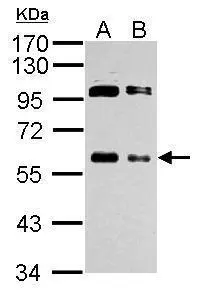
Sample (whole cell lysate) A: 293T 20ug B: 293T 10ug 10% SDS PAGE GTX103436 diluted at 1:1000 The HRP-conjugated anti-rabbit IgG antibody (GTX213110-01) was used to detect the primary antibody.
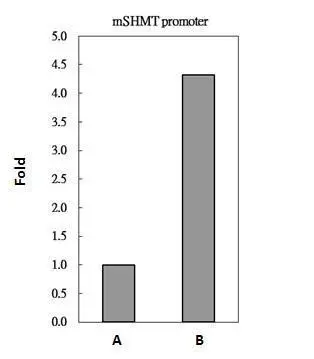
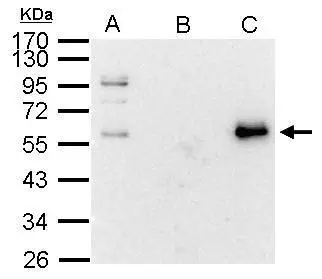
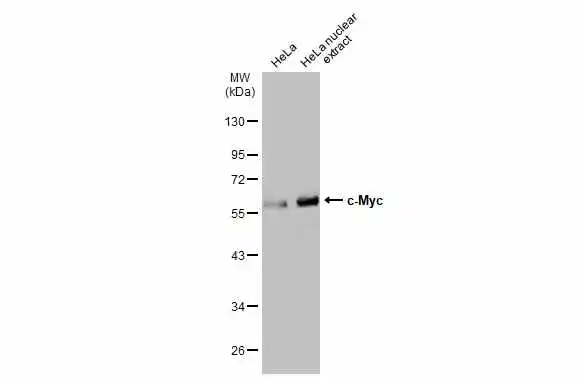
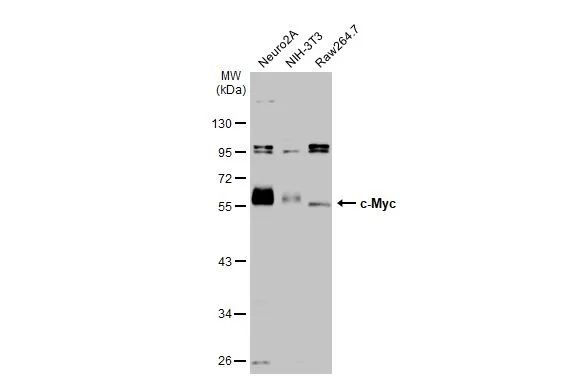
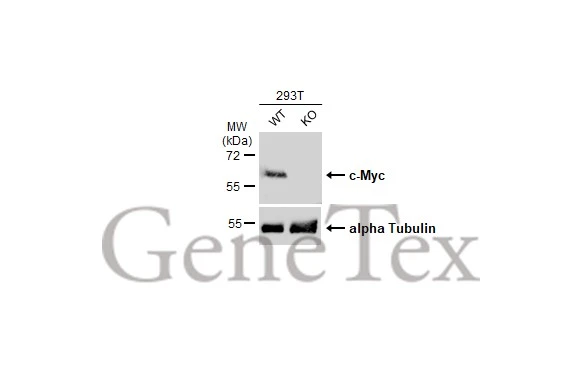
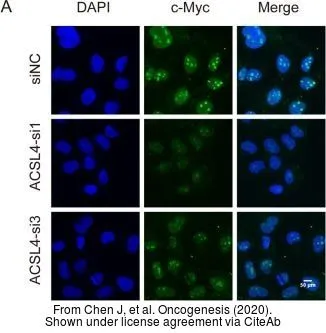
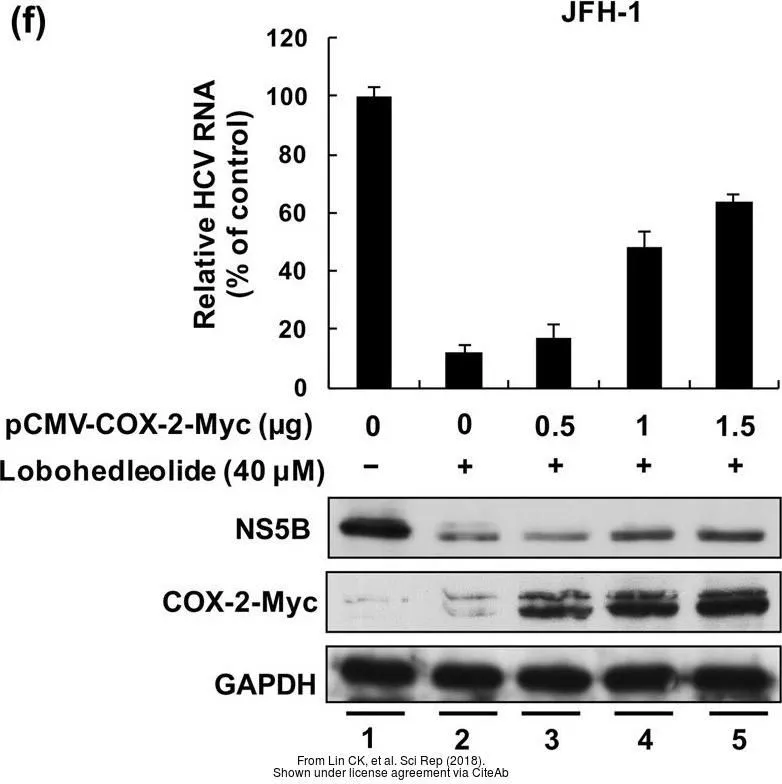
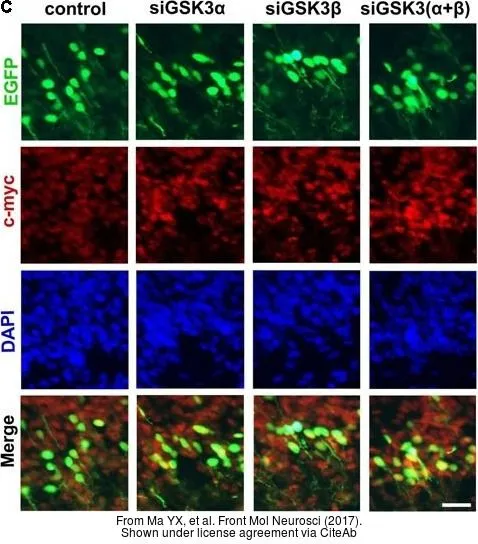
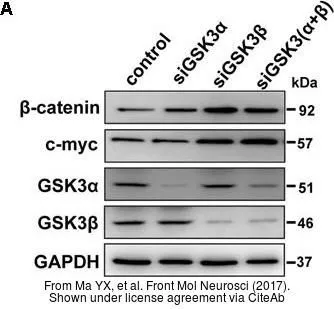
Sample (whole cell lysate) A: 293T 20ug B: 293T 10ug 10% SDS PAGE GTX103436 diluted at 1:1000 The HRP-conjugated anti-rabbit IgG antibody (GTX213110-01) was used to detect the primary antibody.
c-Myc antibody
GTX103436

ApplicationsImmunoFluorescence, ImmunoPrecipitation, Western Blot, ChIP Chromatin ImmunoPrecipitation, ImmunoCytoChemistry, ImmunoHistoChemistry, ImmunoHistoChemistry Frozen, ImmunoHistoChemistry Paraffin
Product group Antibodies
ReactivityHuman, Mouse, Xenopus
TargetMYC
Overview
- SupplierGeneTex
- Product Namec-Myc antibody
- Delivery Days Customer9
- Application Supplier NoteWB: 1:500-1:3000. ICC/IF: 1:100-1:1000. IP: 1:100-1:500. *Optimal dilutions/concentrations should be determined by the researcher.Not tested in other applications.
- ApplicationsImmunoFluorescence, ImmunoPrecipitation, Western Blot, ChIP Chromatin ImmunoPrecipitation, ImmunoCytoChemistry, ImmunoHistoChemistry, ImmunoHistoChemistry Frozen, ImmunoHistoChemistry Paraffin
- CertificationResearch Use Only
- ClonalityPolyclonal
- Concentration0.29 mg/ml
- ConjugateUnconjugated
- Gene ID4609
- Target nameMYC
- Target descriptionMYC proto-oncogene, bHLH transcription factor
- Target synonymsMRTL, MYCC, bHLHe39, c-Myc, myc proto-oncogene protein, avian myelocytomatosis viral oncogene homolog, class E basic helix-loop-helix protein 39, myc-related translation/localization regulatory factor, proto-oncogene c-Myc, transcription factor p64, v-myc avian myelocytomatosis viral oncogene homolog, v-myc myelocytomatosis viral oncogene homolog
- HostRabbit
- IsotypeIgG
- Protein IDP01106
- Protein NameMyc proto-oncogene protein
- Scientific DescriptionThe protein encoded by this gene is a multifunctional, nuclear phosphoprotein that plays a role in cell cycle progression, apoptosis and cellular transformation. It functions as a transcription factor that regulates transcription of specific target genes. Mutations, overexpression, rearrangement and translocation of this gene have been associated with a variety of hematopoietic tumors, leukemias and lymphomas, including Burkitt lymphoma. There is evidence to show that alternative translation initiations from an upstream, in-frame non-AUG (CUG) and a downstream AUG start site result in the production of two isoforms with distinct N-termini. The synthesis of non-AUG initiated protein is suppressed in Burkitts lymphomas, suggesting its importance in the normal function of this gene. [provided by RefSeq]
- ReactivityHuman, Mouse, Xenopus
- Storage Instruction-20°C or -80°C,2°C to 8°C
- UNSPSC41116161
Datasheet
Related products
Product group Antibodies

Anti-MYC AntibodyA95482
ApplicationsImmunoFluorescence, Western Blot, ELISA, ImmunoHistoChemistry
ReactivityHuman, Mouse, Rat
- SizePrice
Product group Antibodies

ApplicationsWestern Blot, ELISA, ImmunoCytoChemistry, ImmunoHistoChemistry
TargetMYC
- SizePrice
Product group Antibodies

Anti-myc [8]Ab02771-10.0
ApplicationsImmunoPrecipitation, Western Blot, ImmunoHistoChemistry
ReactivityHuman, Mouse, Rat
TargetMYC
- SizePrice

Product group Antibodies

Anti-c-Myc/MYC Antibody Picoband(r)A00026-1-CARRIER-FREE
ApplicationsFlow Cytometry, Western Blot, ELISA
ReactivityHuman, Mouse, Rat
TargetMYC
- SizePrice
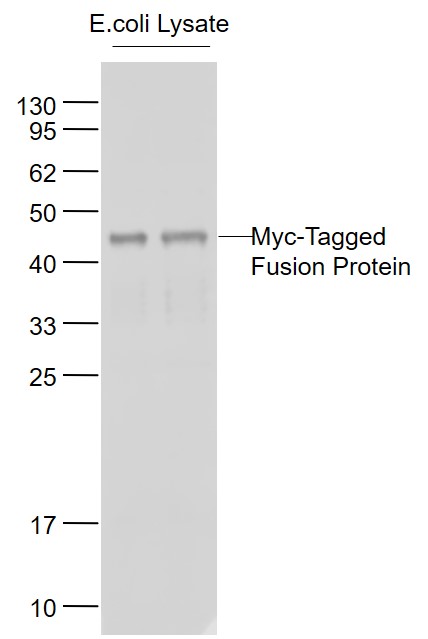
Product group Antibodies
References

Myc tag Polyclonal Antibodybs-0842R
ApplicationsImmunoFluorescence, Western Blot, ELISA, ImmunoCytoChemistry, ImmunoHistoChemistry, ImmunoHistoChemistry Frozen, ImmunoHistoChemistry Paraffin
ReactivityOther Species
TargetMYC
- SizePrice
Product group Antibodies

MYC AntibodyCSB-PA001729
ApplicationsWestern Blot, ELISA, ImmunoHistoChemistry
ReactivityHuman, Mouse, Rat
TargetMYC
- SizePrice
Product group Antibodies

MYC Polyclonal AntibodyCAC13996
ApplicationsWestern Blot, ELISA, ImmunoHistoChemistry
ReactivityMouse
TargetMYC
- SizePrice
Product group Antibodies
c-Myc antibody [8]GTX17355
ApplicationsImmunoPrecipitation, Western Blot
ReactivityHuman, Mouse, Rat
TargetMYC
- SizePrice
Product group Antibodies
References
c-Myc antibody [33]GTX17356
ApplicationsImmunoFluorescence, ImmunoPrecipitation, Western Blot, ImmunoCytoChemistry, ImmunoHistoChemistry, ImmunoHistoChemistry Frozen
ReactivityAvian, Human, Mouse, Rat
TargetMYC
- SizePrice
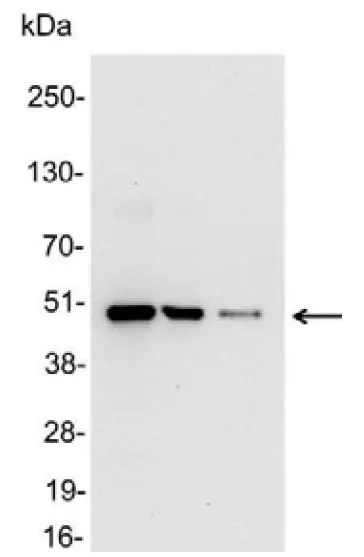
Product group Antibodies
References
c-Myc antibody (HRP)GTX19312
ApplicationsImmunoFluorescence, Western Blot, ELISA, ImmunoCytoChemistry, ImmunoHistoChemistry
ReactivityHuman
TargetMYC
- SizePrice