

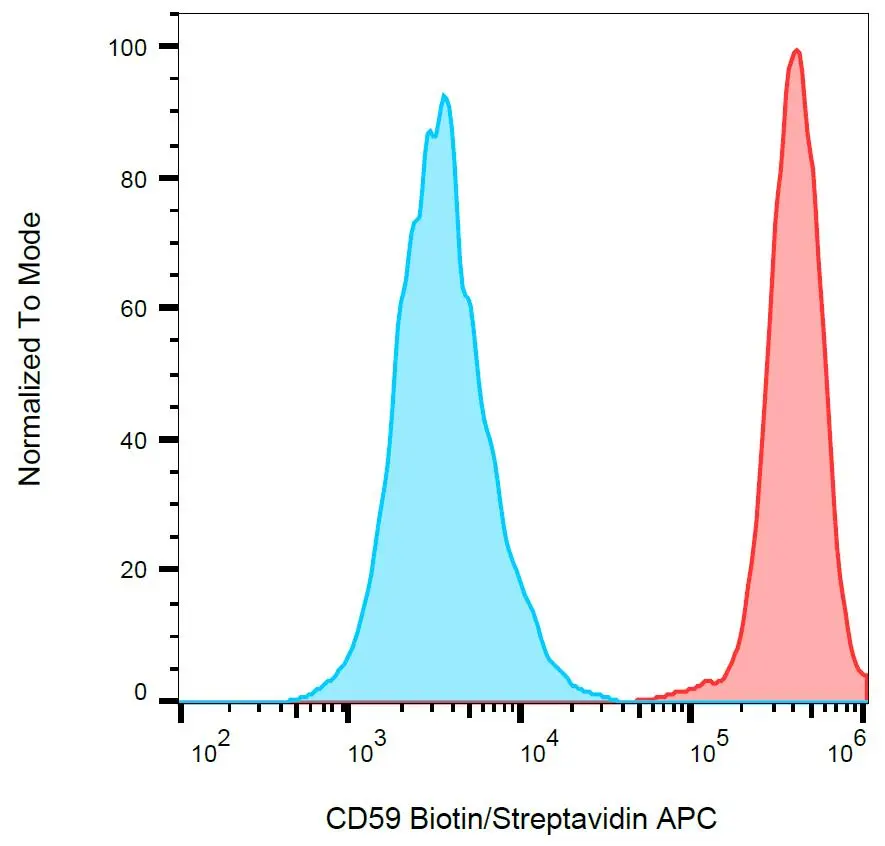
FACS analysis of HL-60 (positive) and SP2 (negative) cells using GTX74616 CD59 antibody [MEM-43] (Biotin).
FACS analysis of HL-60 (positive) and SP2 (negative) cells using GTX74616 CD59 antibody [MEM-43] (Biotin).
CD59 antibody [MEM-43] (Biotin)
GTX74616

ApplicationsFlow Cytometry, ImmunoPrecipitation, ImmunoHistoChemistry, ImmunoHistoChemistry Paraffin
Product group Antibodies
ReactivityHuman
TargetCD59
Overview
- SupplierGeneTex
- Product NameCD59 antibody [MEM-43] (Biotin)
- Delivery Days Customer9
- ApplicationsFlow Cytometry, ImmunoPrecipitation, ImmunoHistoChemistry, ImmunoHistoChemistry Paraffin
- CertificationResearch Use Only
- ClonalityMonoclonal
- Clone IDMEM-43
- Concentration1 mg/ml
- ConjugateBiotin
- Gene ID966
- Target nameCD59
- Target descriptionCD59 molecule (CD59 blood group)
- Target synonyms16.3A5, 1F5, EJ16, EJ30, EL32, G344, HRF-20, HRF20, MAC-IP, MACIF, MEM43, MIC11, MIN1, MIN2, MIN3, MIRL, MSK21, p18-20, CD59 glycoprotein, 1F5 antigen, 20 kDa homologous restriction factor, CD59 antigen p18-20 (antigen identified by monoclonal antibodies 16.3A5, EJ16, EJ30, EL32 and G344), CD59 blood group antigen, CD59 molecule, complement regulatory protein, Ly-6-like protein, MEM43 antigen, T cell-activating protein, human leukocyte antigen MIC11, lymphocytic antigen CD59/MEM43, membrane attack complex (MAC) inhibition factor, membrane attack complex inhibition factor, membrane inhibitor of reactive lysis, protectin, surface anitgen recognized by monoclonal antibody 16.3A5
- HostMouse
- IsotypeIgG2a
- Protein IDP13987
- Protein NameCD59 glycoprotein
- Scientific DescriptionThis gene encodes a cell surface glycoprotein that regulates complement-mediated cell lysis, and it is involved in lymphocyte signal transduction. This protein is a potent inhibitor of the complement membrane attack complex, whereby it binds complement C8 and/or C9 during the assembly of this complex, thereby inhibiting the incorporation of multiple copies of C9 into the complex, which is necessary for osmolytic pore formation. This protein also plays a role in signal transduction pathways in the activation of T cells. Mutations in this gene cause CD59 deficiency, a disease resulting in hemolytic anemia and thrombosis, and which causes cerebral infarction. Multiple alternatively spliced transcript variants, which encode the same protein, have been identified for this gene. [provided by RefSeq, Jul 2008]
- ReactivityHuman
- Storage Instruction2°C to 8°C
- UNSPSC41116161
Datasheet
Related products

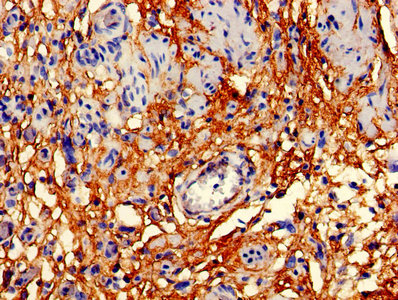
Product group Antibodies

CD59 AntibodyCSB-PA004947EA01HU
ApplicationsImmunoFluorescence, ELISA, ImmunoHistoChemistry
ReactivityHuman
TargetCD59
- SizePrice
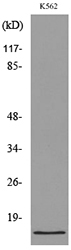
Product group Antibodies

Anti-CD59 AntibodyA101506
ApplicationsWestern Blot, ELISA
ReactivityHuman
- SizePrice
Product group Antibodies

Anti-CD59 [YTH 53.1]Ab00197-1.1
ApplicationsFlow Cytometry
ReactivityHuman
TargetCD59
- SizePrice
Product group Antibodies

CD59 Antibody (clone 001, APC)LS-C819440
ApplicationsFlow Cytometry
ReactivityRat
TargetCD59
- SizePrice


Product group Antibodies

Anti-CD59 AntibodyHPA026494
ApplicationsWestern Blot, ImmunoCytoChemistry, ImmunoHistoChemistry
ReactivityHuman
TargetCD59
- SizePrice

Product group Antibodies

Anti-CD59 glycoprotein CD59 Antibody Picoband(r)RP1076-CARRIER-FREE
ApplicationsFlow Cytometry, ImmunoFluorescence, Western Blot, ImmunoCytoChemistry, ImmunoHistoChemistry
ReactivityHuman
TargetCD59
- SizePrice
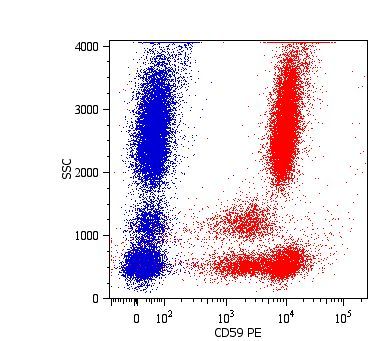
Product group Antibodies
CD59 antibody [MEM-43] (PE)GTX74619
ApplicationsFlow Cytometry
ReactivityHuman
TargetCD59
- SizePrice
![FACS analysis of KG1 cells using GTX75575 CD59 antibody [MEM-43/5].](https://www.genetex.com/upload/website/prouct_img/normal/GTX75575/GTX75575_2452_FACS_w_23061322_797.webp)
Product group Antibodies
CD59 antibody [MEM-43/5]GTX75575
ApplicationsFlow Cytometry, Western Blot, ImmunoHistoChemistry, ImmunoHistoChemistry Frozen
ReactivityHuman
TargetCD59
- SizePrice