

CD80 antibody [MEM-233] (PE-Cy5)
GTX28239-09

ApplicationsFlow Cytometry
Product group Antibodies
ReactivityHuman
TargetCD80
Overview
- SupplierGeneTex
- Product NameCD80 antibody [MEM-233] (PE-Cy5)
- Delivery Days Customer9
- Application Supplier NoteFACS: 4 microl reagent / 100 microl of whole blood or 106 cells in a suspension. *Optimal dilutions/concentrations should be determined by the researcher.Not tested in other applications.
- ApplicationsFlow Cytometry
- CertificationResearch Use Only
- ClonalityMonoclonal
- Clone IDMEM-233
- ConjugateTricolor
- Gene ID941
- Target nameCD80
- Target descriptionCD80 molecule
- Target synonymsB7, B7-1, B7.1, BB1, CD28LG, CD28LG1, LAB7, T-lymphocyte activation antigen CD80, B-lymphocyte activation antigen B7, CD80 antigen (CD28 antigen ligand 1, B7-1 antigen), CTLA-4 counter-receptor B7.1, activation B7-1 antigen, costimulatory factor CD80, costimulatory molecule variant IgV-CD80
- HostMouse
- IsotypeIgG1
- Protein IDP33681
- Protein NameT-lymphocyte activation antigen CD80
- Scientific DescriptionThe protein encoded by this gene is a membrane receptor that is activated by the binding of CD28 or CTLA-4. The activated protein induces T-cell proliferation and cytokine production. This protein can act as a receptor for adenovirus subgroup B and may play a role in lupus neuropathy. [provided by RefSeq, Aug 2011]
- ReactivityHuman
- Storage Instruction2°C to 8°C
- UNSPSC12352203
References
- Manferdini C, Saleh Y, Dolzani P, et al. Impact of Isolation Procedures on the Development of a Preclinical Synovial Fibroblasts/Macrophages in an In Vitro Model of Osteoarthritis. Biology (Basel). 2020,9(12). doi: 10.3390/biology9120459Read this paper
- Paolella F, Manferdini C, Gabusi E, et al. Effect of microfragmented adipose tissue on osteoarthritic synovial macrophage factors. J Cell Physiol. 2019,234(4):5044-5055. doi: 10.1002/jcp.27307Read this paper
- Manferdini C, Paolella F, Gabusi E, et al. From osteoarthritic synovium to synovial-derived cells characterization: synovial macrophages are key effector cells. Arthritis Res Ther. 2016,18:83. doi: 10.1186/s13075-016-0983-4Read this paper
Datasheet
Related products
Product group Antibodies

CD80 Recombinant Antibody, Biotin ConjugatedBSM-61404R-BIOTIN
ApplicationsWestern Blot, ImmunoHistoChemistry, ImmunoHistoChemistry Frozen, ImmunoHistoChemistry Paraffin
ReactivityHuman
TargetCD80
- SizePrice

Product group Antibodies

ApplicationsFlow Cytometry
TargetCD80
- SizePrice
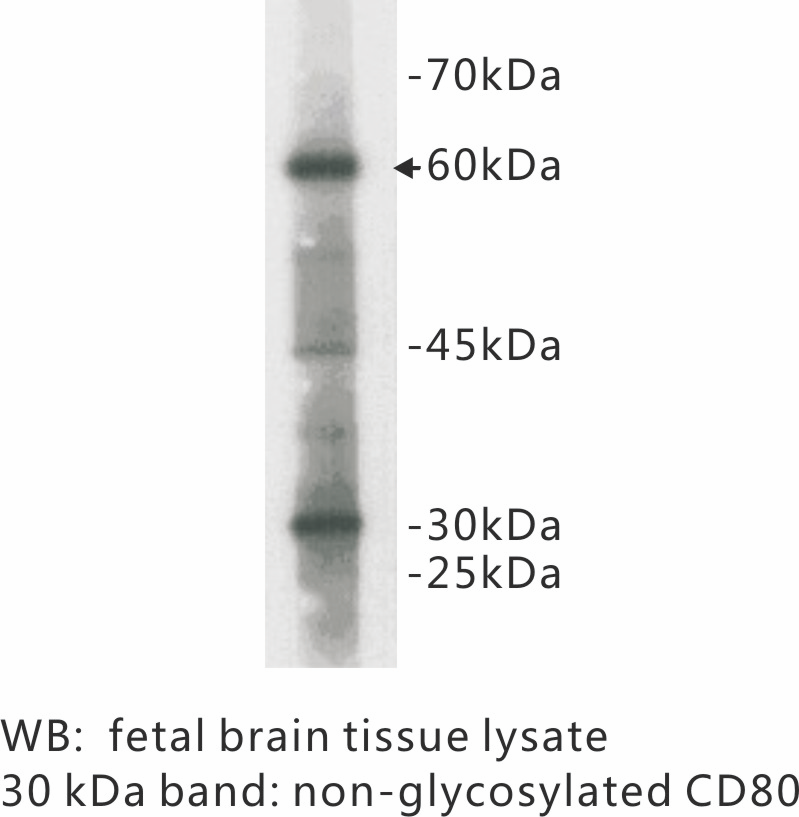


Product group Antibodies

Anti-CD80 Antibody144-64040
ApplicationsImmunoFluorescence, Western Blot
ReactivityHuman, Mouse, Rat
TargetCD80
- SizePrice
Product group Antibodies

Anti-CD80 [IDEC-114 (Galiximab)]Ab00736-10.0
ApplicationsFlow Cytometry, ImmunoPrecipitation, Western Blot, ELISA, ImmunoHistoChemistry, Neutralisation/Blocking
ReactivityHuman
TargetCD80
- SizePrice
Product group Antibodies

Goat anti-CD80 AntibodyEB09701
ApplicationsWestern Blot, ELISA
ReactivityHuman
TargetCD80
- SizePrice
![FACS analysis of Daudi cells using GTX01487-07 CD80 antibody [2D10.4] (APC). Solid lone : primary antibody Dashed line : isotype control antibody amount : 0.5 microg (5 microl)](https://www.genetex.com/upload/website/prouct_img/normal/GTX01487-07/GTX01487-07_20200428_FACS20_w_23053121_864.webp)
Product group Antibodies
References
CD80 antibody [2D10.4] (APC)GTX01487-07
ApplicationsFlow Cytometry
ReactivityHuman, Primate
TargetCD80
- SizePrice
![FACS analysis of Daudi cells using GTX01487-08 CD80 antibody [2D10.4] (PE). Solid lone : primary antibody Dashed line : isotype control antibody amount : 0.5 microg (5 microl)](https://www.genetex.com/upload/website/prouct_img/normal/GTX01487-08/GTX01487-08_20200428_FACS111_w_23053121_604.webp)
Product group Antibodies
References
CD80 antibody [2D10.4] (PE)GTX01487-08
ApplicationsFlow Cytometry
ReactivityHuman, Primate
TargetCD80
- SizePrice