

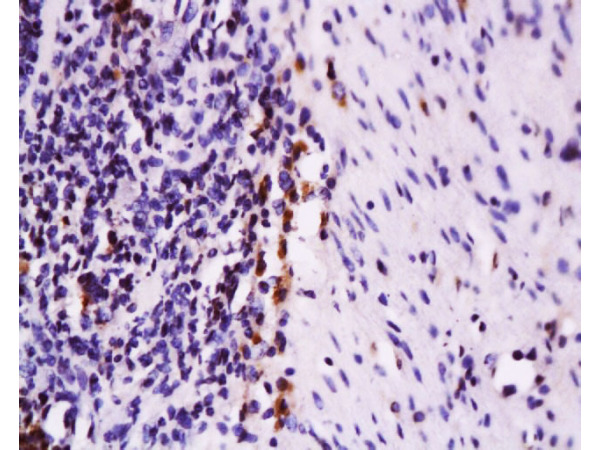
Formalin-fixed and paraffin embedded rat colon tissue labeled with Anti-Fas Polyclonal Antibody, Unconjugated (bs-0215R) at 1:200 followed by conjugation to the secondary antibody and DAB staining
Formalin-fixed and paraffin embedded rat colon tissue labeled with Anti-Fas Polyclonal Antibody, Unconjugated (bs-0215R) at 1:200 followed by conjugation to the secondary antibody and DAB staining
CD95/FAS Polyclonal Antibody
BS-0215R

ApplicationsFlow Cytometry, ImmunoFluorescence, Western Blot, ELISA, ImmunoCytoChemistry, ImmunoHistoChemistry, ImmunoHistoChemistry Frozen, ImmunoHistoChemistry Paraffin
Product group Antibodies
ReactivityHuman, Mouse, Porcine, Rat
TargetFas
Overview
- SupplierBioss
- Product NameCD95/FAS Polyclonal Antibody
- Delivery Days Customer16
- ApplicationsFlow Cytometry, ImmunoFluorescence, Western Blot, ELISA, ImmunoCytoChemistry, ImmunoHistoChemistry, ImmunoHistoChemistry Frozen, ImmunoHistoChemistry Paraffin
- Applications SupplierWB(1:300-5000), ELISA(1:500-1000), FCM(1:20-100), IHC-P(1:200-400), IHC-F(1:100-500), IF(IHC-P)(1:50-200), IF(IHC-F)(1:50-200), IF(ICC)(1:50-200)
- CertificationResearch Use Only
- ClonalityPolyclonal
- Concentration1 ug/ul
- ConjugateUnconjugated
- Gene ID14102
- Target nameFas
- Target descriptionFas cell surface death receptor
- Target synonymsAPO1, APT1, CD95, TNFR6, Tnfrsf6, lpr, tumor necrosis factor receptor superfamily member 6, FASLG receptor, Fas (TNF receptor superfamily member 6), Fas (TNF receptor superfamily member), Fas antigen, apo-1 antigen, apoptosis-mediating surface antigen FAS, lymphoproliferation
- HostRabbit
- IsotypeIgG
- Protein IDP25446
- Protein NameTumor necrosis factor receptor superfamily member 6
- ReactivityHuman, Mouse, Porcine, Rat
- Storage Instruction-20°C
- UNSPSC12352203
References
- Wang Q, Huang WR, Chih WY, et al. Cdc20 and molecular chaperone CCT2 and CCT5 are required for the Muscovy duck reovirus p10.8-induced cell cycle arrest and apoptosis. Vet Microbiol. 2019,235:151-163. doi: 10.1016/j.vetmic.2019.06.017Read this paper
- Peng Y, Fu ZZ, Guo CS, et al. Effects and Mechanism of Baicalin on Apoptosis of Cervical Cancer HeLa Cells I n -v itro. Iran J Pharm Res. 2015,14(1):251-61.Read this paper
- Zhou KW, Zheng XM, Yang ZW, et al. Overexpression of CIRP may reduce testicular damage induced by cryptorchidism. Clin Invest Med. 2009,32(2):E103-11.Read this paper
Datasheet
Related products
Product group Antibodies

ApplicationsImmunoPrecipitation, Western Blot, ImmunoCytoChemistry, ImmunoHistoChemistry
ReactivityMouse
TargetFas
- SizePrice
Product group Antibodies
References

Fas antibodyGTX13550
ApplicationsFlow Cytometry, Western Blot, ImmunoHistoChemistry
ReactivityCanine, Human, Mouse, Rat
TargetFas
- SizePrice