

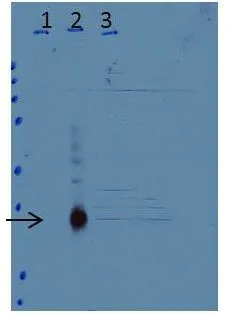
Western Blot of Anti-C/EBPd Antibody Lane 1: untreated wild-type (WT) cells Lane 2: WT cells treated 3 h with LPS Lane 3: C/EBPd-knock-out cells treated 3H with LPS Load: 35 μg per lane Primary: Anti-C/EBPd Antibody used at a dilution of 1:15k overnight at 4oC Blocking: buffer TBST ECL was used for detection of endogenous protein in whole cell extracts from mouse primary macrophage cells. Predicted/Observed size: 28.8 kDa, ~35 kDa
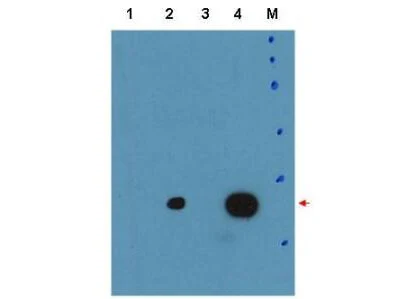
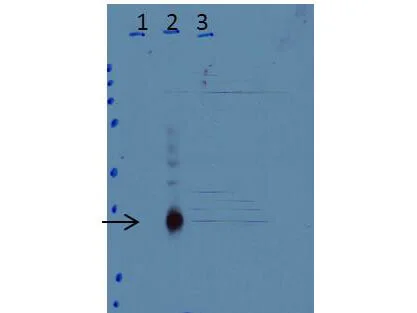
Western Blot of Anti-C/EBPd Antibody Lane 1: untreated wild-type (WT) cells Lane 2: WT cells treated 3 h with LPS Lane 3: C/EBPd-knock-out cells treated 3H with LPS Load: 35 μg per lane Primary: Anti-C/EBPd Antibody used at a dilution of 1:15k overnight at 4oC Blocking: buffer TBST ECL was used for detection of endogenous protein in whole cell extracts from mouse primary macrophage cells. Predicted/Observed size: 28.8 kDa, ~35 kDa
C/EBP delta antibody
GTX48713

ApplicationsImmunoPrecipitation, Western Blot, ELISA, ImmunoHistoChemistry
Product group Antibodies
ReactivityHuman, Mouse
TargetCebpd
Overview
- SupplierGeneTex
- Product NameC/EBP delta antibody
- Delivery Days Customer9
- Application Supplier NoteWB: 1:1000-1:15000. IP: 0.8-1.5 microg/mL. ELISA: 1:4000-1:9000. IHC (Free Floating): 1:2000. *Optimal dilutions/concentrations should be determined by the researcher.Not tested in other applications.
- ApplicationsImmunoPrecipitation, Western Blot, ELISA, ImmunoHistoChemistry
- CertificationResearch Use Only
- ClonalityPolyclonal
- Concentration1 mg/ml
- ConjugateUnconjugated
- Gene ID12609
- Target nameCebpd
- Target descriptionCCAAT/enhancer binding protein delta
- Target synonymsc/EBPdelta, CCAAT/enhancer-binding protein delta, C/EBP delta, CCAAT/enhancer binding protein (C/EBP), delta, c/EBP-related protein 3
- HostRabbit
- IsotypeIgG
- Protein IDQ00322
- Protein NameCCAAT/enhancer-binding protein delta
- Scientific DescriptionC/EBP proteins are DNA-binding proteins that are important transcriptional activators in the regulation of genes involved in immune and inflammatory responses and may play an important role in the regulation of the several genes associated with activation and/or differentiation of macrophages. Members of the C/EBP transcription factor family are related by a high degree of amino acid sequence identity to the basic leucine zipper DNA-binding domain and show distinct but overlapping patterns of tissue- and stage-restricted expression. Osada et al. identified the consensus binding site for the family as RTTGCGYAAY (R = A or G, and Y = C or T). Phosphorylation of C/EBPd may increase binding activity, whereas phosphorylation of the a and b family members may decrease binding affinity. C/EBPd is a nuclear protein that binds DNA as a dimer and can form stable heterodimers with all other C/EBP family members.
- ReactivityHuman, Mouse
- Storage Instruction-20°C or -80°C,2°C to 8°C
- UNSPSC41116161
Datasheet
Related products
Product group Antibodies

ApplicationsImmunoPrecipitation, Western Blot, ImmunoCytoChemistry, ImmunoHistoChemistry
ReactivityMouse, Rat
TargetCebpd
- SizePrice