

CFTR Antibody / Cystic Fibrosis Transmembrane Regulator
ORB606382

ApplicationsImmunoHistoChemistry, ImmunoHistoChemistry Paraffin
Product group Antibodies
ReactivityHuman
TargetCFTR
Overview
- SupplierBiorbyt
- Product NameCFTR Antibody / Cystic Fibrosis Transmembrane Regulator
- Delivery Days Customer16
- Application Supplier NoteOptimal dilution of the recombinant CFTR antibody should be determined by the researcher. 1. The prediluted format is supplied in a dropper bottle and is optimized for use in IHC. After epitope retrieval step (if required), drip mAb solution onto the tissue section and incubate at RT for 30 min.
- ApplicationsImmunoHistoChemistry, ImmunoHistoChemistry Paraffin
- Applications SupplierImmunohistochemistry (FFPE): 0.5-1ug/ml for 30 min at RT IHC-P
- CertificationResearch Use Only
- ClonalityMonoclonal
- Clone IDrCFTR/1342
- ConjugateUnconjugated
- Gene ID1080
- Target nameCFTR
- Target descriptionCF transmembrane conductance regulator
- Target synonymsABC35, ABCC7, CF, CFTR/MRP, MRP7, TNR-CFTR, dJ760C5.1, cystic fibrosis transmembrane conductance regulator, cAMP-dependent chloride channel, channel conductance-controlling ATPase, cystic fibrosis transmembrane conductance regulating, cystic fibrosis transmembrane conductance regulator (ATP-binding cassette sub-family C, member 7)
- HostMouse
- IsotypeIgG1
- Protein IDP13569
- Protein NameCystic fibrosis transmembrane conductance regulator
- Scientific DescriptionCFTR functions as an ATP-gated anion channel, increasing the conductance for certain anions (e.g. Cl+/-) to flow down their electrochemical gradient. ATP-driven conformational changes in CFTR open and close a gate to allow transmembrane flow of anions down their electrochemical gradient.[5] This in contrast to other ABC proteins, in which ATP-driven conformational changes fuel uphill substrate transport across cellular membranes. Essentially, CFTR is an ion channel that evolved as a broken ABC transporter that leaks when in open conformation. CFTR is found in the epithelial cells of many organs including the lung, liver, pancreas, digestive tract, and the reproductive tract. [Wiki]
- ReactivityHuman
- Storage Instruction-20°C,2°C to 8°C
- UNSPSC12352203
Related products
Product group Antibodies

Anti-CFTR Antibody144-66601
ApplicationsWestern Blot
ReactivityHuman
TargetCFTR
- SizePrice

Product group Antibodies

Anti-CFTR (Phospho-Ser737) AntibodyA00028S737
ApplicationsImmunoFluorescence, Western Blot, ImmunoHistoChemistry
ReactivityHuman, Mouse, Rat
TargetCFTR
- SizePrice
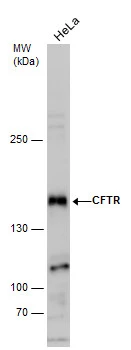
Product group Antibodies

CFTR antibodyGTX129939
ApplicationsWestern Blot
ReactivityHuman
TargetCFTR
- SizePrice

Product group Antibodies

ApplicationsImmunoPrecipitation, Western Blot, ImmunoCytoChemistry, ImmunoHistoChemistry
ReactivityPorcine
TargetCFTR
- SizePrice
Product group Antibodies

CFTR C-terminus Monoclonal AntibodyBSM-60568M
ApplicationsImmunoFluorescence, ImmunoHistoChemistry, ImmunoHistoChemistry Frozen, ImmunoHistoChemistry Paraffin
ReactivityHuman
TargetCFTR
- SizePrice
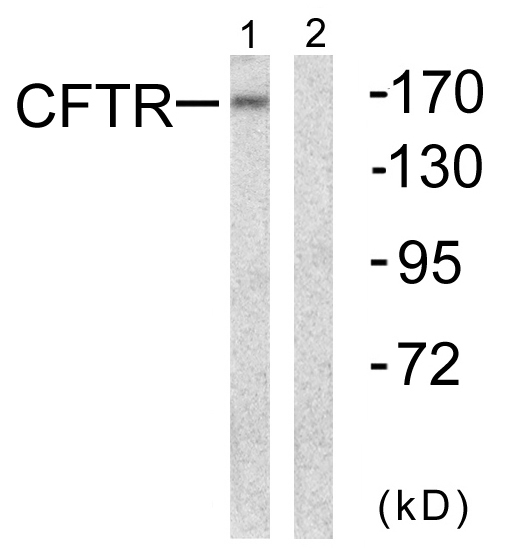
Product group Antibodies

Anti-CFTR AntibodyA96225
ApplicationsWestern Blot, ELISA, ImmunoHistoChemistry
ReactivityHuman, Mouse, Rat
- SizePrice
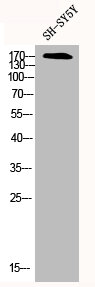
Product group Antibodies

CFTR AntibodyCSB-PA001608
ApplicationsWestern Blot, ELISA, ImmunoHistoChemistry
ReactivityHuman, Mouse, Rat
TargetCFTR
- SizePrice
Product group Antibodies

Goat anti-CFTREB06694
ApplicationsELISA, ImmunoHistoChemistry
ReactivityBovine, Canine, Human, Mouse, Rat
TargetCFTR
- SizePrice