

cis-Bis-(isothiocyanato)-bis-(2,2-bipyridyl- 4,4-dicarboxylato)-ruthenium(II) [141460-19-7]
CDX-D0999

CAS Number141460-19-7
Product group Chemicals
Estimated Purity>95%
Molecular Weight705.63
Overview
- SupplierChemodex
- Product Namecis-Bis-(isothiocyanato)-bis-(2,2-bipyridyl- 4,4-dicarboxylato)-ruthenium(II) [141460-19-7]
- Delivery Days Customer10
- CAS Number141460-19-7
- CertificationResearch Use Only
- Estimated Purity>95%
- Hazard InformationWarning
- Molecular FormulaC26H16N6O8RuS2
- Molecular Weight705.63
- Scientific DescriptionChemical. CAS: 141460-19-7. Formula: C26H16N6O8RuS2. MW: 705.63. cis-Bis(isothiocyanato)bis(2,2-bipyridyl-4,4-dicarboxylato)ruthenium(II) is known to very efficiently photo-sensitize titanium dioxide (titania) in the visible spectrum up to a wavelength of ~750nm. This compound is commonly referred as N3 dye in the literature. It is so far one of the best pigments for Dye Solar Cells, and is considered an industry standard. The N3 dye can be coated on electrodes for improving the sensitivity of the dye sensitized solar cells (DSSCs) which can further enhance the power conversion efficiency (PCE). The N3 dye is used to prepare staining solutions in which metal-oxide semi-conductor electrodes will be immersed. The dye naturally adsorbs on the semi-conductor surface, resulting in a colored electrode bearing a sensitizing layer of dye molecules. N3 acts as a fluorescent sensitive luminescence turn-on type anion sensor in aqueous solution. Spectral Data: Absorption lambdamax: 538nm; 398nm; 314nm (epsilon/10^4 M-1cm-1). Emission lambdamax: 830nm (EtOH). - cis-Bis(isothiocyanato)bis(2,2-bipyridyl-4,4-dicarboxylato)ruthenium(II) is known to very efficiently photo-sensitize titanium dioxide (titania) in the visible spectrum up to a wavelength of ~750nm. This compound is commonly referred as N3 dye in the literature. It is so far one of the best pigments for Dye Solar Cells, and is considered an industry standard. The N3 dye can be coated on electrodes for improving the sensitivity of the dye sensitized solar cells (DSSCs) which can further enhance the power conversion efficiency (PCE). The N3 dye is used to prepare staining solutions in which metal-oxide semi-conductor electrodes will be immersed. The dye naturally adsorbs on the semi-conductor surface, resulting in a colored electrode bearing a sensitizing layer of dye molecules. N3 acts as a fluorescent sensitive luminescence turn-on type anion sensor in aqueous solution. Spectral Data: Absorption lambdamax: 538nm; 398nm; 314nm (epsilon/10^4 M-1cm-1). Emission lambdamax: 830nm (EtOH).
- SMILESS=C=N[Ru]12([N]3=CC=C(C(O)=O)C=C3C4=[N]1C=CC(C(O)=O)=C4)([N]5=CC=C(C(O)=O)C=C5C6=[N]2C=CC(C(O)=O)=C6)N=C=S
- Storage InstructionRT
- UNSPSC12162000
Related products
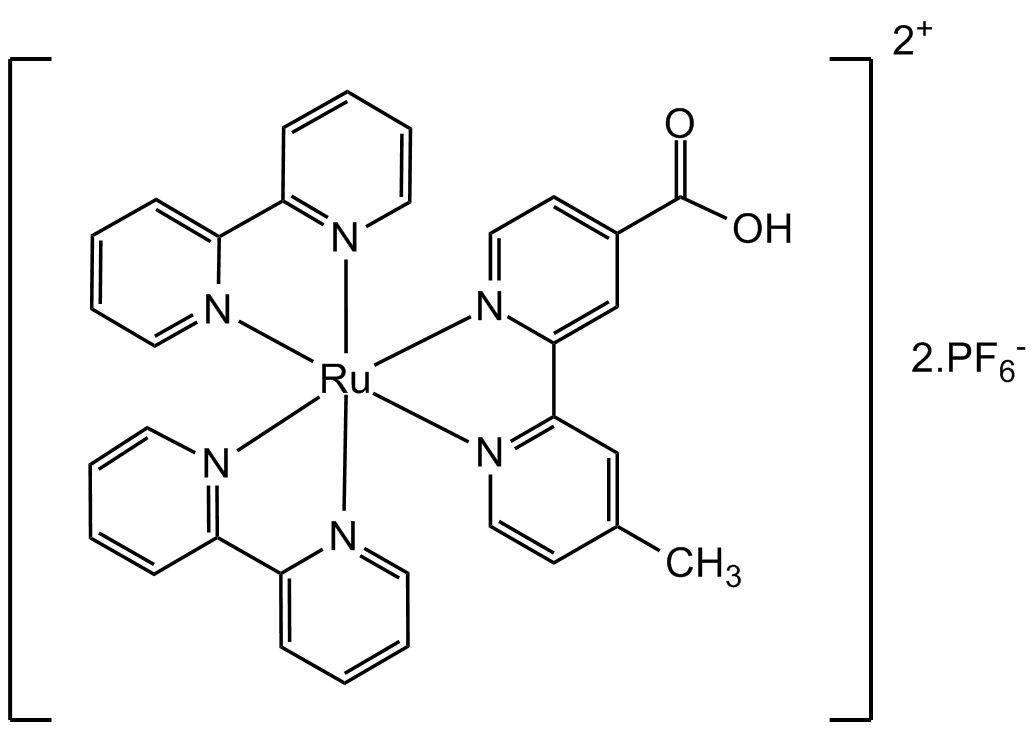
Product group Chemicals
Ru(bpy)2(mcbpy)(PF6)2 [136724-83-9]CDX-B0658
CAS Number136724_83_9
Molecular Weight917.59
- SizePrice
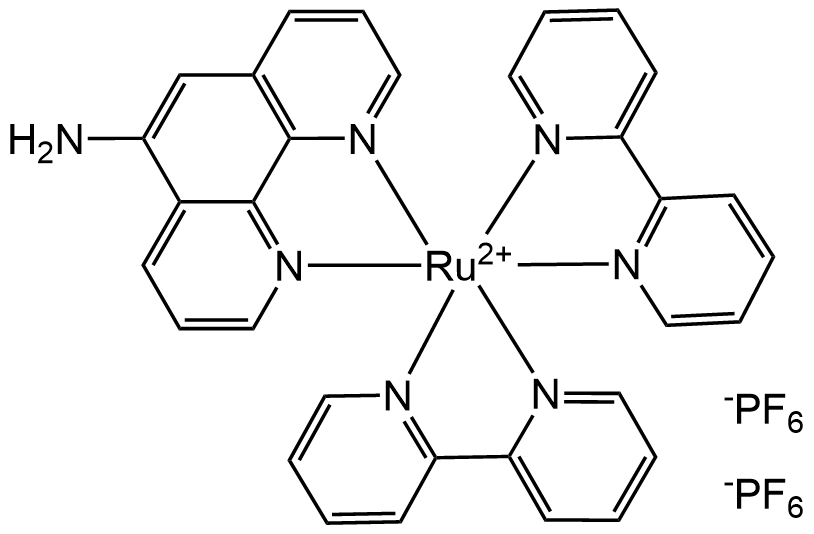
Product group Chemicals
CAS Number84537-86-0
Estimated Purity>95%
Molecular Weight898.59
- SizePrice
Product group Chemicals
CAS Number207347-46-4
Estimated Purity>90%
Molecular Weight1188.55
- SizePrice
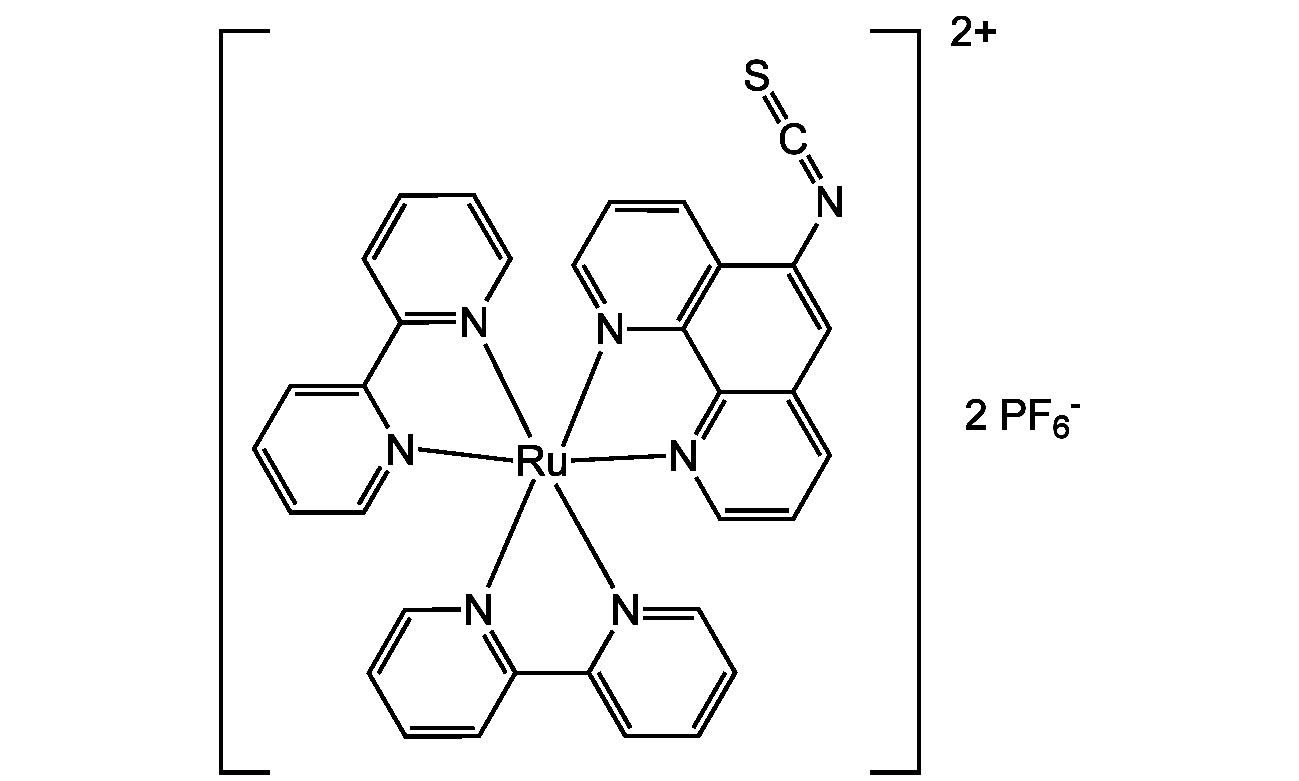
Product group Chemicals
CAS Number288399-07-5
Estimated Purity>95%
Molecular Weight940.65
- SizePrice
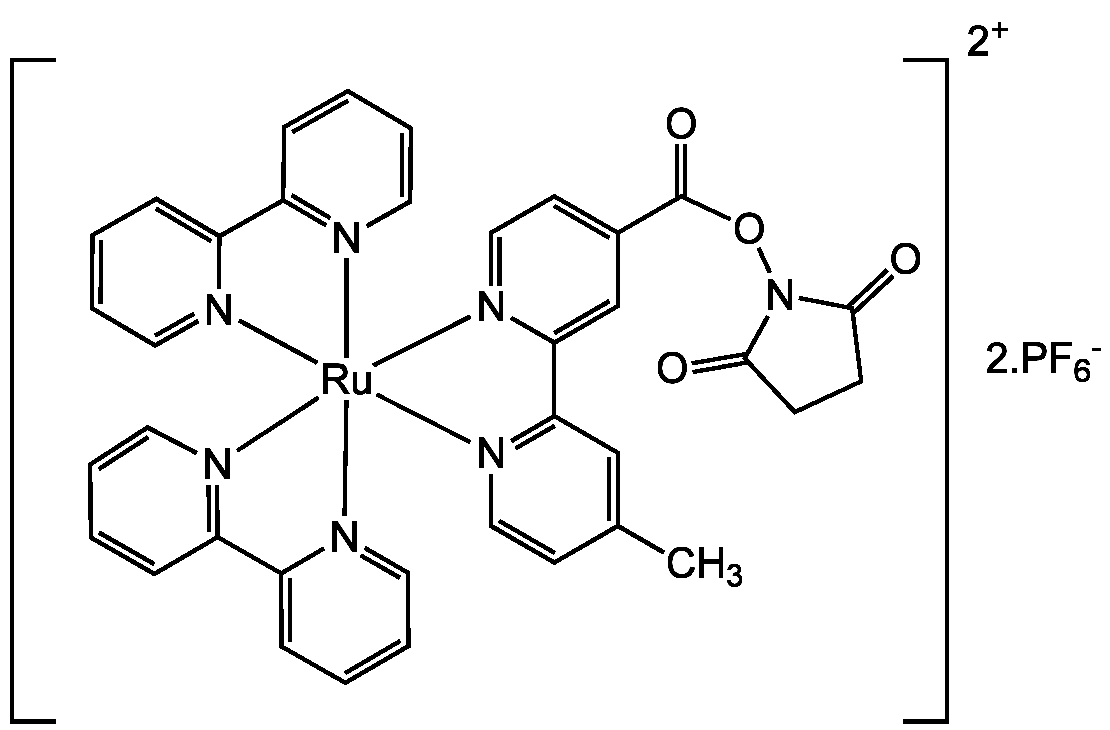
Product group Chemicals
CAS Number136724-73-7
Estimated Purity>97%
Molecular Weight1014.66
- SizePrice