

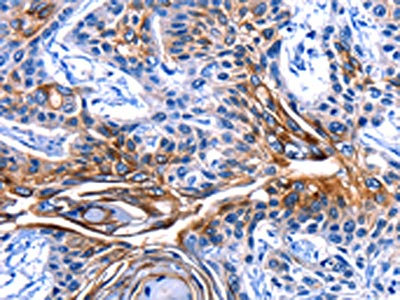
The image on the left is immunohistochemistry of paraffin-embedded Human esophagus cancer tissue using CSB-PA584850(CLCA4 Antibody) at dilution 1/15, on the right is treated with fusion protein. (Original magnification: x200)
The image on the left is immunohistochemistry of paraffin-embedded Human esophagus cancer tissue using CSB-PA584850(CLCA4 Antibody) at dilution 1/15, on the right is treated with fusion protein. (Original magnification: x200)
CLCA4 Antibody
CSB-PA584850

ApplicationsELISA, ImmunoHistoChemistry
Product group Antibodies
ReactivityHuman
TargetCLCA4
Overview
- SupplierCusabio
- Product NameCLCA4 Antibody
- Delivery Days Customer20
- ApplicationsELISA, ImmunoHistoChemistry
- CertificationResearch Use Only
- ClonalityPolyclonal
- ConjugateUnconjugated
- Gene ID22802
- Target nameCLCA4
- Target descriptionchloride channel accessory 4
- Target synonymsCaCC, CaCC2, calcium-activated chloride channel regulator 4, caCC-2, calcium-activated chloride channel family member 4, calcium-activated chloride channel protein 2, chloride channel regulator 4, chloride channel, calcium activated, family member 4, hCLCA4, hCaCC-2
- HostRabbit
- IsotypeIgG
- Protein IDQ14CN2
- Protein NameCalcium-activated chloride channel regulator 4
- Scientific DescriptionThe protein encoded by this gene belongs to the calcium sensitive chloride conductance protein family. To date, all members of this gene family map to the same site on chromosome 1p31-p22 and share high degrees of homology in size, sequence and predicted structure, but differ significantly in their tissue distributions. Alternative splicing results in multiple transcript variants, only one of which is thought to be protein coding.
- ReactivityHuman
- Storage Instruction-20°C or -80°C
- UNSPSC41116161
Related products
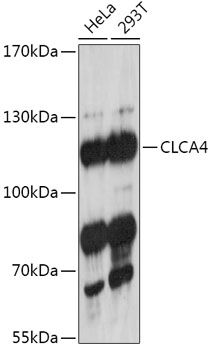
Product group Antibodies

Anti-CLCA4 AntibodyA308647
ApplicationsWestern Blot
ReactivityHuman, Rat
- SizePrice

Product group Antibodies

Anti-CLCA4 AntibodyHPA017045
ApplicationsImmunoHistoChemistry
ReactivityHuman
TargetCLCA4
- SizePrice