

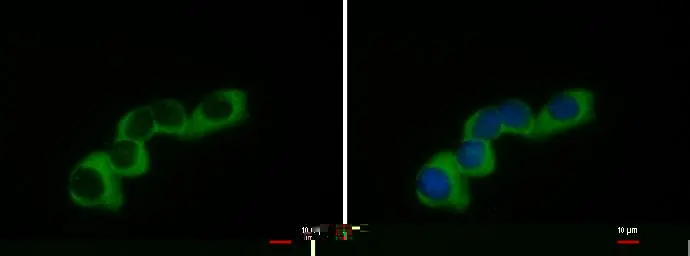
COL1A2 antibody [C2C3], C-term detects COL1A2 protein at cytoplasm by immunofluorescent analysis. Sample: NIH-3T3 cells were fixed in ice-cold MeOH for 5 min. Green: COL1A2 protein stained by COL1A2 antibody [C2C3], C-term (GTX102996) diluted at 1:500. Blue: Hoechst 33342 staining.
![Non-transfected (–) and transfected (+) 293T whole cell extracts were separated by 5% SDS-PAGE, and the membrane was blotted with COL1A2 antibody [C2C3], C-term (GTX102996) diluted at 1:5000. The HRP-conjugated anti-rabbit IgG antibody (GTX213110-01) was used to detect the primary antibody.](https://www.genetex.com/upload/website/prouct_img/normal/GTX102996/GTX102996_43320_20230616_WB_B_23062718_336.webp "Non-transfected (–) and transfected (+) 293T whole cell extracts were separated by 5% SDS-PAGE, and the membrane was blotted with COL1A2 antibody [C2C3], C-term (GTX102996) diluted at 1:5000. The HRP-conjugated anti-rabbit IgG antibody (GTX213110-01) was used to detect the primary antibody.")
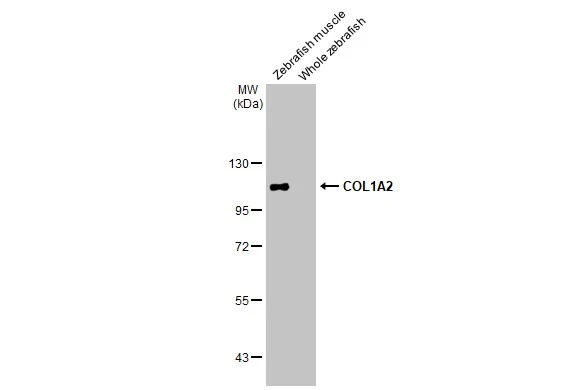
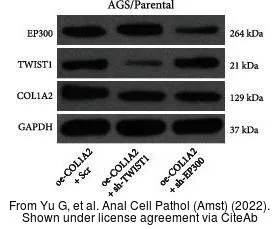
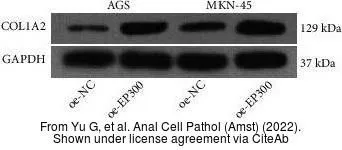
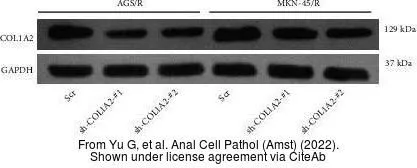
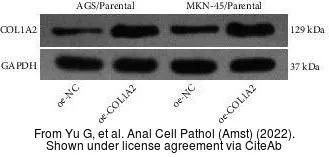
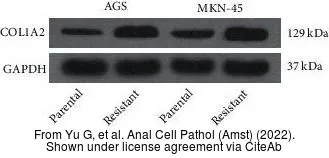
![U87-MG whole cell extract and conditioned medium (30 μg) were separated by 5% SDS-PAGE, and the membrane was blotted with COL1A2 antibody [C2C3], C-term (GTX102996) diluted at 1:1000. The HRP-conjugated anti-rabbit IgG antibody (GTX213110-01) was used to detect the primary antibody.](https://www.genetex.com/upload/website/prouct_img/normal/GTX102996/GTX102996_44020_20200918_WB_Fraction_24061301_470.webp "U87-MG whole cell extract and conditioned medium (30 μg) were separated by 5% SDS-PAGE, and the membrane was blotted with COL1A2 antibody [C2C3], C-term (GTX102996) diluted at 1:1000. The HRP-conjugated anti-rabbit IgG antibody (GTX213110-01) was used to detect the primary antibody.")
COL1A2 antibody [C2C3], C-term detects COL1A2 protein at cytoplasm by immunofluorescent analysis. Sample: NIH-3T3 cells were fixed in ice-cold MeOH for 5 min. Green: COL1A2 protein stained by COL1A2 antibody [C2C3], C-term (GTX102996) diluted at 1:500. Blue: Hoechst 33342 staining.
COL1A2 antibody [C2C3], C-term
GTX102996

ApplicationsImmunoFluorescence, Western Blot, ImmunoCytoChemistry
Product group Antibodies
ReactivityHuman, Mouse, Zebra Fish
TargetCOL1A2
Overview
- SupplierGeneTex
- Product NameCOL1A2 antibody [C2C3], C-term
- Delivery Days Customer9
- Application Supplier NoteWB: 1:1000-1:10000. ICC/IF: 1:100-1:1000. *Optimal dilutions/concentrations should be determined by the researcher.Not tested in other applications.
- ApplicationsImmunoFluorescence, Western Blot, ImmunoCytoChemistry
- CertificationResearch Use Only
- ClonalityPolyclonal
- Concentration0.43 mg/ml
- ConjugateUnconjugated
- Gene ID1278
- Target nameCOL1A2
- Target descriptioncollagen type I alpha 2 chain
- Target synonymsEDSARTH2, EDSCV, OI4, collagen alpha-2(I) chain, alpha 2 type I procollagen, alpha 2(I) procollagen, alpha 2(I)-collagen, alpha-2 type I collagen, collagen I, alpha-2 polypeptide, collagen of skin, tendon and bone, alpha-2 chain, collagen, type I, alpha 2, epididymis secretory sperm binding protein, type I procollagen
- HostRabbit
- IsotypeIgG
- Protein IDP08123
- Protein NameCollagen alpha-2(I) chain
- Scientific DescriptionThis gene encodes the pro-alpha2 chain of type I collagen whose triple helix comprises two alpha1 chains and one alpha2 chain. Type I is a fibril-forming collagen found in most connective tissues and is abundant in bone, cornea, dermis and tendon. Mutations in this gene are associated with osteogenesis imperfecta types I-IV, Ehlers-Danlos syndrome type VIIB, recessive Ehlers-Danlos syndrome Classical type, idiopathic osteoporosis, and atypical Marfan syndrome. Symptoms associated with mutations in this gene, however, tend to be less severe than mutations in the gene for the alpha1 chain of type I collagen (COL1A1) reflecting the different role of alpha2 chains in matrix integrity. Three transcripts, resulting from the use of alternate polyadenylation signals, have been identified for this gene. [provided by R. Dalgleish]
- ReactivityHuman, Mouse, Zebra Fish
- Storage Instruction-20°C or -80°C,2°C to 8°C
- UNSPSC41116161
Datasheet
Related products

Product group Antibodies
References

ApplicationsImmunoFluorescence, Western Blot, ELISA, ImmunoHistoChemistry
ReactivityHuman, Mouse, Rat
TargetCOL1A2
- SizePrice
Product group Antibodies

Anti-Mouse/Rat COL1A2 Antibody144-05786
ApplicationsWestern Blot, ImmunoHistoChemistry
ReactivityHuman, Mouse, Rat
TargetCOL1A2
- SizePrice

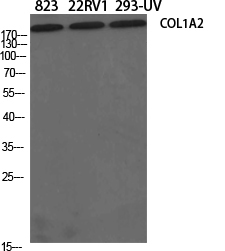
Product group Antibodies

Anti-COL1A2 AntibodyA34367
ApplicationsImmunoFluorescence, Western Blot, ELISA, ImmunoHistoChemistry
ReactivityHuman, Mouse, Rat
- SizePrice
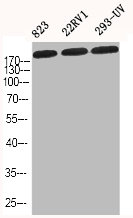
Product group Antibodies

COL1A2 AntibodyCSB-PA001742
ApplicationsImmunoFluorescence, Western Blot, ELISA, ImmunoHistoChemistry
ReactivityHuman, Mouse, Rat
TargetCOL1A2
- SizePrice
Product group Antibodies

ApplicationsWestern Blot, ELISA, ImmunoCytoChemistry, ImmunoHistoChemistry, ImmunoHistoChemistry Frozen, ImmunoHistoChemistry Paraffin
ReactivityMouse, Rat
TargetCOL1A2
- SizePrice

Product group Antibodies

Anti-COL1A2 AntibodyHPA059738
ApplicationsImmunoCytoChemistry
ReactivityHuman
TargetCOL1A2
- SizePrice
![U87-MG whole cell extract and conditioned medium (30 μg) were separated by 5% SDS-PAGE, and the membrane was blotted with COL1A2 antibody [HL2048] (GTX637952) diluted at 1:1000. The HRP-conjugated anti-rabbit IgG antibody (GTX213110-01) was used to detect the primary antibody.](https://www.genetex.com/upload/website/prouct_img/normal/GTX637952/GTX637952_44956_20230217_WB_Fraction_23022022_489.webp)
Product group Antibodies
COL1A2 antibody [HL2048]GTX637952
ApplicationsWestern Blot
ReactivityCanine, Human, Mouse
TargetCOL1A2
- SizePrice
![Various tissue extracts (50 μg) were separated by 5% SDS-PAGE, and the membrane was blotted with COL1A2 antibody [HL2049] (GTX637953) diluted at 1:1000. The HRP-conjugated anti-rabbit IgG antibody (GTX213110-01) was used to detect the primary antibody, and the signal was developed with Trident ECL plus-Enhanced.](https://www.genetex.com/upload/website/prouct_img/normal/GTX637953/GTX637953_T-44886_20221223_WB_M_R_22122722_319.webp)
Product group Antibodies
COL1A2 antibody [HL2049]GTX637953
ApplicationsWestern Blot
ReactivityHuman, Mouse, Rat
TargetCOL1A2
- SizePrice
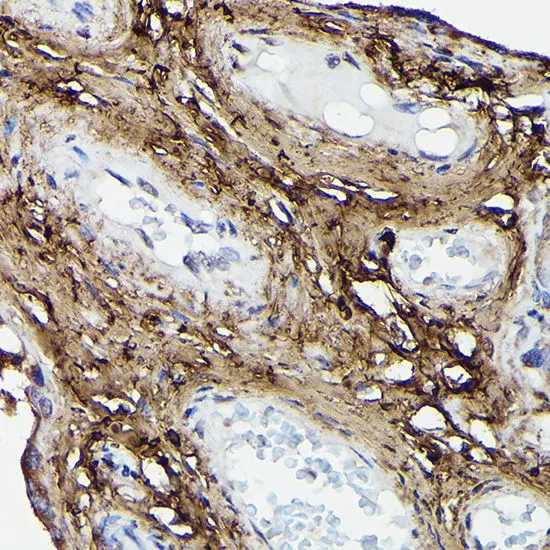
Product group Antibodies
COL1A2 antibodyGTX64468
ApplicationsWestern Blot, ImmunoHistoChemistry, ImmunoHistoChemistry Paraffin
ReactivityHuman, Mouse, Rat
TargetCOL1A2
- SizePrice