

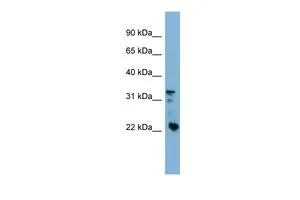
WB analysis of HT1080 cells using GTX45811 CRYBB3 antibody at 0.2-1μg/ml.
WB analysis of HT1080 cells using GTX45811 CRYBB3 antibody at 0.2-1μg/ml.
CRYBB3 antibody, Internal
GTX45811

ApplicationsWestern Blot
Product group Antibodies
ReactivityHuman
TargetCRYBB3
Overview
- SupplierGeneTex
- Product NameCRYBB3 antibody, Internal
- Delivery Days Customer9
- Application Supplier NoteWB: 0.2-2.5 ug/ml. *Optimal dilutions/concentrations should be determined by the researcher.Not tested in other applications.
- ApplicationsWestern Blot
- CertificationResearch Use Only
- ClonalityPolyclonal
- Concentration0.5-1 mg/ml
- ConjugateUnconjugated
- Gene ID1417
- Target nameCRYBB3
- Target descriptioncrystallin beta B3
- Target synonymsCATCN2, CRYB3, CTRCT22, beta-crystallin B3, eye lens structural protein
- HostRabbit
- IsotypeIgG
- Protein IDP26998
- Protein NameBeta-crystallin B3
- Scientific DescriptionCrystallins are separated into two classes: taxon-specific, or enzyme, and ubiquitous. The latter class constitutes the major proteins of vertebrate eye lens and maintains the transparency and refractive index of the lens. Since lens central fiber cells lose their nuclei during development, these crystallins are made and then retained throughout life, making them extremely stable proteins. Mammalian lens crystallins are divided into alpha, beta, and gamma families; beta and gamma crystallins are also considered as a superfamily. Alpha and beta families are further divided into acidic and basic groups. Seven protein regions exist in crystallins: four homologous motifs, a connecting peptide, and N- and C-terminal extensions. Beta-crystallins, the most heterogeneous, differ by the presence of the C-terminal extension (present in the basic group, none in the acidic group). Beta-crystallins form aggregates of different sizes and are able to self-associate to form dimers or to form heterodimers with other beta-crystallins. This gene, a beta basic group member, is part of a gene cluster with beta-A4, beta-B1, and beta-B2. Mutations in this gene result in cataract congenital nuclear autosomal recessive type 2. [provided by RefSeq, Feb 2013]
- ReactivityHuman
- Storage Instruction-20°C or -80°C,2°C to 8°C
- UNSPSC12352203
Datasheet
Related products
Product group Antibodies

Anti-CRYBB3 (C-term) Antibody102-23211
ApplicationsWestern Blot
TargetCRYBB3
- SizePrice

Product group Antibodies

CRYBB3 AntibodyCSB-PA006015GA01HU
ApplicationsImmunoFluorescence, Western Blot, ELISA
ReactivityHuman, Mouse, Rat
TargetCRYBB3
- SizePrice

Product group Antibodies

Anti-CRYBB3 AntibodyHPA055840
ApplicationsImmunoHistoChemistry
ReactivityHuman
TargetCRYBB3
- SizePrice
Product group Antibodies

CRYBB3 AntibodyLS-C664815
ApplicationsImmunoFluorescence, Western Blot, ELISA
ReactivityHuman
TargetCRYBB3
- SizePrice