

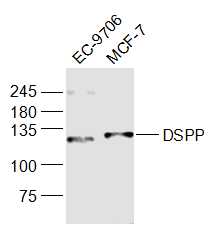
Lane 1: EC-9706 cell lysates; Lane 2: MCF-7 cell lysates probed with DSPP Polyclonal Antibody, Unconjugated (bs-10316R) at 1:1000 dilution and 4˚C overnight incubation. Followed by conjugated secondary antibody incubation at 1:20000 for 60 min at 37˚C.
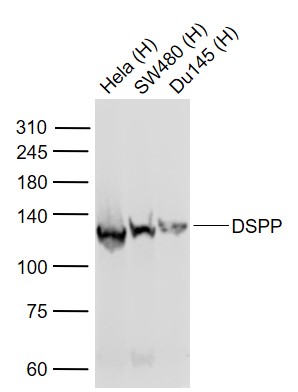
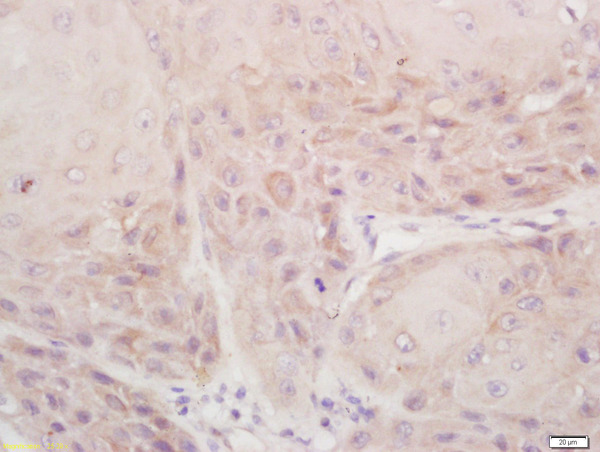
Lane 1: EC-9706 cell lysates; Lane 2: MCF-7 cell lysates probed with DSPP Polyclonal Antibody, Unconjugated (bs-10316R) at 1:1000 dilution and 4˚C overnight incubation. Followed by conjugated secondary antibody incubation at 1:20000 for 60 min at 37˚C.
DSPP Polyclonal Antibody
BS-10316R

ApplicationsImmunoFluorescence, Western Blot, ELISA, ImmunoCytoChemistry, ImmunoHistoChemistry, ImmunoHistoChemistry Frozen, ImmunoHistoChemistry Paraffin
Product group Antibodies
ReactivityHuman
TargetDSPP
Overview
- SupplierBioss
- Product NameDSPP Polyclonal Antibody
- Delivery Days Customer16
- ApplicationsImmunoFluorescence, Western Blot, ELISA, ImmunoCytoChemistry, ImmunoHistoChemistry, ImmunoHistoChemistry Frozen, ImmunoHistoChemistry Paraffin
- Applications SupplierWB(1:300-5000), ELISA(1:500-1000), IHC-P(1:200-400), IHC-F(1:100-500), IF(IHC-P)(1:50-200), IF(IHC-F)(1:50-200), IF(ICC)(1:50-200)
- CertificationResearch Use Only
- ClonalityPolyclonal
- Concentration1 ug/ul
- ConjugateUnconjugated
- Gene ID1834
- Target nameDSPP
- Target descriptiondentin sialophosphoprotein
- Target synonymsDFNA39, DGI1, DMP3, DPP, DSP, dentin sialophosphoprotein, deafness, autosomal dominant 39, dentin phosphophoryn, dentin phosphoprotein, dentin phosphoryn, dentin sialoprotein
- HostRabbit
- IsotypeIgG
- Protein IDQ9NZW4
- Protein NameDentin sialophosphoprotein
- ReactivityHuman
- Storage Instruction-20°C
- UNSPSC41116161
References
- Modulation of proliferation and differentiation of gingiva-derived mesenchymal stem cells by concentrated growth factors: Potential implications in tissue engineering for dental regeneration and repair. Chen X et al., 2019 Jul, Int J Mol MedRead this paper
- Analysis of the characteristics and expression profiles of coding and noncoding RNAs of human dental pulp stem cells in hypoxic conditions. Shi R et al., 2019 Mar 12, Stem Cell Res TherRead this paper
- The Role of MicroRNA-143-5p in the Differentiation of Dental Pulp Stem Cells into Odontoblasts by Targeting Runx2 via the OPG/RANKL Signaling Pathway. Zhan FL et al., 2018 Jan, J Cell BiochemRead this paper
Datasheet
Related products

Product group Antibodies

ApplicationsImmunoFluorescence, Western Blot, ImmunoCytoChemistry, ImmunoHistoChemistry
ReactivityHuman, Mouse, Rat
TargetDSPP
- SizePrice
Product group Antibodies

ApplicationsImmunoPrecipitation, Western Blot, ImmunoCytoChemistry, ImmunoHistoChemistry
TargetDSPP
- SizePrice
Product group Antibodies

DPP / DSPP AntibodyLS-C409948
ApplicationsWestern Blot
ReactivityHuman
TargetDSPP
- SizePrice
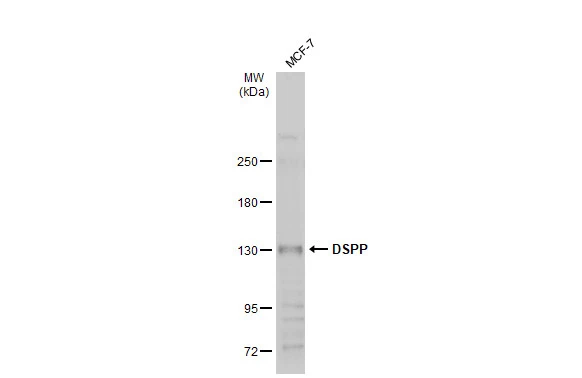
Product group Antibodies

DSPP antibodyGTX134428
ApplicationsWestern Blot, ImmunoHistoChemistry, ImmunoHistoChemistry Paraffin
ReactivityHuman
TargetDSPP
- SizePrice