

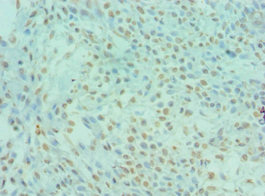
Immunohistochemistry of paraffin-embedded human breast cancer using CSB-PA852896ESR1HU at dilution of 1:100
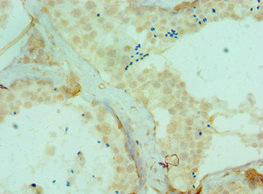
Immunohistochemistry of paraffin-embedded human breast cancer using CSB-PA852896ESR1HU at dilution of 1:100
DYRK2 Antibody
CSB-PA852896ESR1HU

ApplicationsELISA, ImmunoHistoChemistry
Product group Antibodies
ReactivityHuman
TargetDYRK2
Overview
- SupplierCusabio
- Product NameDYRK2 Antibody
- Delivery Days Customer20
- ApplicationsELISA, ImmunoHistoChemistry
- CertificationResearch Use Only
- ClonalityPolyclonal
- ConjugateUnconjugated
- Gene ID8445
- Target nameDYRK2
- Target descriptiondual specificity tyrosine phosphorylation regulated kinase 2
- Target synonymsdual specificity tyrosine-phosphorylation-regulated kinase 2, dual specificity tyrosine-(Y)-phosphorylation regulated kinase 2
- HostRabbit
- IsotypeIgG
- Protein IDQ92630
- Protein NameDual specificity tyrosine-phosphorylation-regulated kinase 2
- Scientific DescriptionSerine/threonine-protein kinase involved in the regulation of the mitotic cell cycle, cell proliferation, apoptosis, organization of the cytoskeleton and neurite outgrowth. Functions in part via its role in ubiquitin-dependent proteasomal protein degradation. Functions downstream of ATM and phosphorylates p53/TP53 at Ser-46, and thereby contributes to the induction of apoptosis in response to DNA damage. Phosphorylates NFATC1, and thereby inhibits its accumulation in the nucleus and its transcription factor activity. Phosphorylates EIF2B5 at Ser-544, enabling its subsequent phosphorylation and inhibition by GSK3B. Likewise, phosphorylation of NFATC1, CRMP2/DPYSL2 and CRMP4/DPYSL3 promotes their subsequent phosphorylation by GSK3B. May play a general role in the priming of GSK3 substrates. Inactivates GYS1 by phosphorylation at Ser-641, and potentially also a second phosphorylation site, thus regulating glycogen synthesis. Mediates EDVP E3 ligase complex formation and is required for the phosphorylation and subsequent degradation of KATNA1. Phosphorylates TERT at Ser-457, promoting TERT ubiquitination by the EDVP complex. Phosphorylates SIAH2, and thereby increases its ubiquitin ligase activity. Promotes the proteasomal degradation of MYC and JUN, and thereby regulates progress through the mitotic cell cycle and cell proliferation. Promotes proteasomal degradation of GLI2 and GLI3, and thereby plays a role in smoothened and sonic hedgehog signaling. Plays a role in cytoskeleton organization and neurite outgrowth via its phosphorylation of DCX and DPYSL2. Phosphorylates CRMP2/DPYSL2, CRMP4/DPYSL3, DCX, EIF2B5, EIF4EBP1, GLI2, GLI3, GYS1, JUN, MDM2, MYC, NFATC1, p53/TP53, TAU/MAPT and KATNA1. Can phosphorylate histone H1, histone H3 and histone H2B (in vitro). Can phosphorylate CARHSP1 (in vitro).
- ReactivityHuman
- Storage Instruction-20°C or -80°C
- UNSPSC41116161
Related products
Product group Antibodies

Anti-DYRK2 AntibodyA31811
ApplicationsImmunoFluorescence, Western Blot, ImmunoHistoChemistry
ReactivityHuman, Mouse, Rat
- SizePrice
Product group Antibodies

Anti-DYRK2 AntibodyA03498-1
ApplicationsImmunoFluorescence, Western Blot, ImmunoHistoChemistry
ReactivityHuman, Mouse, Rat
TargetDYRK2
- SizePrice
Product group Antibodies

Anti-DYRK2 Antibody144-66270
ApplicationsImmunoFluorescence, Western Blot, ImmunoHistoChemistry
ReactivityHuman, Mouse
TargetDYRK2
- SizePrice
Product group Antibodies

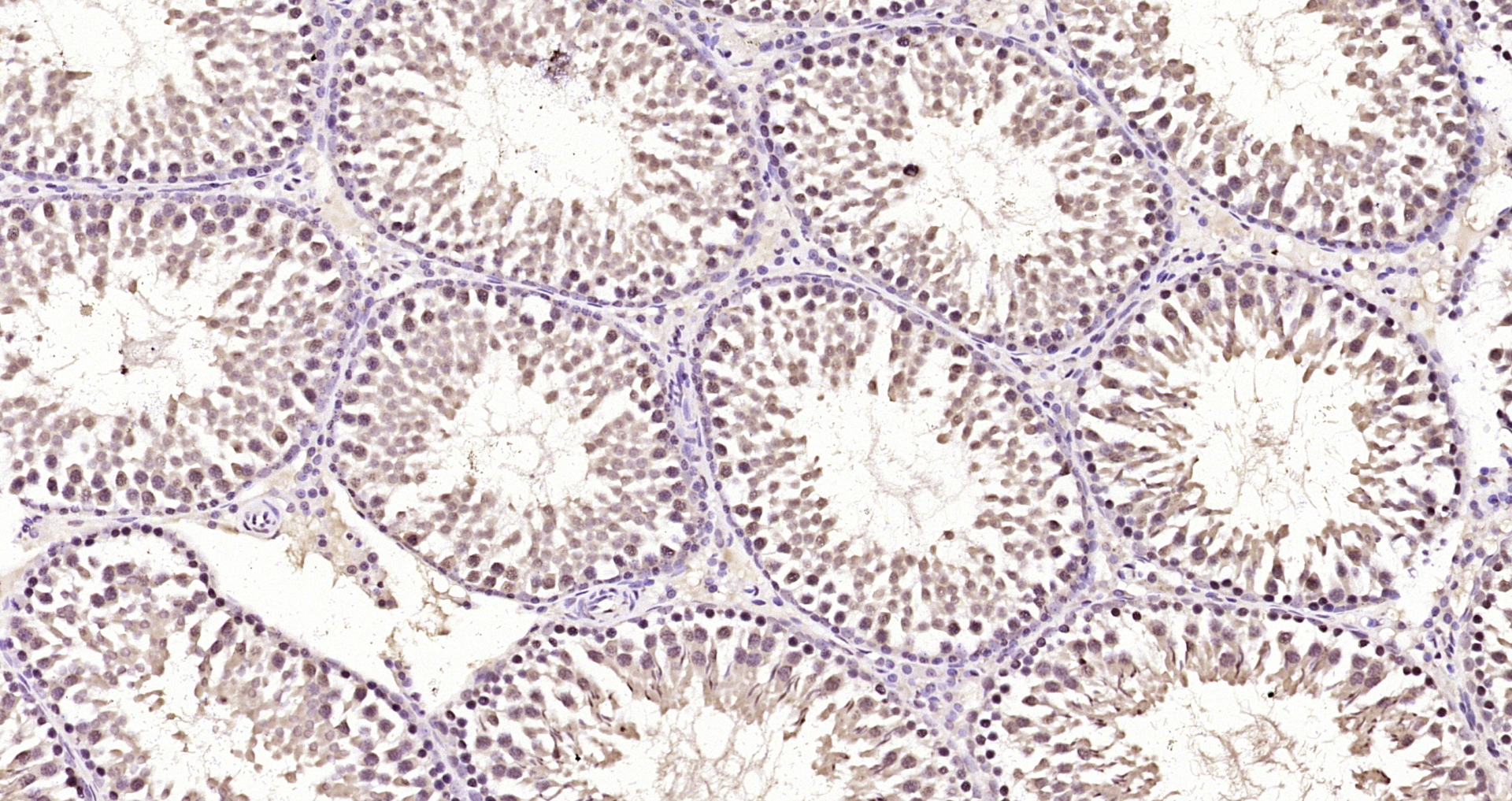
DYRK2 Polyclonal AntibodyBS-12332R
ApplicationsImmunoFluorescence, Western Blot, ELISA, ImmunoCytoChemistry, ImmunoHistoChemistry, ImmunoHistoChemistry Frozen, ImmunoHistoChemistry Paraffin
ReactivityBovine, Canine, Equine, Human, Mouse, Porcine, Rabbit, Rat
TargetDYRK2
- SizePrice
Product group Antibodies

Dyrk2 Polyclonal AntibodyCAC10594
ApplicationsELISA, ImmunoHistoChemistry
TargetDYRK2
- SizePrice
Product group Antibodies

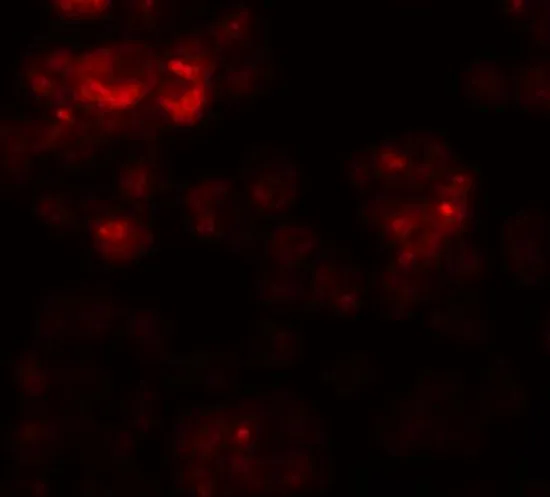
DYRK2 antibodyGTX31833
ApplicationsImmunoFluorescence, Western Blot, ELISA, ImmunoCytoChemistry
ReactivityHuman
TargetDYRK2
- SizePrice
Product group Antibodies

DYRK2 AntibodyLS-C346187
ApplicationsImmunoFluorescence, Western Blot, ImmunoHistoChemistry
ReactivityHuman, Mouse, Rat
TargetDYRK2
- SizePrice

Product group Antibodies

Anti-DYRK2 AntibodyHPA056902
ApplicationsImmunoCytoChemistry
ReactivityHuman
TargetDYRK2
- SizePrice