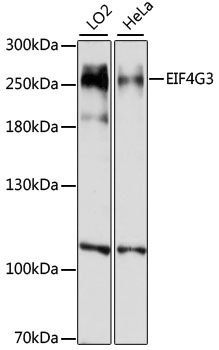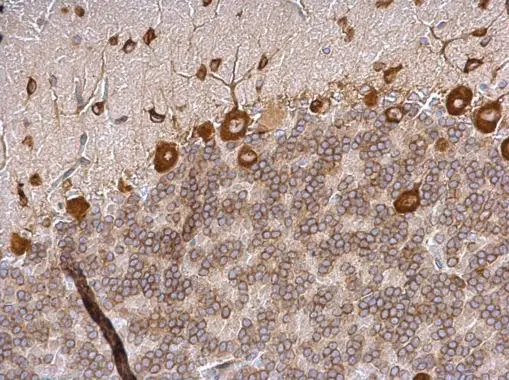
EIF4G3 antibody [N1], N-term detects EIF4G3 protein at cytosol on rat hind brain by immunohistochemical analysis. Sample: Paraffin-embedded rat hind brain. EIF4G3 antibody [N1], N-term (GTX118109) dilution: 1:500.
Antigen Retrieval: Trilogy? (EDTA based, pH 8.0) buffer, 15min
![EIF4G3 antibody [N1], N-term detects EIF4G3 protein at cytoplasm by immunohistochemical analysis. Sample: Paraffin-embedded mouse testis. EIF4G3 stained by EIF4G3 antibody [N1], N-term (GTX118109) diluted at 1:500. Antigen Retrieval: Citrate buffer, pH 6.0, 15 min](https://www.genetex.com/upload/website/prouct_img/normal/GTX118109/GTX118109_42753_20190830_IHC-P_M_w_23060519_414.webp "EIF4G3 antibody [N1], N-term detects EIF4G3 protein at cytoplasm by immunohistochemical analysis. Sample: Paraffin-embedded mouse testis. EIF4G3 stained by EIF4G3 antibody [N1], N-term (GTX118109) diluted at 1:500. Antigen Retrieval: Citrate buffer, pH 6.0, 15 min")
![EIF4G3 antibody [N1], N-term detects EIF4G3 protein at cytoplasm by immunohistochemical analysis. Sample: Paraffin-embedded mouse brain. EIF4G3 stained by EIF4G3 antibody [N1], N-term (GTX118109) diluted at 1:500. Antigen Retrieval: Citrate buffer, pH 6.0, 15 min](https://www.genetex.com/upload/website/prouct_img/normal/GTX118109/GTX118109_42725_20190830_IHC-P_M_w_23060519_840.webp "EIF4G3 antibody [N1], N-term detects EIF4G3 protein at cytoplasm by immunohistochemical analysis. Sample: Paraffin-embedded mouse brain. EIF4G3 stained by EIF4G3 antibody [N1], N-term (GTX118109) diluted at 1:500. Antigen Retrieval: Citrate buffer, pH 6.0, 15 min")
![Mouse tissue extract (50 μg) was separated by 5% SDS-PAGE, and the membrane was blotted with EIF4G3 antibody [N1], N-term (GTX118109) diluted at 1:1000. The HRP-conjugated anti-rabbit IgG antibody (GTX213110-01) was used to detect the primary antibody.](https://www.genetex.com/upload/website/prouct_img/normal/GTX118109/GTX118109_42725_20171201_WB_M_testis_w_23060519_974.webp "Mouse tissue extract (50 μg) was separated by 5% SDS-PAGE, and the membrane was blotted with EIF4G3 antibody [N1], N-term (GTX118109) diluted at 1:1000. The HRP-conjugated anti-rabbit IgG antibody (GTX213110-01) was used to detect the primary antibody.")
![EIF4G3 antibody [N1], N-term detects EIF4G3 protein at cytoplasm by immunofluorescent analysis. Sample: HeLa cells were fixed in 4% paraformaldehyde at RT for 15 min. Green: EIF4G3 protein stained by EIF4G3 antibody [N1], N-term (GTX118109) diluted at 1:500. Blue: Hoechst 33342 staining. Scale bar = 10 μm.](https://www.genetex.com/upload/website/prouct_img/normal/GTX118109/GTX118109_42753_20170419_IFA_w_23060519_340.webp "EIF4G3 antibody [N1], N-term detects EIF4G3 protein at cytoplasm by immunofluorescent analysis. Sample: HeLa cells were fixed in 4% paraformaldehyde at RT for 15 min. Green: EIF4G3 protein stained by EIF4G3 antibody [N1], N-term (GTX118109) diluted at 1:500. Blue: Hoechst 33342 staining. Scale bar = 10 μm.")
![EIF4G3 antibody [N1], N-term detects EIF4G3 protein at cytosol on mouse brain stem by immunohistochemical analysis. Sample: Paraffin-embedded mouse brain stem. EIF4G3 antibody [N1], N-term (GTX118109) dilution: 1:500.
Antigen Retrieval: Trilogy? (EDTA based, pH 8.0) buffer, 15min](https://www.genetex.com/upload/website/prouct_img/normal/GTX118109/GTX118109_40919_IHC_M_w_23060519_740.webp "EIF4G3 antibody [N1], N-term detects EIF4G3 protein at cytosol on mouse brain stem by immunohistochemical analysis. Sample: Paraffin-embedded mouse brain stem. EIF4G3 antibody [N1], N-term (GTX118109) dilution: 1:500.
Antigen Retrieval: Trilogy? (EDTA based, pH 8.0) buffer, 15min")
![Immunoprecipitation of EIF4G3 protein from 293T whole cell extracts using 5 μg of EIF4G3 antibody [N1], N-term (GTX118109). Western blot analysis was performed using EIF4G3 antibody [N1], N-term (GTX118109). EasyBlot anti-Rabbit IgG (GTX221666-01) was used as a secondary reagent.](https://www.genetex.com/upload/website/prouct_img/normal/GTX118109/GTX118109_40919_20150724_IP_w_23060519_507.webp "Immunoprecipitation of EIF4G3 protein from 293T whole cell extracts using 5 μg of EIF4G3 antibody [N1], N-term (GTX118109). Western blot analysis was performed using EIF4G3 antibody [N1], N-term (GTX118109). EasyBlot anti-Rabbit IgG (GTX221666-01) was used as a secondary reagent.")
![EIF4G3 antibody [N1], N-term detects EIF4G3 protein expression by immunohistochemical analysis. Sample: Frozen-sectioned adult mouse cerebellum. Green: EIF4G3 protein stained by EIF4G3 antibody [N1], N-term (GTX118109) diluted at 1:250. Red: NeuN, stained by NeuN antibody [2Q158] (GTX30773) diluted at 1:500. Blue: Fluoroshield with DAPI (GTX30920).](https://www.genetex.com/upload/website/prouct_img/normal/GTX118109/GTX118109_42725_20170807_IHC-Fr_M_w_23060519_755.webp "EIF4G3 antibody [N1], N-term detects EIF4G3 protein expression by immunohistochemical analysis. Sample: Frozen-sectioned adult mouse cerebellum. Green: EIF4G3 protein stained by EIF4G3 antibody [N1], N-term (GTX118109) diluted at 1:250. Red: NeuN, stained by NeuN antibody [2Q158] (GTX30773) diluted at 1:500. Blue: Fluoroshield with DAPI (GTX30920).")
![Various whole cell extracts (30 μg) were separated by 5% SDS-PAGE, and the membrane was blotted with EIF4G3 antibody [N1], N-term (GTX118109) diluted at 1:10000.](https://www.genetex.com/upload/website/prouct_img/normal/GTX118109/GTX118109_42725_20170126_WB_w_23060519_686.webp "Various whole cell extracts (30 μg) were separated by 5% SDS-PAGE, and the membrane was blotted with EIF4G3 antibody [N1], N-term (GTX118109) diluted at 1:10000.")
![EIF4G3 antibody [N1], N-term detects EIF4G3 protein at cytoplasm by immunohistochemical analysis. Sample: Paraffin-embedded rat brain. EIF4G3 stained by EIF4G3 antibody [N1], N-term (GTX118109) diluted at 1:500. Antigen Retrieval: Citrate buffer, pH 6.0, 15 min](https://www.genetex.com/upload/website/prouct_img/normal/GTX118109/GTX118109_42753_20190830_IHC-P_R_w_23060519_289.webp "EIF4G3 antibody [N1], N-term detects EIF4G3 protein at cytoplasm by immunohistochemical analysis. Sample: Paraffin-embedded rat brain. EIF4G3 stained by EIF4G3 antibody [N1], N-term (GTX118109) diluted at 1:500. Antigen Retrieval: Citrate buffer, pH 6.0, 15 min")
EIF4G3 antibody [N1], N-term detects EIF4G3 protein at cytosol on rat hind brain by immunohistochemical analysis. Sample: Paraffin-embedded rat hind brain. EIF4G3 antibody [N1], N-term (GTX118109) dilution: 1:500.
Antigen Retrieval: Trilogy? (EDTA based, pH 8.0) buffer, 15min
EIF4G3 antibody [N1], N-term
GTX118109

ApplicationsImmunoFluorescence, ImmunoPrecipitation, Western Blot, ImmunoCytoChemistry, ImmunoHistoChemistry, ImmunoHistoChemistry Frozen, ImmunoHistoChemistry Paraffin
Product group Antibodies
ReactivityHuman, Mouse, Rat
TargetEIF4G3
Overview
- SupplierGeneTex
- Product NameEIF4G3 antibody [N1], N-term
- Delivery Days Customer9
- Application Supplier NoteWB: 1:500-1:20000. ICC/IF: 1:100-1:1000. IHC-P: 1:100-1:1000. IHC-Fr: 1:100-1:1000. IP: 1:100-1:500. *Optimal dilutions/concentrations should be determined by the researcher.Not tested in other applications.
- ApplicationsImmunoFluorescence, ImmunoPrecipitation, Western Blot, ImmunoCytoChemistry, ImmunoHistoChemistry, ImmunoHistoChemistry Frozen, ImmunoHistoChemistry Paraffin
- CertificationResearch Use Only
- ClonalityPolyclonal
- Concentration0.26 mg/ml
- ConjugateUnconjugated
- Gene ID8672
- Target nameEIF4G3
- Target descriptioneukaryotic translation initiation factor 4 gamma 3
- Target synonymseIF-4G 3, eIF4G 3, eIF4GII, eukaryotic translation initiation factor 4 gamma 3, eIF-4-gamma 3, eIF-4-gamma II
- HostRabbit
- IsotypeIgG
- Protein IDO43432
- Protein NameEukaryotic translation initiation factor 4 gamma 3
- ReactivityHuman, Mouse, Rat
- Storage Instruction-20°C or -80°C,2°C to 8°C
- UNSPSC12352203
References
- Méndez-Solís O, Bendjennat M, Naipauer J, et al. Kaposi's sarcoma herpesvirus activates the hypoxia response to usurp HIF2α-dependent translation initiation for replication and oncogenesis. Cell Rep. 2021,37(13):110144. doi: 10.1016/j.celrep.2021.110144Read this paper
- Theodoridis PR, Bokros M, Marijan D, et al. Local translation in nuclear condensate amyloid bodies. Proc Natl Acad Sci U S A. 2021,118(7). doi: 10.1073/pnas.2014457118Read this paper
- Lin CJ, Chang L, Chu HW, et al. High Amplification of the Antiviral Activity of Curcumin through Transformation into Carbon Quantum Dots. Small. 2019,15(41):e1902641. doi: 10.1002/smll.201902641Read this paper
- Sundararaman B, Zhan L, Blue SM, et al. Resources for the Comprehensive Discovery of Functional RNA Elements. Mol Cell. 2016,61(6):903-13. doi: 10.1016/j.molcel.2016.02.012Read this paper
Datasheet
Related products

Product group Antibodies

EIF4G3 AntibodyCSB-PA007570OA01HU
ApplicationsImmunoFluorescence, ELISA, ImmunoHistoChemistry
ReactivityHuman
TargetEIF4G3
- SizePrice
Product group Antibodies

EIF4G3 AntibodyLS-C749615
ApplicationsWestern Blot
ReactivityHuman, Mouse
TargetEIF4G3
- SizePrice
Product group Antibodies
EIF4G3 antibody, InternalGTX47374
ApplicationsWestern Blot
ReactivityHuman
TargetEIF4G3
- SizePrice
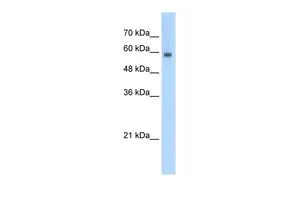
Product group Antibodies
EIF4G3 antibody, N-termGTX47375
ApplicationsWestern Blot
ReactivityHuman
TargetEIF4G3
- SizePrice

Product group Antibodies

Anti-EIF4G3 AntibodyHPA025031
ApplicationsImmunoCytoChemistry, ImmunoHistoChemistry
ReactivityHuman
TargetEIF4G3
- SizePrice