ELISA Kit for Albumin (ALB)
CEB028MU

Product group Assays
Overview
- SupplierCloud-Clone Corp.
- Product NameELISA Kit for Albumin (ALB)
- Delivery Days Customer12
- ApplicationsELISA
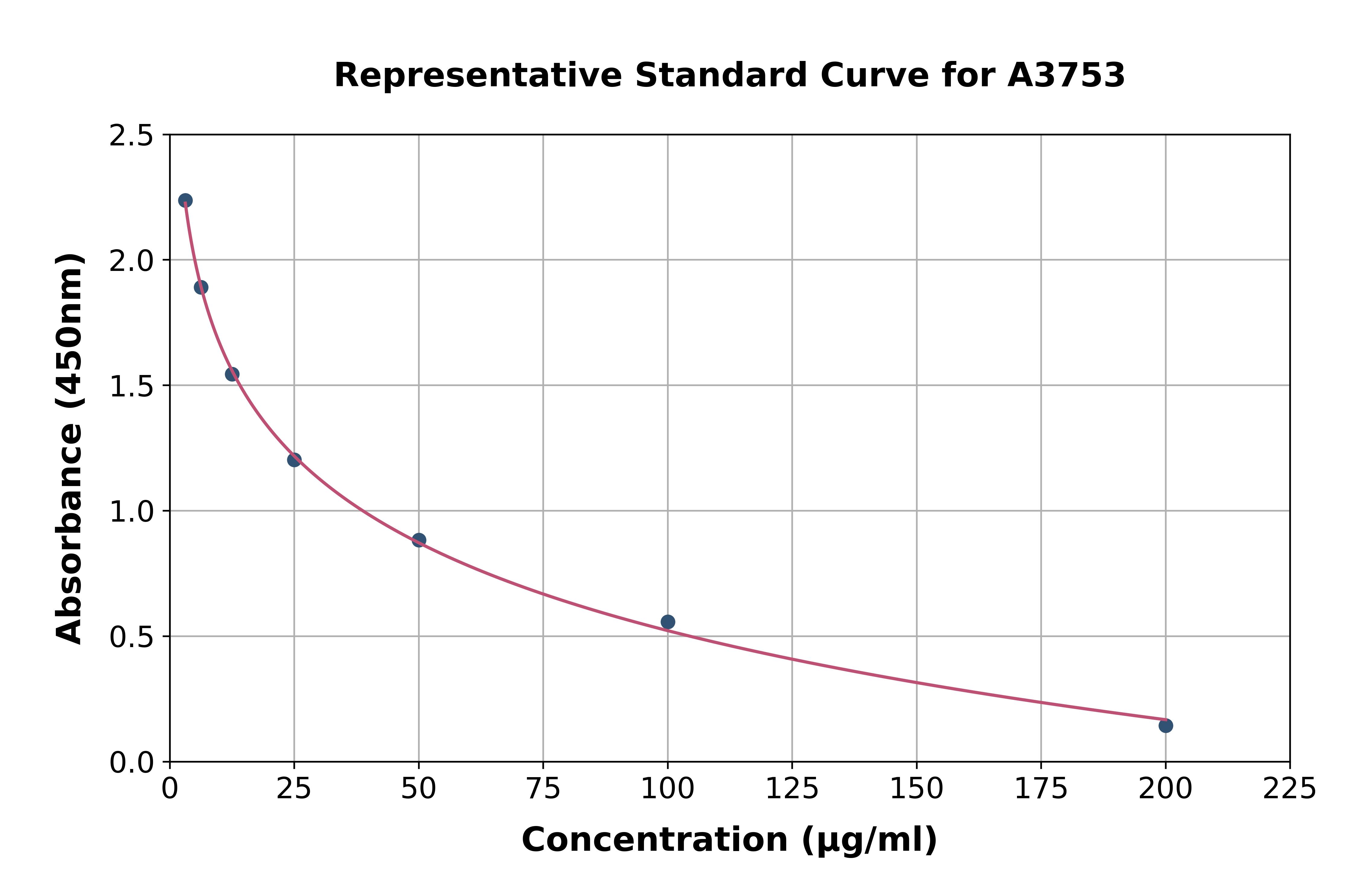
- Assay Detection Range1.23-100ug/mL
- Assay PrecisionIntra-assay Precision (Precision within an assay): 3 samples with low, middle and high level Albumin (ALB) were tested 20 times on one plate, respectively. Inter-assay Precision (Precision between assays): 3 samples with low, middle and high level...
- Assay SensitivityThe minimum detectable dose of this kit is typically less than 0.57ug/mL
- Assay Test PrincipleThis assay employs the competitive inhibition enzyme immunoassay technique. A monoclonal antibody specific to Albumin (ALB) has been pre-coated onto a microplate. A competitive inhibition reaction is launched between biotin labeled Albumin (ALB) and...
- Assay Time2h
- CertificationResearch Use Only
- UNSPSC41116100
References
- GP73 is a TBC-domain Rab GTPase-activating protein contributing to the pathogenesis of non-alcoholic fatty liver disease without obesity. Peng Y et al., 2021 Dec 1, Nat CommunRead this paper
- Syringaresinol Resisted Sepsis-Induced Acute Lung Injury by Suppressing Pyroptosis Via the Oestrogen Receptor-beta Signalling Pathway. Zhuo Y et al., 2022 Apr, InflammationRead this paper
- cGAS promotes sepsis in radiotherapy of cancer by up-regulating caspase-11 signaling. Wu M et al., 2021 Apr 30, Biochem Biophys Res CommunRead this paper
- Resolvin D1 Promotes SIRT1 Expression to Counteract the Activation of STAT3 and NF-kappaB in Mice with Septic-Associated Lung Injury. Zhuo Y et al., 2018 Oct, InflammationRead this paper
- The wnt/beta-catenin signaling pathway participates in rhein ameliorating kidney injury in DN mice. Duan S et al., 2016 Jan, Mol Cell BiochemRead this paper
- Adjunctive corticosteroid therapy improves lung immunopathology and survival during severe secondary pneumococcal pneumonia in mice. Ghoneim HE et al., 2014 May 1, J Infect DisRead this paper
- Simvastatin reduces endotoxin-induced acute lung injury by decreasing neutrophil recruitment and radical formation. Grommes J et al., 2012, PLoS OneRead this paper
Related products
Product group Assays

Assay Sample TypeSerum, plasma and other biological fluids.
ReactivityRat
- SizePrice


Product group Assays

ReactivityHuman
- SizePrice