

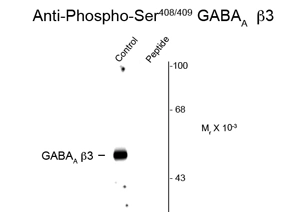
Western blot of rat hippocampal lysate showing specific immunolabeling of the ~53k GABAA beta 3 protein phosphorylated at Ser 408/409 (control) using GABAA Receptor, beta 3 (phospho Ser408/409) antibody (GTX82680). Immunolabeling is blocked by the phospho-peptide (peptide) used as antigen.
Western blot of rat hippocampal lysate showing specific immunolabeling of the ~53k GABAA beta 3 protein phosphorylated at Ser 408/409 (control) using GABAA Receptor, beta 3 (phospho Ser408/409) antibody (GTX82680). Immunolabeling is blocked by the phospho-peptide (peptide) used as antigen.
GABA A Receptor beta 3 (phospho Ser408/409) antibody
GTX82680

ApplicationsWestern Blot
Product group Antibodies
ReactivityRat
TargetGabrb3
Overview
- SupplierGeneTex
- Product NameGABA A Receptor beta 3 (phospho Ser408/409) antibody
- Delivery Days Customer9
- Application Supplier NoteOptimal working dilutions should be determined experimentally by the end user.
- ApplicationsWestern Blot
- CertificationResearch Use Only
- ClonalityPolyclonal
- ConjugateUnconjugated
- Gene ID24922
- Target nameGabrb3
- Target descriptiongamma-aminobutyric acid type A receptor subunit beta 3
- Target synonymsgamma-aminobutyric acid receptor subunit beta-3, GABA(A) receptor subunit beta-3, GABA-alpha receptor beta-3 subunit, GABAAR subunit beta-3, Gamma-aminobutyric acid receptor beta 3, gamma-aminobutyric acid (GABA) A receptor, beta 3, gamma-aminobutyric acid (GABA-A) receptor, subunit beta 3, gamma-aminobutyric acid type A receptor beta 3 subunit, testis gamma-aminobutyric acid receptor subunit beta 3
- HostRabbit
- IsotypeIgG
- Protein IDP63079
- Protein NameGamma-aminobutyric acid receptor subunit beta-3
- Scientific Descriptionbeta 3 subunit, with alpha subunits forms active GABA-A receptors [RGD, Feb 2006]
- ReactivityRat
- Storage Instruction-20°C or -80°C,2°C to 8°C
- UNSPSC12352203
References
- Huang L, Li Q, Wen R, et al. Rho-kinase inhibitor prevents acute injury against transient focal cerebral ischemia by enhancing the expression and function of GABA receptors in rats. Eur J Pharmacol. 2017,797:134-142. doi: 10.1016/j.ejphar.2017.01.021Read this paper
- Huang L, Zhao LB, Yu ZY, et al. Long-term inhibition of Rho-kinase restores the LTP impaired in chronic forebrain ischemia rats by regulating GABAA and GABAB receptors. Neuroscience. 2014,277:383-91. doi: 10.1016/j.neuroscience.2014.07.015Read this paper
Datasheet
Related products
Product group Antibodies
GABA A Receptor beta 3 antibodyGTX82681
ApplicationsWestern Blot
ReactivityMouse, Rat
TargetGabrb3
- SizePrice
Product group Antibodies

GABAA Receptor beta3 AntibodyBS-70105R
ApplicationsWestern Blot, ImmunoHistoChemistry, ImmunoHistoChemistry Paraffin
ReactivityMouse, Rat
TargetGabrb3
- SizePrice