

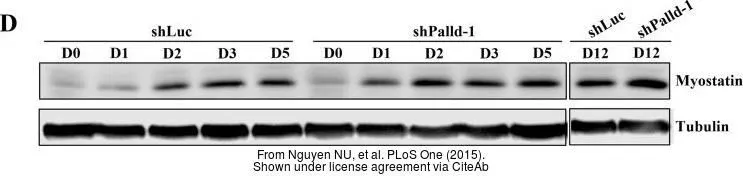
The data was published in the journal PLoS One in 2015.
The data was published in the journal PLoS One in 2015.
GDF8 / Myostatin antibody [13F2]
GTX53334

ApplicationsWestern Blot
Product group Antibodies
ReactivityMouse
TargetMstn
Overview
- SupplierGeneTex
- Product NameGDF8 / Myostatin antibody [13F2]
- Delivery Days Customer9
- Application Supplier NoteWB: 1:500 - 1:2000. *Optimal dilutions/concentrations should be determined by the researcher.Not tested in other applications.
- ApplicationsWestern Blot
- CertificationResearch Use Only
- ClonalityMonoclonal
- Clone ID13F2
- Concentration500 ug/ml
- ConjugateUnconjugated
- Gene ID17700
- Target nameMstn
- Target descriptionmyostatin
- Target synonymsCmpt, Gdf8, growth/differentiation factor 8
- HostRat
- IsotypeIgG2
- Protein IDO08689
- Protein NameGrowth/differentiation factor 8
- Scientific DescriptionThis gene encodes a secreted ligand of the TGF-beta (transforming growth factor-beta) superfamily of proteins. Ligands of this family bind various TGF-beta receptors leading to recruitment and activation of SMAD family transcription factors that regulate gene expression. The encoded preproprotein is proteolytically processed to generate each subunit of the disulfide-linked homodimer. This protein negatively regulates skeletal muscle cell proliferation and differentiation. Homozygous knockout mice for this gene exhibit increased muscle mass and bone density, and reduced adiposity. [provided by RefSeq, Jul 2016]
- ReactivityMouse
- Storage Instruction-20°C or -80°C,2°C to 8°C
- UNSPSC41116161
References
- Dual roles of palladin protein in in vitro myogenesis: inhibition of early induction but promotion of myotube maturation. Nguyen NU et al., 2015, PLoS OneRead this paper
Datasheet
Related products
Product group Antibodies

ApplicationsImmunoPrecipitation, Western Blot, ImmunoCytoChemistry, ImmunoHistoChemistry
ReactivityMouse, Rat
TargetMstn
- SizePrice