

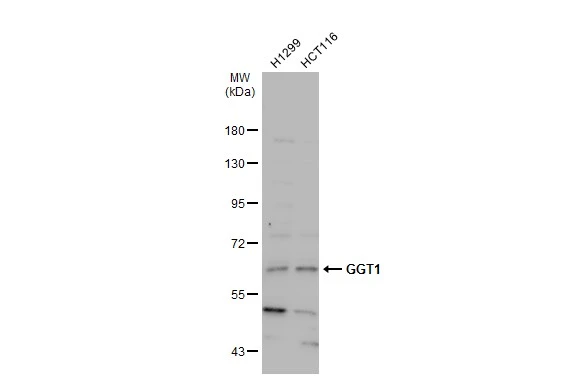
Various whole cell extracts (30 μg) were separated by 7.5% SDS-PAGE, and the membrane was blotted with GGT1 antibody (GTX101198) diluted at 1:1000. The HRP-conjugated anti-rabbit IgG antibody (GTX213110-01) was used to detect the primary antibody.
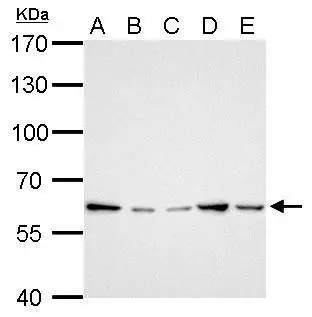
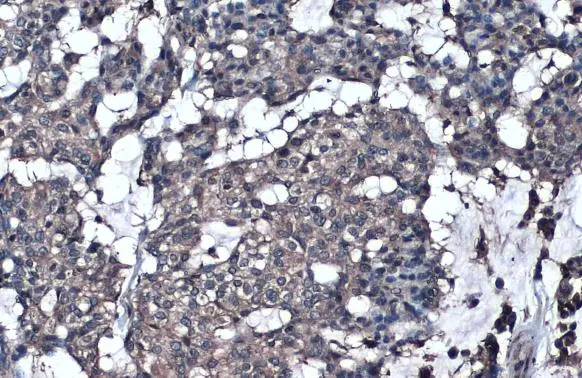
Various whole cell extracts (30 μg) were separated by 7.5% SDS-PAGE, and the membrane was blotted with GGT1 antibody (GTX101198) diluted at 1:1000. The HRP-conjugated anti-rabbit IgG antibody (GTX213110-01) was used to detect the primary antibody.
GGT1 antibody
GTX101198

ApplicationsWestern Blot, ImmunoHistoChemistry, ImmunoHistoChemistry Paraffin
Product group Antibodies
ReactivityHuman, Mouse
TargetGGT1
Overview
- SupplierGeneTex
- Product NameGGT1 antibody
- Delivery Days Customer9
- Application Supplier NoteWB: 1:500-1:3000. IHC-P: 1:100-1:1000. *Optimal dilutions/concentrations should be determined by the researcher.Not tested in other applications.
- ApplicationsWestern Blot, ImmunoHistoChemistry, ImmunoHistoChemistry Paraffin
- CertificationResearch Use Only
- ClonalityPolyclonal
- Concentration0.71 mg/ml
- ConjugateUnconjugated
- Gene ID2678
- Target nameGGT1
- Target descriptiongamma-glutamyltransferase 1
- Target synonymsCD224, D22S672, D22S732, GGT, GGT 1, GGTD, GTG, glutathione hydrolase 1 proenzyme, gamma-glutamyltranspeptidase 1, leukotriene-C4 hydrolase, testicular tissue protein Li 73
- HostRabbit
- IsotypeIgG
- Protein IDP19440
- Protein NameGlutathione hydrolase 1 proenzyme
- Scientific DescriptionThe enzyme encoded by this gene catalyzes the transfer of the glutamyl moiety of glutathione to a variety of amino acids and dipeptide acceptors. The enzyme is composed of a heavy chain and a light chain, which are derived from a single precursor protein, and is present in tissues involved in absorption and secretion. This enzyme is a member of the gamma-glutamyltransferase protein family, of which many members have not yet been fully characterized and some of which may represent pseudogenes. This gene is classified as type I gamma-glutamyltransferase. Multiple alternatively spliced variants, encoding the same protein, have been identified. [provided by RefSeq]
- ReactivityHuman, Mouse
- Storage Instruction-20°C or -80°C,2°C to 8°C
- UNSPSC41116161
Datasheet
Related products
Product group Antibodies

Anti-GGT1 AntibodyA101435
ApplicationsWestern Blot, ELISA
ReactivityHuman
- SizePrice
Product group Antibodies

Anti-GGT1 Antibody144-01776
ApplicationsWestern Blot, ImmunoHistoChemistry
ReactivityHuman, Mouse, Rat
TargetGGT1
- SizePrice
Product group Antibodies

Goat anti-GGT1EB11992
ApplicationsWestern Blot, ELISA
ReactivityHuman
TargetGGT1
- SizePrice
Product group Antibodies

GGT1 Polyclonal AntibodyCAC13269
ApplicationsImmunoFluorescence, ELISA, ImmunoHistoChemistry
TargetGGT1
- SizePrice
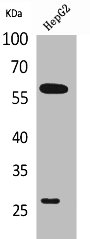
Product group Antibodies

GGT1 AntibodyCSB-PA005261
ApplicationsWestern Blot, ELISA
ReactivityHuman
TargetGGT1
- SizePrice
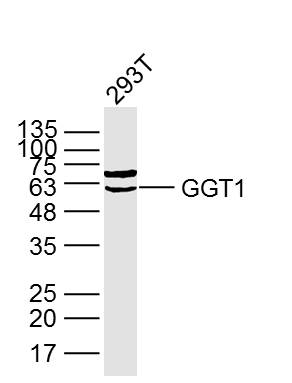
Product group Antibodies

GGT1 Polyclonal AntibodyBS-2976R
ApplicationsFlow Cytometry, Western Blot, ELISA
ReactivityHuman, Mouse, Rat
TargetGGT1
- SizePrice

Product group Antibodies

ApplicationsWestern Blot, ImmunoHistoChemistry
ReactivityHuman
TargetGGT1
- SizePrice
Product group Antibodies

GGT1 / GGT Antibody (aa1-225)LS-C401711
ApplicationsWestern Blot, ELISA, ImmunoHistoChemistry
ReactivityHuman, Rat
TargetGGT1
- SizePrice
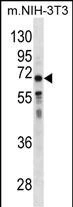
Product group Antibodies
GGT1 antibodyGTX04721
ApplicationsWestern Blot
ReactivityHuman, Mouse
TargetGGT1
- SizePrice
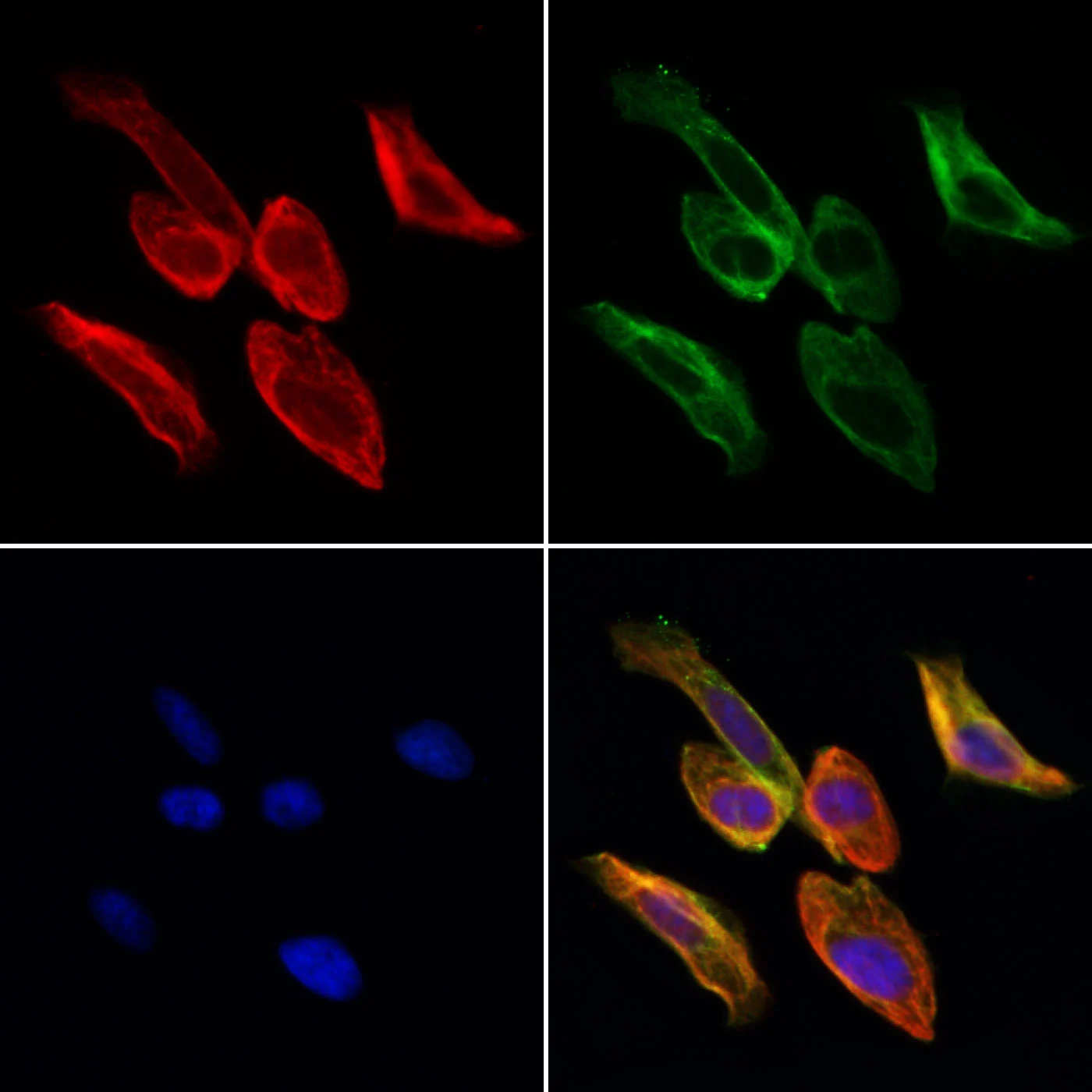
Product group Antibodies
GGT1 antibodyGTX04723
ApplicationsImmunoFluorescence, Western Blot, ImmunoCytoChemistry
ReactivityHuman, Mouse
TargetGGT1
- SizePrice