

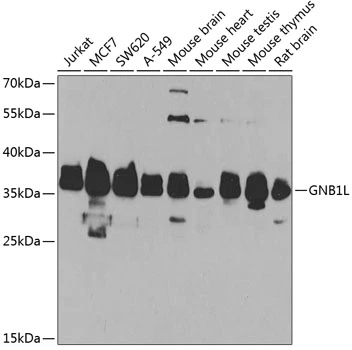
WB analysis of various sample lysates using GTX66505 GNB1L antibody. Dilution : 1:1000 Loading : 25microg per lane
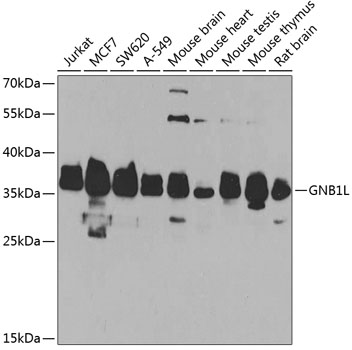
WB analysis of various sample lysates using GTX66505 GNB1L antibody. Dilution : 1:1000 Loading : 25microg per lane
GNB1L antibody
GTX66505

ApplicationsWestern Blot
Product group Antibodies
ReactivityHuman, Mouse, Rat
TargetGNB1L
Overview
- SupplierGeneTex
- Product NameGNB1L antibody
- Delivery Days Customer9
- Application Supplier NoteWB: 1:500 - 1:2000. *Optimal dilutions/concentrations should be determined by the researcher.Not tested in other applications.
- ApplicationsWestern Blot
- CertificationResearch Use Only
- ClonalityPolyclonal
- ConjugateUnconjugated
- Gene ID54584
- Target nameGNB1L
- Target descriptionG protein subunit beta 1 like
- Target synonymsDGCRK3, FKSG1, GY2, WDR14, WDVCF, guanine nucleotide-binding protein subunit beta-like protein 1, G-protein beta subunit-like protein, WD repeat-containing protein 14, WD40 repeat-containing protein deleted in VCFS, g protein subunit beta-like protein 1, guanine nucleotide binding protein (G protein), beta polypeptide 1-like, guanine nucleotide binding protein beta-subunit-like polypeptide
- HostRabbit
- IsotypeIgG
- Protein IDQ9BYB4
- Protein NameGuanine nucleotide-binding protein subunit beta-like protein 1
- Scientific DescriptionThis gene encodes a G-protein beta-subunit-like polypeptide which is a member of the WD repeat protein family. WD repeats are minimally conserved regions of approximately 40 amino acids typically bracketed by gly-his and trp-asp (GH-WD), which may facilitate formation of heterotrimeric or multiprotein complexes. Members of this family are involved in a variety of cellular processes, including cell cycle progression, signal transduction, apoptosis, and gene regulation. This protein contains 6 WD repeats and is highly expressed in the heart. The gene maps to the region on chromosome 22q11, which is deleted in DiGeorge syndrome, trisomic in derivative 22 syndrome and tetrasomic in cat-eye syndrome. Therefore, this gene may contribute to the etiology of those disorders. Transcripts from this gene share exons with some transcripts from the C22orf29 gene. [provided by RefSeq, Jul 2008]
- ReactivityHuman, Mouse, Rat
- Storage Instruction-20°C or -80°C,2°C to 8°C
- UNSPSC12352203
Datasheet
Related products

Product group Antibodies

GNB1L Polyclonal AntibodyBS-13465R
ApplicationsImmunoFluorescence, ELISA, ImmunoCytoChemistry, ImmunoHistoChemistry, ImmunoHistoChemistry Frozen, ImmunoHistoChemistry Paraffin
ReactivityCanine, Equine, Human, Mouse, Rat, Zebra Fish
TargetGNB1L
- SizePrice
Product group Antibodies

Anti-GNB1L AntibodyA15911
ApplicationsWestern Blot
ReactivityHuman, Mouse, Rat
- SizePrice
Product group Antibodies

Anti-GNB1L Antibody144-07810
ApplicationsWestern Blot
ReactivityHuman, Mouse, Rat
TargetGNB1L
- SizePrice
Product group Antibodies

GNB1L / FKSG1 AntibodyLS-C830014
ApplicationsELISA, ImmunoHistoChemistry
ReactivityHuman, Mouse
TargetGNB1L
- SizePrice
Product group Antibodies
GNB1L antibody, C-termGTX47168
ApplicationsWestern Blot, ImmunoHistoChemistry, ImmunoHistoChemistry Paraffin
ReactivityHuman
TargetGNB1L
- SizePrice
Product group Antibodies

GNB1L AntibodyCSB-PA866315ESR1HU
ApplicationsWestern Blot, ELISA
ReactivityHuman
TargetGNB1L
- SizePrice

Product group Antibodies

Anti-GNB1L AntibodyA11797
ApplicationsWestern Blot
ReactivityHuman, Mouse, Rat
TargetGNB1L
- SizePrice