

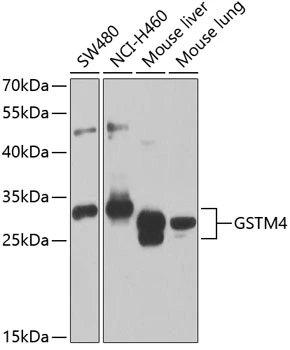
WB analysis of various sample lysates using GTX32637 GSTM4 antibody. The signal was developed with ECL plus-Enhanced. Dilution : 1:1000 Loading : 25μg per lane
WB analysis of various sample lysates using GTX32637 GSTM4 antibody. The signal was developed with ECL plus-Enhanced. Dilution : 1:1000 Loading : 25μg per lane
GSTM4 antibody
GTX32637

ApplicationsWestern Blot
Product group Antibodies
ReactivityHuman, Mouse
TargetGSTM4
Overview
- SupplierGeneTex
- Product NameGSTM4 antibody
- Delivery Days Customer9
- Application Supplier NoteWB: 1:500 - 1:2000. *Optimal dilutions/concentrations should be determined by the researcher.Not tested in other applications.
- ApplicationsWestern Blot
- CertificationResearch Use Only
- ClonalityPolyclonal
- ConjugateUnconjugated
- Gene ID2948
- Target nameGSTM4
- Target descriptionglutathione S-transferase mu 4
- Target synonymsGSTM4-4, GTM4, glutathione S-transferase Mu 4, GST class-mu 4, GST-Mu2, GTS-Mu2, S-(hydroxyalkyl)glutathione lyase M4, glutathione S-alkyltransferase M4, glutathione S-aralkyltransferase M4, glutathione S-aryltransferase M4, glutathione S-transferase M4, leukotriene C4 synthase GSTM4, testis tissue sperm-binding protein Li 60n
- HostRabbit
- IsotypeIgG
- Protein IDQ03013
- Protein NameGlutathione S-transferase Mu 4
- Scientific DescriptionCytosolic and membrane-bound forms of glutathione S-transferase are encoded by two distinct supergene families. At present, eight distinct classes of the soluble cytoplasmic mammalian glutathione S-transferases have been identified: alpha, kappa, mu, omega, pi, sigma, theta and zeta. This gene encodes a glutathione S-transferase that belongs to the mu class. The mu class of enzymes functions in the detoxification of electrophilic compounds, including carcinogens, therapeutic drugs, environmental toxins and products of oxidative stress, by conjugation with glutathione. The genes encoding the mu class of enzymes are organized in a gene cluster on chromosome 1p13.3 and are known to be highly polymorphic. These genetic variations can change an individuals susceptibility to carcinogens and toxins as well as affect the toxicity and efficacy of certain drugs. Diversification of these genes has occurred in regions encoding substrate-binding domains, as well as in tissue expression patterns, to accommodate an increasing number of foreign compounds. Multiple transcript variants, each encoding a distinct protein isoform, have been identified. [provided by RefSeq, Jul 2008]
- ReactivityHuman, Mouse
- Storage Instruction-20°C or -80°C,2°C to 8°C
- UNSPSC12352203
References
- Jou YC, Wang SC, Dia YC, et al. Anti-Cancer Effects and Tumor Marker Role of Glutathione S-Transferase Mu 5 in Human Bladder Cancer. Int J Mol Sci. 2021,22(6). doi: 10.3390/ijms22063056Read this paper
Datasheet
Related products
Product group Antibodies

Anti-GSTM4 Antibody144-07434
ApplicationsWestern Blot
ReactivityHuman, Mouse
TargetGSTM4
- SizePrice
Product group Antibodies

GSTM4 AntibodyCSB-PA009984ESR1HU
ApplicationsWestern Blot, ELISA, ImmunoHistoChemistry
ReactivityHuman, Rat
TargetGSTM4
- SizePrice

Product group Antibodies

Anti-GSTM4 AntibodyA32060
ApplicationsWestern Blot, ImmunoHistoChemistry
ReactivityHuman, Mouse
- SizePrice
Product group Antibodies

ApplicationsImmunoPrecipitation, Western Blot, ImmunoCytoChemistry, ImmunoHistoChemistry
ReactivityMouse, Rat
TargetGSTM4
- SizePrice
Product group Antibodies

Goat anti-GSTM4 AntibodyEB13026
ApplicationsWestern Blot, ELISA, ImmunoHistoChemistry
ReactivityHuman, Mouse, Rat
TargetGSTM4
- SizePrice
Product group Antibodies

GSTM4-4 / GSTM4 AntibodyLS-C349137
ApplicationsWestern Blot, ImmunoHistoChemistry
ReactivityHuman, Mouse
TargetGSTM4
- SizePrice

Product group Antibodies

ApplicationsWestern Blot
ReactivityHuman, Mouse
TargetGSTM4
- SizePrice