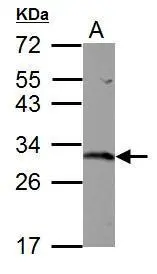
Sample (30 ug of whole cell lysate) A: HepG2 12% SDS PAGE GTX118439 diluted at 1:5000
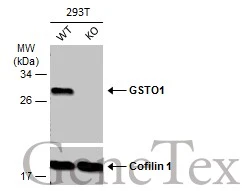
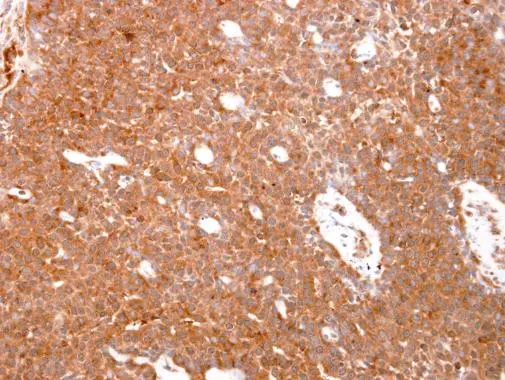
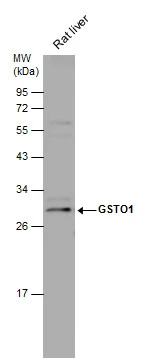
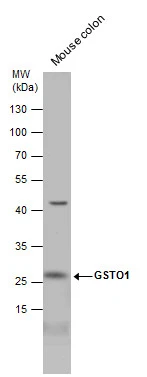
Sample (30 ug of whole cell lysate) A: HepG2 12% SDS PAGE GTX118439 diluted at 1:5000
GSTO1 antibody
GTX118439

ApplicationsWestern Blot, ImmunoHistoChemistry, ImmunoHistoChemistry Paraffin
Product group Antibodies
ReactivityHuman, Mouse, Rat
TargetGSTO1
Overview
- SupplierGeneTex
- Product NameGSTO1 antibody
- Delivery Days Customer9
- Application Supplier NoteWB: 1:500-1:10000. IHC-P: 1:100-1:1000. *Optimal dilutions/concentrations should be determined by the researcher.Not tested in other applications.
- ApplicationsWestern Blot, ImmunoHistoChemistry, ImmunoHistoChemistry Paraffin
- CertificationResearch Use Only
- ClonalityPolyclonal
- Concentration1 mg/ml
- ConjugateUnconjugated
- Gene ID9446
- Target nameGSTO1
- Target descriptionglutathione S-transferase omega 1
- Target synonymsGSTO 1-1, GSTTLp28, HEL-S-21, P28, SPG-R, glutathione S-transferase omega-1, MMA(V) reductase, S-(Phenacyl)glutathione reductase, epididymis secretory protein Li 21, glutathione S-transferase omega 1-1, glutathione-S-transferase like, glutathione-dependent dehydroascorbate reductase, monomethylarsonic acid reductase
- HostRabbit
- IsotypeIgG
- Protein IDP78417
- Protein NameGlutathione S-transferase omega-1
- Scientific DescriptionThis gene encodes a member of the theta class glutathione S-transferase-like (GSTTL) protein family. In mouse, the encoded protein acts as a small stress response protein, likely involved in cellular redox homeostasis. [provided by RefSeq]
- ReactivityHuman, Mouse, Rat
- Storage Instruction-20°C or -80°C,2°C to 8°C
- UNSPSC41116161
Datasheet
Related products
Product group Antibodies

Anti-GSTO1 AntibodyA31190
ApplicationsWestern Blot, ImmunoHistoChemistry
ReactivityHuman, Mouse, Rat
- SizePrice
Product group Antibodies

Anti-GSTO1 Antibody144-61010
ApplicationsWestern Blot
ReactivityHuman, Mouse, Rat
TargetGSTO1
- SizePrice
Product group Antibodies

GSTO1 Recombinant Antibody, AbBy Fluor-405 ConjugatedBSM-62273R-BF405
ApplicationsImmunoFluorescence, Western Blot
ReactivityHuman, Rat
TargetGSTO1
- SizePrice
Product group Antibodies

Goat anti-GSTO1EB12411
ApplicationsWestern Blot, ELISA
ReactivityHuman
TargetGSTO1
- SizePrice
Product group Antibodies

GSTO1 AntibodyCSB-PA748508
ApplicationsWestern Blot, ELISA, ImmunoHistoChemistry
ReactivityHuman
TargetGSTO1
- SizePrice
Product group Antibodies

ApplicationsImmunoPrecipitation, Western Blot, ImmunoCytoChemistry, ImmunoHistoChemistry
ReactivityMouse
TargetGSTO1
- SizePrice
Product group Antibodies

ApplicationsImmunoFluorescence, Western Blot, ImmunoCytoChemistry
ReactivityHuman
TargetGSTO1
- SizePrice
Product group Antibodies

GSTO1 AntibodyLS-C401731
ApplicationsWestern Blot, ELISA, ImmunoHistoChemistry
ReactivityHuman
TargetGSTO1
- SizePrice
![Wild-type (WT) and GSTO1 knockout (KO) 293T cell extracts (30 μg) were separated by 12% SDS-PAGE, and the membrane was blotted with GSTO1 antibody [N1C3] (GTX105655) diluted at 1:2000. The HRP-conjugated anti-rabbit IgG antibody (GTX213110-01) was used to detect the primary antibody, and the signal was developed with Trident ECL plus-Enhanced.](https://www.genetex.com/upload/website/prouct_img/normal/GTX105655/GTX105655_39785_20180119_WB_KO_watermark_w_23060120_891.webp)
Product group Antibodies
GSTO1 antibody [N1C3]GTX105655
ApplicationsWestern Blot, ImmunoHistoChemistry, ImmunoHistoChemistry Paraffin
ReactivityHuman, Mouse
TargetGSTO1
- SizePrice