

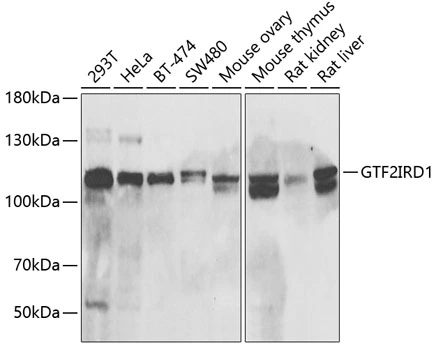
WB analysis of various sample lysates using GTX33232 GTF2IRD1 antibody. The signal was developed with ECL plus-Enhanced. Dilution : 1:1000 Loading : 25μg per lane
WB analysis of various sample lysates using GTX33232 GTF2IRD1 antibody. The signal was developed with ECL plus-Enhanced. Dilution : 1:1000 Loading : 25μg per lane
GTF2IRD1 antibody
GTX33232

ApplicationsWestern Blot
Product group Antibodies
ReactivityHuman, Mouse, Rat
TargetGTF2IRD1
Overview
- SupplierGeneTex
- Product NameGTF2IRD1 antibody
- Delivery Days Customer9
- Application Supplier NoteWB: 1:500 - 1:2000. *Optimal dilutions/concentrations should be determined by the researcher.Not tested in other applications.
- ApplicationsWestern Blot
- CertificationResearch Use Only
- ClonalityPolyclonal
- ConjugateUnconjugated
- Gene ID9569
- Target nameGTF2IRD1
- Target descriptionGTF2I repeat domain containing 1
- Target synonymsBEN, CREAM1, GTF3, MUSTRD1, RBAP2, WBS, WBSCR11, WBSCR12, hMusTRD1alpha1, general transcription factor II-I repeat domain-containing protein 1, USE B1-binding protein, Williams-Beuren syndrome chromosome region 11, binding factor for early enhancer, general transcription factor 3, general transcription factor III, muscle TFII-I repeat domain-containing protein 1 alpha 1, slow-muscle-fiber enhancer-binding protein, williams-Beuren syndrome chromosomal region 12 protein
- HostRabbit
- IsotypeIgG
- Protein IDQ9UHL9
- Protein NameGeneral transcription factor II-I repeat domain-containing protein 1
- Scientific DescriptionThe protein encoded by this gene contains five GTF2I-like repeats and each repeat possesses a potential helix-loop-helix (HLH) motif. It may have the ability to interact with other HLH-proteins and function as a transcription factor or as a positive transcriptional regulator under the control of Retinoblastoma protein. This gene plays a role in craniofacial and cognitive development and mutations have been associated with Williams-Beuren syndrome, a multisystem developmental disorder caused by deletion of multiple genes at 7q11.23. Alternative splicing results in multiple transcript variants. [provided by RefSeq, Nov 2010]
- ReactivityHuman, Mouse, Rat
- Storage Instruction-20°C or -80°C,2°C to 8°C
- UNSPSC41116161
Datasheet
Related products
Product group Antibodies

Anti-GTF2IRD1 AntibodyA285963
ApplicationsFlow Cytometry, ImmunoFluorescence, Western Blot, ELISA
ReactivityHuman
- SizePrice

Product group Antibodies

Anti-WBSCR11 GTF2IRD1 AntibodyA04254-2
ApplicationsImmunoFluorescence, Western Blot, ELISA, ImmunoHistoChemistry
ReactivityHuman, Mouse, Rat
TargetGTF2IRD1
- SizePrice
Product group Antibodies

Anti-GTF2IRD1 Antibody144-06613
ApplicationsWestern Blot
ReactivityHuman, Mouse, Rat
TargetGTF2IRD1
- SizePrice
Product group Antibodies

GTF2IRD1 AntibodyCSB-PA004483
ApplicationsWestern Blot, ELISA, ImmunoHistoChemistry
ReactivityHuman, Mouse, Rat
TargetGTF2IRD1
- SizePrice
Product group Antibodies

Goat anti-GTF2IRD1EB07355
ApplicationsFlow Cytometry, ImmunoFluorescence, Western Blot, ELISA
ReactivityCanine, Human, Mouse, Rat
TargetGTF2IRD1
- SizePrice
Product group Antibodies

GTF3 / GTF2IRD1 Antibody (N-Terminus)LS-C368678
ApplicationsImmunoPrecipitation, Western Blot, ImmunoHistoChemistry, ImmunoHistoChemistry Paraffin
ReactivityHuman, Mouse
TargetGTF2IRD1
- SizePrice

Product group Antibodies

Anti-GTF2IRD1 AntibodyHPA044254
ApplicationsWestern Blot, ImmunoCytoChemistry, ImmunoHistoChemistry
ReactivityHuman
TargetGTF2IRD1
- SizePrice
Product group Antibodies
GTF2IRD1 antibodyGTX131433
ApplicationsImmunoFluorescence, Western Blot, ImmunoCytoChemistry
ReactivityHuman
TargetGTF2IRD1
- SizePrice
Product group Antibodies

Anti-GTF2IRD1 AntibodyCAB6613
ApplicationsWestern Blot, ELISA
ReactivityHuman
TargetGTF2IRD1
- SizePrice