

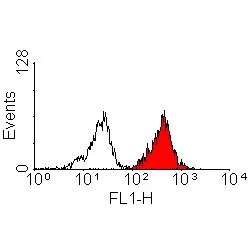
FACS analysis of human peripheral blood lymphocytes using GTX75803 HLA-A2 antibody [BB7.2].
FACS analysis of human peripheral blood lymphocytes using GTX75803 HLA-A2 antibody [BB7.2].
HLA-A2 antibody [BB7.2]
GTX75803

ApplicationsFlow Cytometry, ImmunoPrecipitation, ImmunoHistoChemistry, ImmunoHistoChemistry Frozen
Product group Antibodies
ReactivityHuman
TargetHLA-A
Overview
- SupplierGeneTex
- Product NameHLA-A2 antibody [BB7.2]
- Delivery Days Customer9
- Application Supplier NoteFACS: 10microg/ml. *Optimal dilutions/concentrations should be determined by the researcher.Not tested in other applications.
- ApplicationsFlow Cytometry, ImmunoPrecipitation, ImmunoHistoChemistry, ImmunoHistoChemistry Frozen
- CertificationResearch Use Only
- ClonalityMonoclonal
- Clone IDBB7.2
- Concentration1 mg/ml
- ConjugateUnconjugated
- Gene ID3105
- Target nameHLA-A
- Target descriptionmajor histocompatibility complex, class I, A
- Target synonymsHLAA, HLA class I histocompatibility antigen, A alpha chain, HLA class I histocompatibility antigen, A-1 alpha chain, MHC class I antigen HLA-A heavy chain, leukocyte antigen class I-A
- HostMouse
- IsotypeIgG2b
- Scientific DescriptionHLA-A belongs to the HLA class I heavy chain paralogues. This class I molecule is a heterodimer consisting of a heavy chain and a light chain (beta-2 microglobulin). The heavy chain is anchored in the membrane. Class I molecules play a central role in the immune system by presenting peptides derived from the endoplasmic reticulum lumen. They are expressed in nearly all cells. The heavy chain is approximately 45 kDa and its gene contains 8 exons. Exon 1 encodes the leader peptide, exons 2 and 3 encode the alpha1 and alpha2 domains, which both bind the peptide, exon 4 encodes the alpha3 domain, exon 5 encodes the transmembrane region, and exons 6 and 7 encode the cytoplasmic tail. Polymorphisms within exon 2 and exon 3 are responsible for the peptide binding specificity of each class one molecule. Typing for these polymorphisms is routinely done for bone marrow and kidney transplantation. Hundreds of HLA-A alleles have been described. [provided by RefSeq, Jul 2008]
- ReactivityHuman
- Storage Instruction-20°C or -80°C,2°C to 8°C
- UNSPSC12352203
References
- Repáraz D, Ruiz M, Llopiz D, et al. Neoantigens as potential vaccines in hepatocellular carcinoma. J Immunother Cancer. 2022,10(2). doi: 10.1136/jitc-2021-003978Read this paper
- Bonaventura P, Alcazer V, Mutez V, et al. Identification of shared tumor epitopes from endogenous retroviruses inducing high-avidity cytotoxic T cells for cancer immunotherapy. Sci Adv. 2022,8(4):eabj3671. doi: 10.1126/sciadv.abj3671Read this paper
- Wu L, Zhang H, Jiang Y, et al. Induction of antitumor cytotoxic lymphocytes using engineered human primary blood dendritic cells. Proc Natl Acad Sci U S A. 2018,115(19):E4453-E4462. doi: 10.1073/pnas.1800550115Read this paper
- Chung B, Stuge TB, Murad JP, et al. Antigen-specific inhibition of high-avidity T cell target lysis by low-avidity T cells via trogocytosis. Cell Rep. 2014,8(3):871-882. doi: 10.1016/j.celrep.2014.06.052Read this paper
- Liu B, Zhong S, Malecek K, et al. 2D TCR-pMHC-CD8 kinetics determines T-cell responses in a self-antigen-specific TCR system. Eur J Immunol. 2014,44(1):239-50. doi: 10.1002/eji.201343774Read this paper
Datasheet
Related products
Product group Antibodies

Anti-HLA-class I [YTH 862.2]Ab00200-1.1
ApplicationsFlow Cytometry, ImmunoFluorescence, ImmunoPrecipitation
ReactivityHuman
TargetHLA-A
- SizePrice
Product group Antibodies

ReactivityHuman, Mouse, Primate
TargetHLA-A
- SizePrice


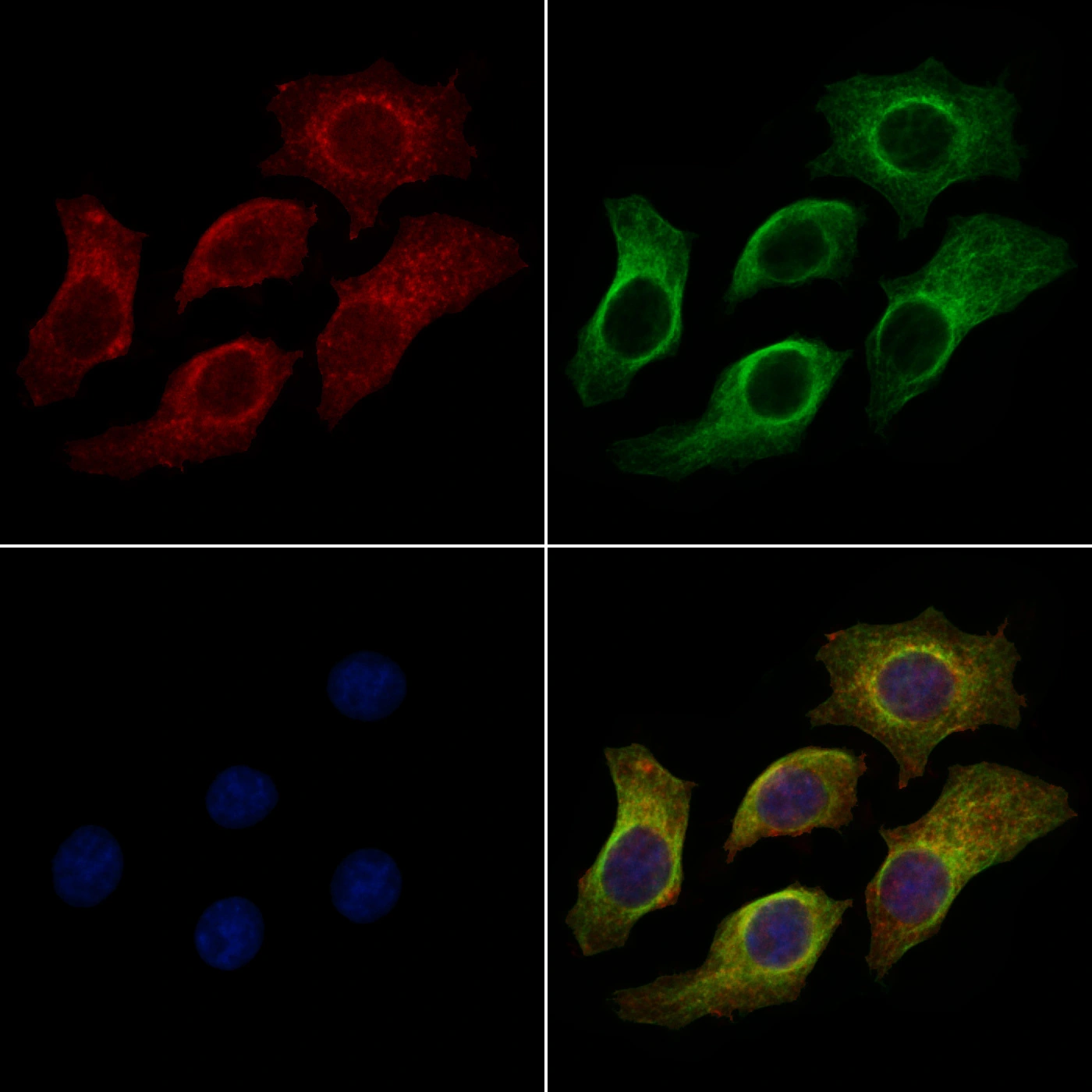
Product group Antibodies
HLA Class I antibodyGTX04853
ApplicationsImmunoFluorescence, Western Blot, ImmunoCytoChemistry, ImmunoHistoChemistry, ImmunoHistoChemistry Paraffin
ReactivityHuman, Mouse
TargetHLA-A
- SizePrice
![HLA-A antibody [N1C2] immunoprecipitates HLA-A protein in IP experiments. IP samples: A549 whole cell extract A. Control with 4 μg of preimmune Rabbit IgG B. Immunoprecipitation of HLA-A protein by 4 μg HLA-A antibody [N1C2] (GTX114080) 10 % SDS-PAGE The immunoprecipitated HLA-A protein was detected by HLA-A antibody [N1C2] (GTX114080) diluted at 1:500. [EasyBlot anti-rabbit IgG (GTX221666-01) was used as a secondary reagent]](https://www.genetex.com/upload/website/prouct_img/normal/GTX114080/GTX114080_40611_IP_w_23060501_714.webp)
Product group Antibodies
References
HLA-A antibody [N1C2]GTX114080
ApplicationsImmunoPrecipitation, Western Blot, ImmunoHistoChemistry, ImmunoHistoChemistry Paraffin
ReactivityHuman
TargetHLA-A
- SizePrice
![Non-transfected (–) and transfected (+) 293T whole cell extracts (30 μg) were separated by 10% SDS-PAGE, and the membrane was blotted with HLA class I antibody [HL1882] (GTX637631) diluted at 1:5000. The HRP-conjugated anti-rabbit IgG antibody (GTX213110-01) was used to detect the primary antibody.](https://www.genetex.com/upload/website/prouct_img/normal/GTX637631/GTX637631_T-44837_20240729_WB_multiple_B_24080622_850.webp)
Product group Antibodies
HLA class I antibody [HL1882]GTX637631
ApplicationsWestern Blot, ImmunoHistoChemistry, ImmunoHistoChemistry Paraffin
ReactivityHuman
TargetHLA-A
- SizePrice
![FACS analysis of human peripheral blood monocytes using GTX75804 HLA-A2 antibody [BB7.2] (FITC).](https://www.genetex.com/upload/website/prouct_img/normal/GTX75804/GTX75804_3802_FACS_w_23061322_200.webp)
Product group Antibodies
References
HLA-A2 antibody [BB7.2] (FITC)GTX75804
ApplicationsFlow Cytometry
ReactivityHuman
TargetHLA-A
- SizePrice
![FACS analysis of human peripheral blood lymphocytes using GTX75805 HLA-A2 antibody [BB7.2] (PE).](https://www.genetex.com/upload/website/prouct_img/normal/GTX75805/GTX75805_3805_FACS_w_23061322_233.webp)
Product group Antibodies
References
HLA-A2 antibody [BB7.2] (PE)GTX75805
ApplicationsFlow Cytometry
ReactivityHuman
TargetHLA-A
- SizePrice
![FACS analysis of human peripheral blood lymphocytes using GTX75806 HLA-A2 antibody [BB7.2] (Low endotoxin, azide free).](https://www.genetex.com/upload/website/prouct_img/normal/GTX75806/GTX75806_3793_FACS_w_23061322_961.webp)
Product group Antibodies
References
ApplicationsFlow Cytometry, ImmunoFluorescence, ImmunoPrecipitation, ImmunoCytoChemistry, ImmunoHistoChemistry, ImmunoHistoChemistry Frozen, Neutralisation/Blocking
ReactivityHuman
TargetHLA-A
- SizePrice