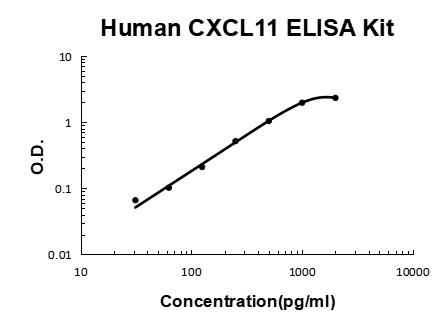
Human CXCL11/I-TAC PicoKine ELISA Kit standard curve
Human CXCL11/I-TAC PicoKine ELISA Kit standard curve
Human CXCL11/I-TAC ELISA Kit PicoKine(r)
EK0737

ReactivityHuman
Product group Assays
Overview
- SupplierBoster Bio
- Product NameHuman CXCL11/I-TAC ELISA Kit PicoKine(r)
- Delivery Days Customer9
- ApplicationsELISA
- Applications SupplierELI
- Assay Detection Range31.2 pg/ml - 2,000 pg/ml
- Assay Sensitivity<10 pg/ml
- Assay Time15-20
- CertificationResearch Use Only
- Scientific DescriptionHuman CXCL11/I-TAC ELISA Kit PicoKine® (96 Tests). Quantitate Human CXCL11 in cell culture supernatants, cell lysates, serum and plasma (heparin, EDTA). Sensitivity: 10pg/ml. The brand Picokine indicates this is a premium quality ELISA kit. Each Picokine kit delivers precise quantification, high sensitivity, and excellent reproducibility. Only our most reliable and effective kits qualify as Picokine, guaranteeing top-tier results for your assays.
- ReactivityHuman
- Reactivity SupplierHuman CXCL11
- Storage Instruction-20°C,2°C to 8°C
- UNSPSC41116158
References
- Lv Y, Yang Z, Hai L, et al. Differential alterations of CXCR3, CXCR5 and CX3CR1 in patients with immune thrombocytopenia. Cytokine. 2024,181:156684. doi: 10.1016/j.cyto.2024.156684Read this paper
- Cai X, Yu X, Tang T, et al. JMJD2A promotes the development of castration-resistant prostate cancer by activating androgen receptor enhancer and inhibiting the cGAS-STING pathway. Mol Carcinog. 2024,63(9):1682-1696. doi: 10.1002/mc.23753Read this paper
- Lu Y, Lin LY, Tan JG, et al. A correlation study between gene polymorphism of Th cell expressed chemokine receptor CXCR3 and its ligand levels with HCV infection prognosis. Eur Rev Med Pharmacol Sci. 2017,21(6):1290-1295.Read this paper
Datasheet
MSDS
Related products
Product group Assays

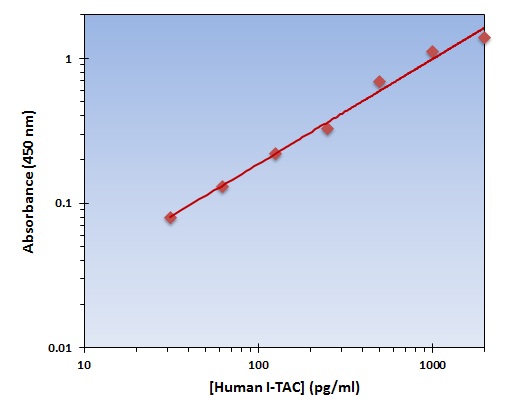
Human I-TAC ELISA KitA101906
Assay Sample TypePlasma, serum, and lysates.
ReactivityHuman
- SizePrice
Product group Assays

ReactivityHuman
- SizePrice
Product group Assays

Human I-Tac ELISA KitEKA51862
Assay Sample TypePlasma, serum, lysate
ReactivityHuman
- SizePrice